
How Should Dialogue be Punctuated?
Quotations cheat sheet

Dialogue is conversation between people. It consists of the exact words a speaker says and always has quotation marks and two other punctuation marks. It is a form of showing in writing that moves the plot forward while adding interest to the story. Compare the energy of genuine dialogue in contrast to a summary reporting the conversation.
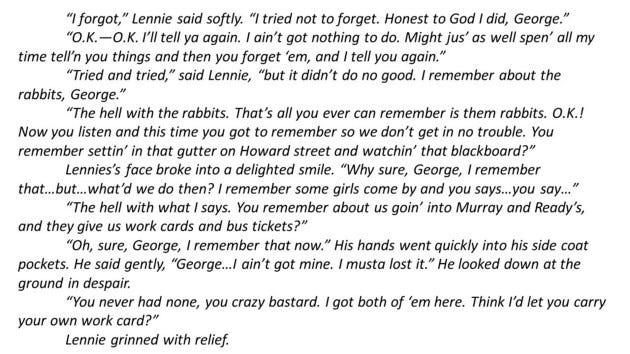
This conversation between George and Lennie illustrates a conflict in their relationship. It suggests George is concerned about the future, prompting a reader to question the situation, increasing engagement with the text. It never directly states but infers that George is a caretaker who provides for Lennie but at the same time, shares his frustration. The discussion prepares the reader for possible conflict. Through the dialect, word choice and sentence structure infer both characters have limited educations. The dialogue is nestled in a description that shares the setting for the scene and characters behaviors.
A writer could present the same event by telling the reader what happened. This approach would leave the reader unsatisfied, bored and less informed. It might read like this.
George grew frustrated with Lennie as they discussed earlier events. Knowing it was important that Lennie know the facts and be able to report them accurately, George talked him through the incident even though he knew his friend would forget when he most needed to remember.
As they recapture the memories, Lennie reached in his pocket for his work card only to find it missing. This increased George’s irritation as he had never given the card to Lennie knowing it would only become lost.
Upon reading each example, it is immediately obvious Steinbeck’s presentation of the narrative is far superior. Dialogue captivates readers and pulls them into the scene. If done well, dialogue creates a world to enter and experience.
Dialogue Rules
Rule #1: Indent to create a new paragraph each time a different person speaks
This provides readers a cue assisting the reader in understanding who is speaking. Notice in the conversation from Of Mice and Men, there are nine different paragraphs. Each presents the words of a contrasting character creating clarity of who is speaking without the need of repeating tag lines (he said) that would make the writing awkward and bulky.
Rule #2: Avoid using tag lines each time a person speaks
Overuse of tag lines identify a novice writer and lulls readers to sleep or worse yet, prompts her to abandon the read. Find alternatives for the word “said” as often as possible to minimize repetition. The best result eliminates the tag line almost entirely. Steinbeck masterfully accomplishes this in the excerpt.
Rule #3: A direct quotation begins with a capital letter
- “I forgot,” Lennie said softly. “I tried not to forget. Honest to God I did, George.”
This follows the standard rule, whenever a new sentence begins start with a capital letter.
However, if the sentence begins with a tag line (he said) followed by a quote, the quote also begins with a capital letter.
- He said gently, “George…I ain’t got mine. I musta lost it.”
Rule #4: When a quote is divided into parts in the sentence and interrupted with a tag line (he asked), the second part of the sentence begins with a lower-case letter
- “Tried and tried,” said Lennie, “but it didn’t do no good. I remember about the rabbits, George.”
Rule #5: Place punctuation marks at the end of a quotation inside the quotation marks
- “The hell with what I says. You remember about us goin’ into Murray and Ready’s, and they give us work cards and bus tickets?”
- “Oh, sure, George, I remember that now.”
Rule #6: Do not place a period at the end of a quotation followed by a tag line (he said). Use commas, question marks or exclamation marks. Do not use a period because periods end sentences
- “I forgot,” Lennie said softly.