avatarKimi Ceridon

Free AI web copilot to create summaries, insights and extended knowledge, download it at here

6960

Abstract

 <a href="https://shenglufashion.com/2018/03/04/wage-level-for-garment-workers-in-the-world-updated-in-2017/">
        <div>
          <div>
            <h2>Wage Level for Garment Workers in the World (updated in 2017)</h2>
            <div><h3>Statistics from the Public Radio International (PRI) show that garment workers in many parts of the world earn much…</h3></div>
            <div><p>shenglufashion.com</p></div>
          </div>
          <div>
            <div style="background-image: url(https://miro.readmedium.com/v2/resize:fit:320/0*mg5eJCGd2hRs4gI0)"></div>
          </div>
        </div>
      </a>
    </div><p id="ab5e">In the Philippines, textile workers earn approximately $372 per month, which is 71% of the country’s average wage. In China, those numbers are $270 per month and a dismal 20% of the country’s average salary. But America isn’t much better with an average monthly wage of $1864, which is slightly higher than the national minimum wage and just 51% of the national average.</p><h1 id="4aff">Thinking about the price of my face mask</h1><p id="4f0d">I posted a photo of my first face mask on social media. I was proud of it, and I had used a fun quilting material that made for a cute selfie. Within minutes, friends were commenting, asking if I could make them one. I got three texts asking for one and offering to pay for them. And over the next few days, more requests for my shoddy homemade mask trickled in.</p><p id="5258">I panicked. I would love to make friends and family masks. I would do it for free as a gesture of kindness and community during these hard times. With the new CDC recommendations, people were scrambling to get face coverings. I felt terrible telling turning friends down.</p><p id="1e2e">But I couldn’t possibly make all the masks being requested. I had other work to do, and even if I didn’t, my sewing skills were not up to the task.</p><p id="a7d2">A local nonprofit, The Chelsea Collaborative, started making similar face masks for hospitals during the first weeks of the outbreak. Many of their masks were donated, but they later started selling them for $10 each. The money goes toward paying the seamstresses and supporting the collaborative’s aid to the immigrant community.</p><div id="43f6" class="link-block">
      <a href="https://www.chelseacollab.org/single-post/2020/03/31/Medical-Masks-for-First-Responders">
        <div>
          <div>
            <h2>Medical Masks for First Responders</h2>
            <div><h3>A group of jornaleros (day laborers) in Chelsea, who lost their jobs as a result of the COVID-19 pandemic and statewide…</h3></div>
            <div><p>www.chelseacollab.org</p></div>
          </div>
          <div>
            <div style="background-image: url(https://miro.readmedium.com/v2/resize:fit:320/0*a0SGwGqFDY5uEDVf)"></div>
          </div>
        </div>
      </a>
    </div><p id="cac4">The seamstresses were people who lost work during the pandemic. They were day laborers before their work dried up from the coronavirus outbreaks. None of them were seamstresses until they sewed their first masks for this cause.</p><p id="ee09">I spent an hour and a half on my first face mask. The next day, I understood the pattern better, so I made four simultaneously. Those four took me four hours to complete. The craftsmanship was a bit better, but I finished with my neck and shoulders screaming.</p><p id="ff9c">Over the next few days, I batched another 15 masks. I did one operation on all 15 between other work. Breaking it up helped to stave off the body aches, but there were also psychological tolls.</p><p id="0654">I had grabbed a new spool of thread from my box and filled up a bobbin. After I reloaded it, the machine kept binding. Tears flowed, and I banged the table with my fists. It turns out, the cheaper thread was causing the problem, but I was on the verge of throwing everything out my third-story window.</p><p id="cc73">I don’t know the total time it took to make that batch. Barring further mechanical problems, I think I am close 30-minute per mask mark.</p><p id="8b48">Supplies cost me about $2. So, if I sold them for the same price as the collaborative, I could make $16/hour off them.</p><p id="ea28">That’s better than the minimum wage for where I live — <a href="https://www.minimumwage.com/state/massachusetts/?utm_source=google&amp;utm_medium=cpc&amp;gclid=CjwKCAjw7LX0BRBiEiwA__gNwwdfOAdPKzL8nevWY3QQDDKj5hWJ3OCkG9oSmI0fcyhrBmsmh2KcHxoCVioQAvD_BwE">$12/hour in Massachusetts</a>. It’s much better than the $7.25/hour <a href="https://www.dol.gov/general/topic/wages/minimumwage">national minimum wage</a>. But it won’t get you much in the Boston Metro area, and it is certainly less than what I get paid typically.</p><h1 id="1a5d">They are willing to pay.</h1><p id="5870">“I’ll pay you!” was often the reply I got when I told people I couldn’t make all masks requested. They didn’t understand it a matter of time and ability rather than a matter of money. Again, I would gladly offer them for free, but couldn’t meet the demand even if I turned making faces masks into my full-time job.</p><p id="2c1d">But American’s are so accustomed to our fast and commodified culture.</p><div id="2585" class="link-block">
      <a href="https://goodonyou.eco/what-is-fast-fashion/">
        <div>
          <div>
            <h2>What Is Fast Fashion? - Good On You</h2>
            <div><h3>Clothes shopping used to be an occasional event - something that happened a few times a year when the seasons changed…</h3></div>
            <div><p>goodonyou.eco</p></div>
          </div>
          <div>
            <div style="background-image: url(https://miro.readmedium.com/v2/resize:fit:320/0*na2naQFc2Qadk0_n)"></div>
          </div>
        </div>
      </a>
    </div><p id="8227">They believe money is a magic wand they can leverage to get what they want when they want it. They are used to getting every whim shipped to them in two days. If that is not fast enough, they think they can shove their credit cards into the machine and grease the wheels to get it overnight, or faster, within hours.</p><p id="8fba">Many people had already tried throwing money at online sellers for surgical masks. They found that even those systems had become immune to their willingness to pay whatever it took. Companies like <a href="https://www.cnbc.com/2020/04/02/amazon-blocks-sale-of-n95-masks-to-public-begins-supplying-hospitals.html">Amazon had stopped</a> selling the specialized N95 masks to the public, redirecting to medical facilities.</p><p id="b3b1">I felt guilty for turning people away. I am a perfectionist who finds it hard to say no. I desperately wanted to do all I could to get my friends this new product — a product the government was recommending they have.<

Options

/p><p id="de02">“I can only give you one,” I said.</p><p id="bf5a">“I really could use three or four.I’ll pay you.”</p><p id="8e4e">“I could take weeks,” I told them.</p><p id="d8b1">“I need it sooner. I’ll pay you.”</p><p id="423c">“I just can’t do it that fast. I suck at this.” I pleaded.</p><p id="8faa">“But, I’ll pay you!”</p><p id="6086">Amid the COVID-19 pandemic, masks suddenly became coveted commodities. And, they also suddenly became subject to a new supply chain. A supply chain that consisted of people making face masks one at a time on their home sewing machines.</p><p id="1754">COVID-19 laid to bare the fallacies of our fast and commodified culture. Money would not make my masks better. And it certainly couldn’t make me make my masks faster either.</p><h1 id="2239">How much would they pay?</h1><p id="39fe">When I had to turn people away, I referred them to The Chelsea Collaborative. I sent them websites and told them they could order them ahead for 10 each and pick them up curbside.</p><p id="d69f">Most people were grateful for the resource, but one response stood out, “They’re selling them for 10? That’s a bit pricey, isn’t it?”</p><p id="187e">I didn’t argue with them. I didn’t ask them how much they thought it should cost. I just thought about how if I sold mine for the same price, I thought I could make 16/hour. If they were half the price, my wages would drop to 6/hour.</p><p id="6d4b">I don’t blame them for thinking a simple face mask should be cheaper. We are all conditioned to getting all sorts of convenience items and necessities for a low cost. In a world where H&M can sell me an entire dress for 14.99, it’s no surprise someone thinks a piece of fabric that covers their mouth and nose should be less than 10.</p><p id="d1ce">To be fair, this one response was an outlier. Most people I gave masks to insisted on giving me some money, a lovely gesture. When I told them, “Well, the collaborative is making them for 10, so pay me whatever you want up to 10.” Most were so ecstatic to have this new hot commodity that they simply shoved a 10 bill at me.</p><p id="8110">When I poked around online, I found many retailers who have jumped on the fabric mask bandwagon. They are selling them for anywhere from 2.99 to 25 apiece. Some retailers were out of stock, and several others said it would take weeks to start shipping.</p><div id="ce83" class="link-block"> <a href="https://www.gq.com/story/where-to-buy-face-masks"> <div> <div> <h2> Where You Can Buy a Face Mask Right Now</h2> <div><h3>In a reversal of earlier guidance that Americans don’t need to wear face coverings in public in order to combat the…</h3></div> <div><p>www.gq.com</p></div> </div> <div> <div style="background-image: url(https://miro.readmedium.com/v2/resize:fit:320/0*PmCD6SOyO14wO1Ls)"></div> </div> </div> </a> </div><p id="d5b3">The numbers also indicate there are a lot of people willing to pay a premium for one of these masks. The upshot is some companies that start making fabric masks can keep people employed, which is a big feat given the economic crisis COVID-19 had leveled around the world.</p><p id="6d72">On the low end of the price spectrum is the 2.99 mask, a price some people expect to pay for a simple face mask. It is a price that would barely cover my supply costs.</p><p id="62cd">The 1.98/hour I would earn if I sold my masks for 2.99 each is still around double what a garment worker makes in Sri Lanka makes.</p><div id="5235" class="link-block"> <a href="https://globalpressjournal.com/asia/sri_lanka/sri-lankan-garment-factories-boost-wages-benefits-labor-shortage-looms/"> <div> <div> <h2>Sri Lankan Garment Factories Boost Wages and Benefits as Labor Shortage Looms</h2> <div><h3>The clothing-manufacturing industry in Sri Lanka produces the country's leading export, but it is also facing a chronic…</h3></div> <div><p>globalpressjournal.com</p></div> </div> <div> <div style="background-image: url(https://miro.readmedium.com/v2/resize:fit:320/0*UgHnUl3aO1sRL6BJ)"></div> </div> </div> </a> </div><p id="2286">I could increase my production or decrease my cost to make more money. And that is precisely what clothing makers around the world do to make fast fashion.</p><p id="b35f">They buy cheap fabric and cheap thread; the things that bound up my machine and drove me to tears. They increase worker quotas for output. But, no matter how good I get, there are physical limits to how many I can make. Finally, they decrease wages for workers. An option I don’t have.</p><h1 id="595f">What a homemade face mask taught me about clothing</h1><p id="5247">Thanks to COVID-19, I had to dust off my sewing machine and face a harsh reality. Although I am not a fashionista, my abstinence from fast fashion does not absolve me from taking responsibility for my clothing choices.</p><p id="dea6">I’ve contributed to a broken system out of convenience. I’ve impulse shopped cheap T-shirts and have-to-have items. I’ve clicked and pointed and hit “Buy Now” to get myself a pair of yoga pants in two days.</p><div id="a288" class="link-block"> <a href="https://interactive.pri.org/2017/fair-fashion-quiz/index.html"> <div> <div> <h2>How fair is your fashion?</h2> <div><h3>Fast fashion is polluting the world's air and water, filling landfills and overworking and underpaying workers. How…</h3></div> <div><p>interactive.pri.org</p></div> </div> <div> <div style="background-image: url(https://miro.readmedium.com/v2/resize:fit:320/0*Z35sDhB7n5FBRaBW)"></div> </div> </div> </a> </div><p id="957f">And now, I have spent hours at my sewing machine desperately making a simple face covering. Something that the CDC is recommending for saving lives.</p><p id="27b4">I hope that is a lesson I keep with me. When we emerge from our physical distancing, shelter-in-place, or isolation, I will scrutinize a label as carefully as I examined each of my stitches.</p><p id="c87a"><i>Kimi is a recovering corporate engineer figuring out what’s next. She is a Boston area freelance writer with work featured in <a href="https://herstryblg.com/true/2020/1/1/motorcycle-riding-through-grief-and-separation">HerStry</a>, For Women Who Roar, Snapdragon: A Journal of Art and Healing, The MOON Magazine, Backroads, and Culture. Follow her at <a href="http://noreturnticket.kceridon.com/">NoReturnTicket.kceridon.com</a> or as [at]WordsbyKimi on Facebook, Twitter, Instagram.</i></p></article></body>

How Sewing Face Masks Made Me Rethink My Clothing

My first face mask was a mess, but so is our addiction to cheap clothes
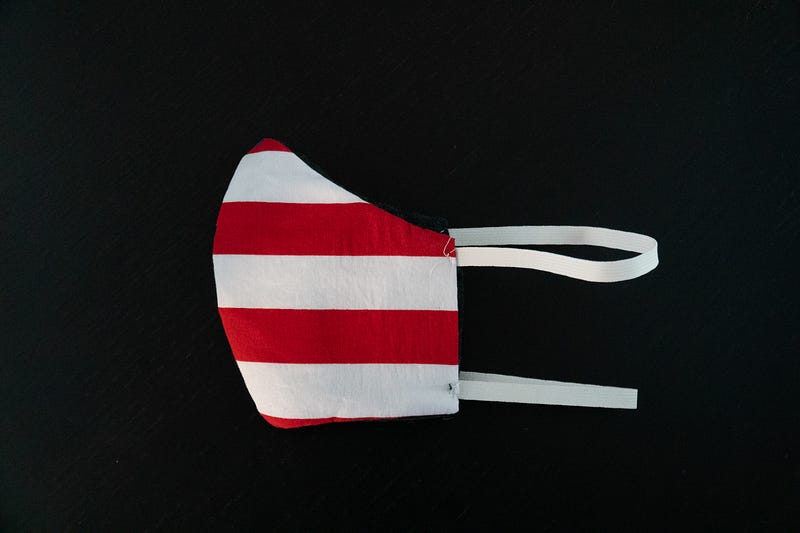
Photo by Martin Sanchez on Unsplash

When the recommendation to wear face masks came from the CDC, like many other people, I pulled out my old sewing machine. I fumbled around, refamiliarizing myself with how it worked, but once a full bobbin was loaded, a fresh needle inserted, and the machine was threaded, I was ready to crank out a pile of face masks.

I had picked a pattern labeled “easy,” and the instructions said it would take half an hour. I knew I needed several masks, so I cut enough fabric to make 10.

For the first one, I keyed up the instructional video to guide me through the steps. I’d play each step, pause the video then try to duplicate the operation on my machine. After nearly an hour and a half, I had finally completed one mask.

No, what I had was one poorly-made face mask.

The seams were pocked and uneven. Topstitches looked drunk and wobbly. Backstitches made wild zigzags rather than proper stitch locks. I couldn’t thread the elastics for ear loops into the mask because my sloppy work made the holes too small.

My neck and shoulders also ached. My pedal foot was crampy. I looked at my hands, already chapped from obsessive hand washing, and little scissor nips riddled my fingertips alongside tiny pinpricks.

It was a dismal showing. My face mask would serve its purpose, covering my mouth and nose. And, from six-feet away, no one would see all the defects. But, I needed to look no further than every piece of clothing I was wearing to see how my skills stacked up.

It took 90 minutes of struggling to make an “easy” face mask to rethink my entire closet full of clothing.

Sitting at my sewing machine, I unzipped the fleece jacket I wore and looked for the label — Made in Sri Lanka. My T-shirt and yoga pants were made in the Philippines, and my undergarments were made in China. The only thing on my body made in the USA was the “ethically sourced” wool socks on my feet.

I am not fashionable

I don’t actively participate in the fashion world, and I avoid fast fashion — straight from the catwalk, trendy clothing that is typically cheap — as best as I can. I have always felt fashion meant to be so cheap that it is disposable was wasteful — no matter how trendy and inexpensive.

Comfort, durability, and neutral colors drive My clothing choices. When I shop, my style leans toward outdoorsy, dull, and hopefully timeless. Some might call that boring, but I like my less is more approach.

Honestly, most of my practical attitude toward clothing is probably set by my size 14/16 body. I hate shopping because it is a terrible experience. Trying on clothing that doesn’t fit is exhausting. And when a garment does fit, it is often ill-fitting and unflattering. I am grateful my strangely proportioned body has kept me from getting too into fashion.

At times, I’ve inspected labels and researched clothing companies to learn about their sustainable and ethical sourcing efforts. But I admit, when browsing stores and websites for clothes, I often lose sight of this research and opt for items that reflect my style rather than items that reflect my values.

I also tend to return to the same retailers and brands repeatedly. Finding a brand that consistently fits and flatters my larger and oddly shaped body is rare. So, when I do find one of those gems, I am often inclined to turn a blind eye to the label.

Just wanting stuff that fits means I don’t know where my clothing is made. I prioritize my style over reviewing the sourcing practices of the clothing company. And I value my comfort over learning whether people in the countries making my clothes earn a living wage.

After making my first face mask, I looked up the average wage for textile workers around the world.

According to 2017 data from Dr. Sheng Lu, Associate Professor, Department of Fashion & Apparel Studies, University of Delaware, in Sri Lanka, textile workers make $194 per month on average. That is above the Sri Lankan minimum wage, but it is still only 44% of the average Sri Lankan worker’s wages.

In the Philippines, textile workers earn approximately $372 per month, which is 71% of the country’s average wage. In China, those numbers are $270 per month and a dismal 20% of the country’s average salary. But America isn’t much better with an average monthly wage of $1864, which is slightly higher than the national minimum wage and just 51% of the national average.

Thinking about the price of my face mask

I posted a photo of my first face mask on social media. I was proud of it, and I had used a fun quilting material that made for a cute selfie. Within minutes, friends were commenting, asking if I could make them one. I got three texts asking for one and offering to pay for them. And over the next few days, more requests for my shoddy homemade mask trickled in.

I panicked. I would love to make friends and family masks. I would do it for free as a gesture of kindness and community during these hard times. With the new CDC recommendations, people were scrambling to get face coverings. I felt terrible telling turning friends down.

But I couldn’t possibly make all the masks being requested. I had other work to do, and even if I didn’t, my sewing skills were not up to the task.

A local nonprofit, The Chelsea Collaborative, started making similar face masks for hospitals during the first weeks of the outbreak. Many of their masks were donated, but they later started selling them for $10 each. The money goes toward paying the seamstresses and supporting the collaborative’s aid to the immigrant community.

The seamstresses were people who lost work during the pandemic. They were day laborers before their work dried up from the coronavirus outbreaks. None of them were seamstresses until they sewed their first masks for this cause.

I spent an hour and a half on my first face mask. The next day, I understood the pattern better, so I made four simultaneously. Those four took me four hours to complete. The craftsmanship was a bit better, but I finished with my neck and shoulders screaming.

Over the next few days, I batched another 15 masks. I did one operation on all 15 between other work. Breaking it up helped to stave off the body aches, but there were also psychological tolls.

I had grabbed a new spool of thread from my box and filled up a bobbin. After I reloaded it, the machine kept binding. Tears flowed, and I banged the table with my fists. It turns out, the cheaper thread was causing the problem, but I was on the verge of throwing everything out my third-story window.

I don’t know the total time it took to make that batch. Barring further mechanical problems, I think I am close 30-minute per mask mark.

Supplies cost me about $2. So, if I sold them for the same price as the collaborative, I could make $16/hour off them.

That’s better than the minimum wage for where I live — $12/hour in Massachusetts. It’s much better than the $7.25/hour national minimum wage. But it won’t get you much in the Boston Metro area, and it is certainly less than what I get paid typically.

They are willing to pay.

“I’ll pay you!” was often the reply I got when I told people I couldn’t make all masks requested. They didn’t understand it a matter of time and ability rather than a matter of money. Again, I would gladly offer them for free, but couldn’t meet the demand even if I turned making faces masks into my full-time job.

But American’s are so accustomed to our fast and commodified culture.

They believe money is a magic wand they can leverage to get what they want when they want it. They are used to getting every whim shipped to them in two days. If that is not fast enough, they think they can shove their credit cards into the machine and grease the wheels to get it overnight, or faster, within hours.

Many people had already tried throwing money at online sellers for surgical masks. They found that even those systems had become immune to their willingness to pay whatever it took. Companies like Amazon had stopped selling the specialized N95 masks to the public, redirecting to medical facilities.

I felt guilty for turning people away. I am a perfectionist who finds it hard to say no. I desperately wanted to do all I could to get my friends this new product — a product the government was recommending they have.

“I can only give you one,” I said.

“I really could use three or four.I’ll pay you.”

“I could take weeks,” I told them.

“I need it sooner. I’ll pay you.”

“I just can’t do it that fast. I suck at this.” I pleaded.

“But, I’ll pay you!”

Amid the COVID-19 pandemic, masks suddenly became coveted commodities. And, they also suddenly became subject to a new supply chain. A supply chain that consisted of people making face masks one at a time on their home sewing machines.

COVID-19 laid to bare the fallacies of our fast and commodified culture. Money would not make my masks better. And it certainly couldn’t make me make my masks faster either.

How much would they pay?

When I had to turn people away, I referred them to The Chelsea Collaborative. I sent them websites and told them they could order them ahead for $10 each and pick them up curbside.

Most people were grateful for the resource, but one response stood out, “They’re selling them for $10? That’s a bit pricey, isn’t it?”

I didn’t argue with them. I didn’t ask them how much they thought it should cost. I just thought about how if I sold mine for the same price, I thought I could make $16/hour. If they were half the price, my wages would drop to $6/hour.

I don’t blame them for thinking a simple face mask should be cheaper. We are all conditioned to getting all sorts of convenience items and necessities for a low cost. In a world where H&M can sell me an entire dress for $14.99, it’s no surprise someone thinks a piece of fabric that covers their mouth and nose should be less than $10.

To be fair, this one response was an outlier. Most people I gave masks to insisted on giving me some money, a lovely gesture. When I told them, “Well, the collaborative is making them for $10, so pay me whatever you want up to $10.” Most were so ecstatic to have this new hot commodity that they simply shoved a $10 bill at me.

When I poked around online, I found many retailers who have jumped on the fabric mask bandwagon. They are selling them for anywhere from $2.99 to $25 apiece. Some retailers were out of stock, and several others said it would take weeks to start shipping.

The numbers also indicate there are a lot of people willing to pay a premium for one of these masks. The upshot is some companies that start making fabric masks can keep people employed, which is a big feat given the economic crisis COVID-19 had leveled around the world.

On the low end of the price spectrum is the $2.99 mask, a price some people expect to pay for a simple face mask. It is a price that would barely cover my supply costs.

The $1.98/hour I would earn if I sold my masks for $2.99 each is still around double what a garment worker makes in Sri Lanka makes.

I could increase my production or decrease my cost to make more money. And that is precisely what clothing makers around the world do to make fast fashion.

They buy cheap fabric and cheap thread; the things that bound up my machine and drove me to tears. They increase worker quotas for output. But, no matter how good I get, there are physical limits to how many I can make. Finally, they decrease wages for workers. An option I don’t have.

What a homemade face mask taught me about clothing

Thanks to COVID-19, I had to dust off my sewing machine and face a harsh reality. Although I am not a fashionista, my abstinence from fast fashion does not absolve me from taking responsibility for my clothing choices.

I’ve contributed to a broken system out of convenience. I’ve impulse shopped cheap T-shirts and have-to-have items. I’ve clicked and pointed and hit “Buy Now” to get myself a pair of yoga pants in two days.

And now, I have spent hours at my sewing machine desperately making a simple face covering. Something that the CDC is recommending for saving lives.

I hope that is a lesson I keep with me. When we emerge from our physical distancing, shelter-in-place, or isolation, I will scrutinize a label as carefully as I examined each of my stitches.

Kimi is a recovering corporate engineer figuring out what’s next. She is a Boston area freelance writer with work featured in HerStry, For Women Who Roar, Snapdragon: A Journal of Art and Healing, The MOON Magazine, Backroads, and Culture. Follow her at NoReturnTicket.kceridon.com or as [at]WordsbyKimi on Facebook, Twitter, Instagram.

Covid-19
Fashion
Self-awareness
Clothing
Consumerism
Recommended from ReadMedium