How scientists are breathing new life into French forests through green corridors
By Madga Bou Dagher, Professor in Forest genetics, European Forest Institute
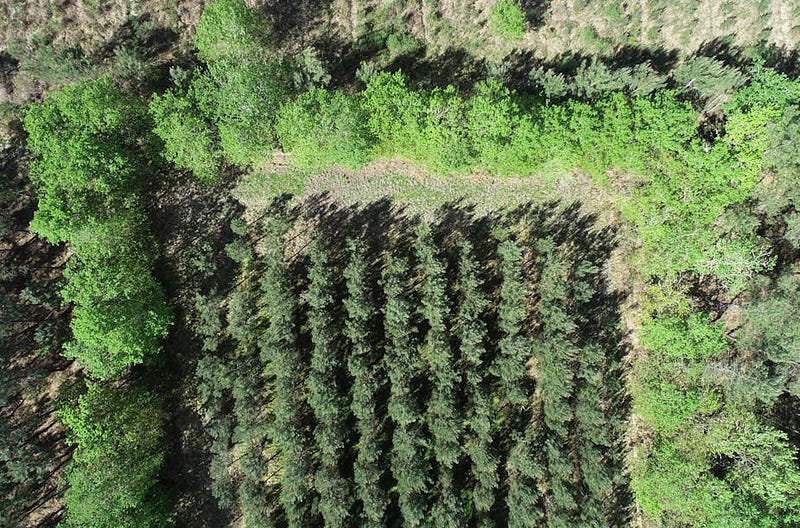
In the summer of 2008, during a family holiday road trip, we passed by the Aquitaine region in southwestern France. As we drove through a sprawling woodland, a mesmerizing sight unfolded before my eyes: a meticulously ordered army of trees, standing tall and proud. It could have been an army regiment classified by age.
This uniformity — in stark contrast to the wild and varied Mediterranean forests I was accustomed to — left me utterly captivated. Beneath the leafy canopy, the undergrowth seemed sparse, with only the occasional glimpse of heather and its discreet flowers, repeating like an infinite copy-paste.
I immediately thought that if I were a wild animal, this forest might not be the most stimulating place to call home. There was little biomass to sustain life, and while the simplified food chain offered few competitors, there were no companions, either. The woods felt monotonous.
A European plan to revive thousands of acres
Fast forward to last April, I returned to the same location, this time accompanied by more than 100 experts from SUPERB, an ambitious 20 million euro project funded by the Horizon programme to restore thousands of hectares of forest landscape across Europe.
The initiative, which relies on 12 forests including the Aquitaine site, will go some way in making good on the EU’s Nature Restoration bill, which commits the bloc to restoring at least 30% of degraded habitats by 2030, 60% by 2040 and 90% by 2050. It will also provide policy-makers with critical insights into the continent’s wildlife, life support systems and carbon sequestration capacity.
Spanning 1 million hectares of planted forests, the Aquitaine site plays an important part in the local economy, with 90% of its plantations private. Historically, the landowners here had thrived on long-term thinking and patience. Trees took their time to grow, but the rewards were bountiful. In the harvest, the first trees to be cleared are typically used for the manufacture of pulp and paper. Small trees are for pallets and packaging, while bigger trees are exploited for structural wood, beams or panelling parquet.
For generations, locals had employed top-notch forest management techniques, yielding high returns. But the forest and its wood-based economy are now under threat. During my week there, I realised that what had once appeared orderly and disciplined had by then struck me as odd and unbalanced. With time, relentless production had depleted the soil and flora. The climate was also growing more arid by the day. Landowners complained of increasingly frequent natural calamities — wildfires, pest outbreaks, and destructive windstorms.
I was there with colleagues to check on the restoration progress and learn from local scientists’ restoration experience. In our conversations, one word echoed repeatedly: resilience — the ability to rebound after disturbances, regardless of their origin. Another word for it when it comes to forest management is biodiversity, the dry term we scientists use for thriving wildlife. Since December 2021, SUPERB has been on a mission to bring it back to the woods of Aquitaine.
Life through green corridors
To revive dull, homogeneous nature, one typically has to mess it up, or at least according to our human eyes. At several levels: that of the landscape, by ensuring that forests, pastures and agricultural land rotate and balance one another out; at the species level, so that a multitude of trees, shrubs, and herbs can provide shelter for wildlife; and at the population level, where even large numbers of trees of the same species can react differently to environmental challenges, thereby maximising their survival chances.
However, this poses economic and logistical challenges. Unevenly aged trees and different tree species can hardly be harvested simultaneously, and large machinery face access difficulties. This is where SUPERB’s hedgerows come in. Working across 20 000 hectares, our team has spent the past months planting 10 km-long hedgerows to connect pockets of existing broad-leaf species, such as oaks. The idea is to form a physical barrier to increase resilience to pests and diseases and potentially other threats that may increase with a warming planet such as winds, storms, wildfires and drought.
Swaying resistant landlords
While many landowners are already committed to planting mixed hedgerows around their pine plantations, others are more prudent, and will need strong evidence to adopt this practice that costs money and breaks with tradition.
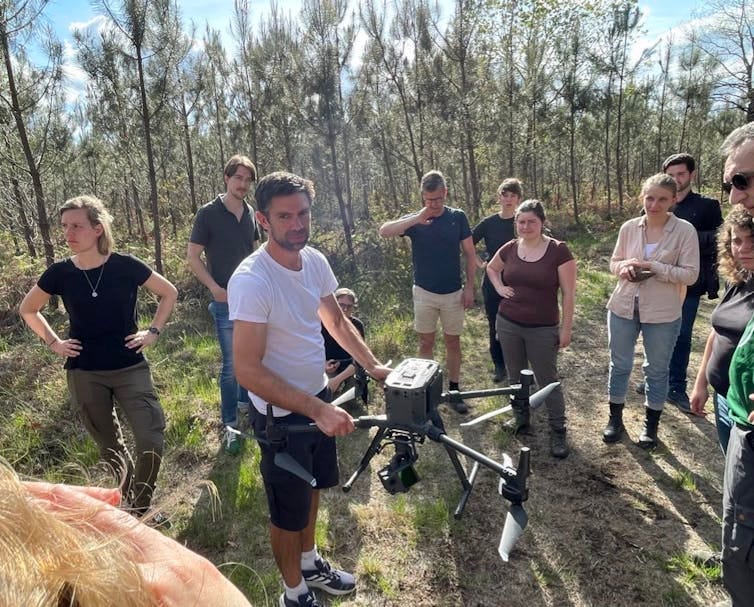
Scientists from French partners, including INRAE and the European Institute of Planted Forests, did their best to reassure them. Throughout the week, they had three drones scan the landscape from above, revealing the contrast between homogeneous pine forests and diverse hedgerows. On the ground, our team encountered traps for insects, pitfall traps for snakes, microhabitats for lizards, tree caves for bats, and audio recording and camera traps for other organisms. Even the soil’s diversity was examined through DNA analysis of its hidden microorganisms.
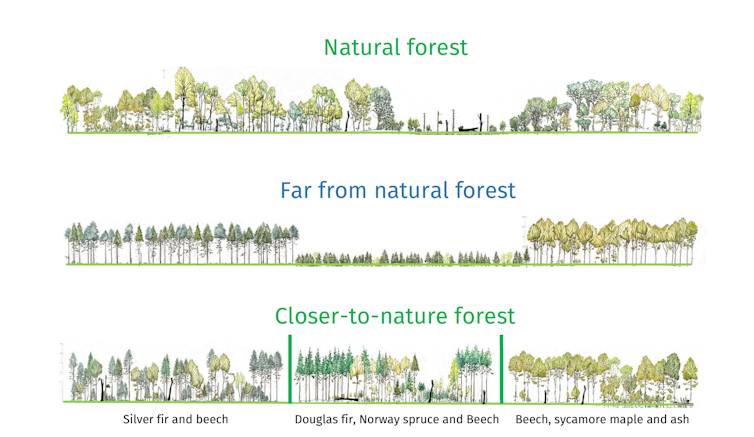
In the pursuit of understanding ecosystem and bolstering resilience, much remains to be uncovered. While we await a complete understanding, the “closer to nature” management approach, which seeks to “prioritize ecological integrity, biodiversity and sustainable practices over intensive human interventions” is gaining traction, emulating what nature does best. Yet translating this knowledge into actionable management plans for the forest managers is the other area that SUPERB is working on.
As the coordinator of the SUPERB project, I had the privilege of visiting all its demonstration sites, from woods in Castille in Leon to the alpine landscapes of the Vindelälven-Juhttatahkka biosphere in Sweden, down to the mountainous region of Vysočina and North Moravia in Czech Republic. Each forest brought its own set of challenges such as bark-beetle attacks, fragmented trees, wildfires, and abandoned lands. It became evident that customized approaches were necessary to address restoration, even when facing similar problems.
This article is the result of The Conversation’s collaboration with Horizon, the EU research and innovation magazine. In June, the author published an article with the magazine.
Written by Madga Bou Dagher, Professor in Forest genetics, European Forest Institute. Originally published on The Conversation.