avatarJoanna Henderson

Free AI web copilot to create summaries, insights and extended knowledge, download it at here

2870

Abstract

KHdIOBWgQzmd6BAgWEAU">46 square miles</a> in size, and it’s surrounded by water on three sides — there is no opportunity for expansion. Due to an increased demand for housing, and almost a total lack of supply, the cost has been going up for many years, and the population <a href="https://worldpopulationreview.com/us-cities/san-francisco-population/">has been growing</a>.</p><p id="12cc">The excruciating cost of housing in San Francisco started when numerous tech giants, such as <a href="https://www.builtinsf.com/2019/11/13/largest-companies-san-francisco-bay-area">Uber and Twitter</a>, decided to base their headquarters within the city perimeter. Currently, a total of <a href="https://www.crunchbase.com/hub/san-francisco-bay-area-companies#section-overview">9,928 companies</a> headquartered in the Bay Area, with the average founding date of April 2011. The graph above explains the rapid gross of housing prices, as all of these companies employ a significant number of people, with Wells Fargo and Salesforce <a href="https://www.bizjournals.com/sanfrancisco/subscriber-only/2019/01/04/largest-san-francisco-employers.html">topping the list</a>.</p><p id="29e1">The high salaries of tech specialists also influenced the housing market greatly. With an average salary of 115,044 <a href="https://www.payscale.com/research/US/Employer=Salesforce.com%2C_Inc./Salary">at Salesforce</a> and 120,000 <a href="https://www.inc.com/business-insider/how-facebook-decides-employee-salary-earnings-how-much-money-pays-formula.html">at Facebook</a>, it’s evident that many individuals are financially capable of paying a housing premium. This resulted in a price increase, as low-income families were pushed out of San Francisco, while those earning more were able to stay within the city limits.</p><h1 id="d707">The coronavirus might become a game-changer</h1><p id="2eb5">No one expected the entire world to go into quarantine in 2020. Because of that, many things are changing, including the real estate market and housing prices around the country — and in other countries as well.</p><p id="7561">A lot of people switched from working at an office to remote work. There is no need to get ready, commute to work, and spend half a day in downtown. Instead, many of us got an opportunity to perform our work duties remotely, without leaving our homes.</p><p id="0fb5">While this may end once the pandemic is over, certain companies may choose to keep their employees working from home. If this occurs, it can have a severe effect on the housing market long-term, which means it will reshape cities as well.</p><h1 id="f986">What will happen to San Francisco?</h1><figure id="e086"><img src="https://cdn-images-1.readmedium.com/v2/resize:fit:800/1*e3Bh0Fs-d1PuEUA-5aaZfA.jpeg"><figcaption>Licensed via <a href="https://www.freepik.com/home">Freepik</a></figcaption>

Options

</figure><p id="b2b7">At the beginning of May, Jack Dorsey, CEO Twitter, <a href="https://people.com/human-interest/twitter-ceo-jack-dorsey-allows-employees-work-from-home-forever/">announced</a> his employees could work from home going forward — in fact, forever. Shopify, which also has an office in San Francisco, <a href="https://www.bloomberg.com/news/articles/2020-05-21/shopify-is-joining-twitter-in-permanent-work-from-home-shift">joined Twitter</a> shortly after. <a href="https://www.forbes.com/sites/rachelsandler/2020/05/07/facebook-will-reportedly-allow-employees-to-work-from-home-until-the-end-of-2020/#78e154b97346">Facebook</a>, <a href="https://www.forbes.com/sites/rachelsandler/2020/05/08/google-will-let-employees-work-from-home-until-the-end-of-2020/#25b1486e7db3">Google</a> and <a href="https://www.businessinsider.com/microsoft-work-from-home-policy-coronavirus-october-2020-5">Microsoft</a> confirmed they would allow their workers to work from home at least until the end of 2020.</p><p id="f067">This should not come as a surprise since the commercial rent prices are quite steep. In San Francisco, renting office space can be <a href="https://www.squarefoot.com/ca/san-francisco/office-space">as high as $87 per square foot</a>. For giants like Twitter and others, who employ a large number of people, it makes sense to switch to remote work. Such a move will allow companies to save on rent and other expenses while offering their employees the convenience of working from home.</p><p id="072e">However, this will cause a swift change in office space demand. The tech giants’ decision to remove leasing office space from the equation will result in decreased demand and many empty spaces. Moreover, the remote work option would allow workers to relocate outside of San Francisco — not to mention, outside of the state. When you have the opportunity to work from anywhere, why would you live in the most expensive city? Working remotely would allow people to leave The Bay area and move somewhere much cheaper: two hours away, five hours away, and even further.</p><h1 id="93cc">The glimpse of the future</h1><p id="211f">If other San Francisco-based companies follow the example of Twitter and others, this city should expect a plunge in housing demand. Consequently, both rental costs and real estate prices will go down drastically. The rent won’t be around $3,700 anymore, which will allow the residents, who were pushed away previously, to come back home.</p><p id="9c5e">The demographics will change, so will the culture. But we shouldn’t see this as a downside — on the contrary; it might be for the best. San Francisco will go back to looking the way it was 10 to 20 years ago.</p><p id="efba">The world will not be the same after the pandemic is over. Despite how scary it might be, we should embrace the change.</p></article></body>

How San Francisco’s Housing Market Is Changing Due to Coronavirus

The most expensive city in the United States is going through dramatic changes.
Licensed via Freepik

San Francisco has been serving as an example of all-time high real estate prices for many years. At the beginning of 2020, the average rent price of a one-bedroom apartment was $3,500, which made it the number one most expensive city in the country. If you make less than $82,200 yearly as a single person or less than $117,400 as a family of four, you are considered to be low-income.

But, because of the coronavirus pandemic, it may not stay this way for long. Once quarantine ends, and we have a fully-working vaccine, the real estate image of San Francisco may change significantly.

The historical trend

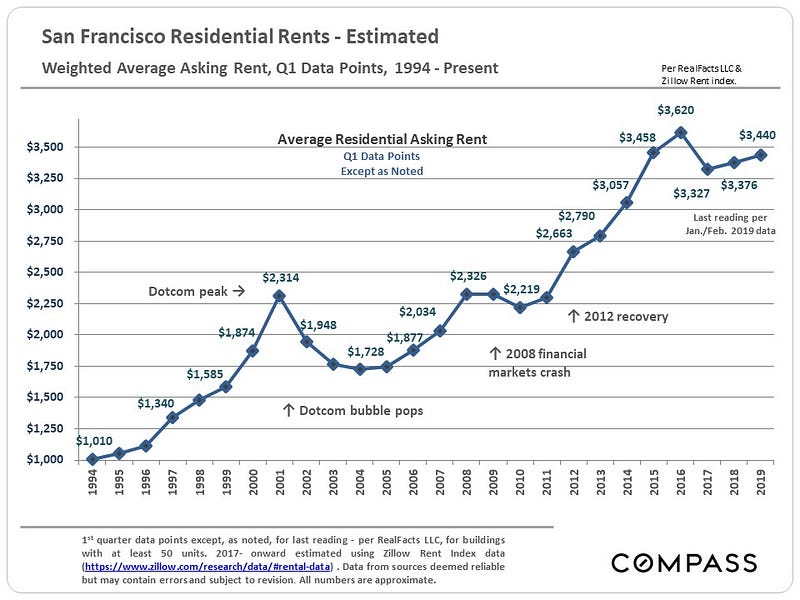
Housing prices haven’t always been exorbitantly high in The Bay area. According to the historical trend, the rent cost $1,010 in 1994, $2,219 in 2010, and int went up to $3,440 in 2019. The graph below reflects the changes over the years:
Source: BayAreaMarket

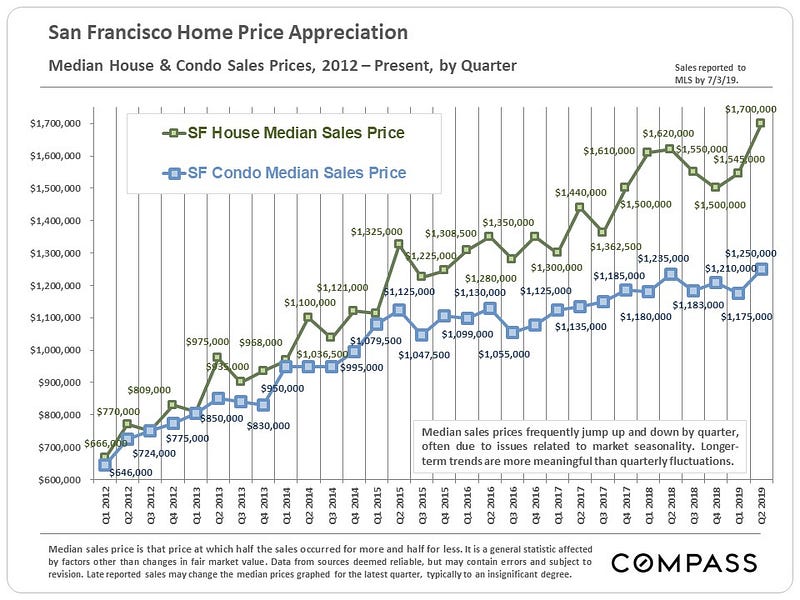
Similarly, the real estate prices skyrocketed as well. This graph highlights how a house, which set you back $666,000 in 2012, nearly tripled to $1,700,000 by 2019:
Source: BayAreaMarket

An individual with a median income of $96,265 wouldn’t be able to afford a home on their own. As for someone working a minimum wage job and earning $15.59 for an hour, residing in San Francisco is out of the question.

What caused such a change?

High housing cost is easy to explain: it’s a supply and demand problem. There is a rising demand for rent and homeownership in San Francisco, while it’s impossible to make the city “bigger.” San Francisco is only 46 square miles in size, and it’s surrounded by water on three sides — there is no opportunity for expansion. Due to an increased demand for housing, and almost a total lack of supply, the cost has been going up for many years, and the population has been growing.

The excruciating cost of housing in San Francisco started when numerous tech giants, such as Uber and Twitter, decided to base their headquarters within the city perimeter. Currently, a total of 9,928 companies headquartered in the Bay Area, with the average founding date of April 2011. The graph above explains the rapid gross of housing prices, as all of these companies employ a significant number of people, with Wells Fargo and Salesforce topping the list.

The high salaries of tech specialists also influenced the housing market greatly. With an average salary of $115,044 at Salesforce and $120,000 at Facebook, it’s evident that many individuals are financially capable of paying a housing premium. This resulted in a price increase, as low-income families were pushed out of San Francisco, while those earning more were able to stay within the city limits.

The coronavirus might become a game-changer

No one expected the entire world to go into quarantine in 2020. Because of that, many things are changing, including the real estate market and housing prices around the country — and in other countries as well.

A lot of people switched from working at an office to remote work. There is no need to get ready, commute to work, and spend half a day in downtown. Instead, many of us got an opportunity to perform our work duties remotely, without leaving our homes.

While this may end once the pandemic is over, certain companies may choose to keep their employees working from home. If this occurs, it can have a severe effect on the housing market long-term, which means it will reshape cities as well.

What will happen to San Francisco?
Licensed via Freepik

At the beginning of May, Jack Dorsey, CEO Twitter, announced his employees could work from home going forward — in fact, forever. Shopify, which also has an office in San Francisco, joined Twitter shortly after. Facebook, Google and Microsoft confirmed they would allow their workers to work from home at least until the end of 2020.

This should not come as a surprise since the commercial rent prices are quite steep. In San Francisco, renting office space can be as high as $87 per square foot. For giants like Twitter and others, who employ a large number of people, it makes sense to switch to remote work. Such a move will allow companies to save on rent and other expenses while offering their employees the convenience of working from home.

However, this will cause a swift change in office space demand. The tech giants’ decision to remove leasing office space from the equation will result in decreased demand and many empty spaces. Moreover, the remote work option would allow workers to relocate outside of San Francisco — not to mention, outside of the state. When you have the opportunity to work from anywhere, why would you live in the most expensive city? Working remotely would allow people to leave The Bay area and move somewhere much cheaper: two hours away, five hours away, and even further.

The glimpse of the future

If other San Francisco-based companies follow the example of Twitter and others, this city should expect a plunge in housing demand. Consequently, both rental costs and real estate prices will go down drastically. The rent won’t be around $3,700 anymore, which will allow the residents, who were pushed away previously, to come back home.

The demographics will change, so will the culture. But we shouldn’t see this as a downside — on the contrary; it might be for the best. San Francisco will go back to looking the way it was 10 to 20 years ago.

The world will not be the same after the pandemic is over. Despite how scary it might be, we should embrace the change.

Economy
Business
Money
Coronavirus
San Francisco
Recommended from ReadMedium