
How Samsung squandered its lead with the Galaxy Z Fold Series
Or, how the folding phone could be the companies Xerox moment
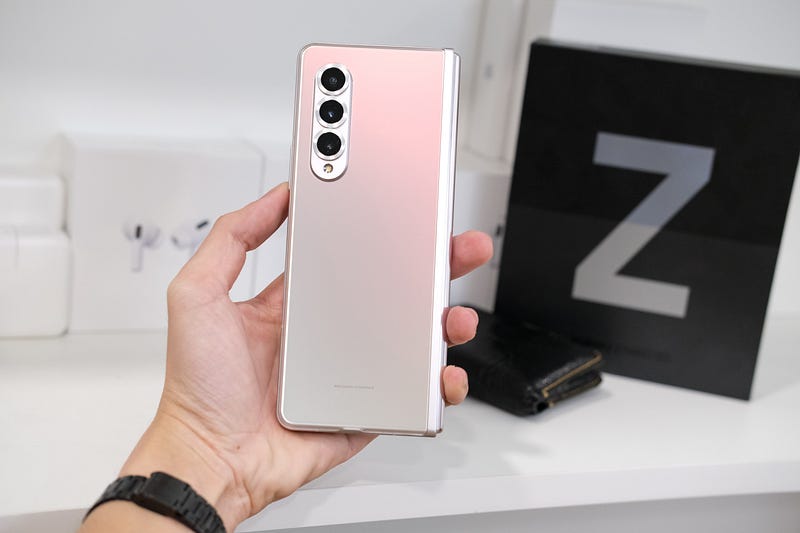
In late 2019, Samsung shook up the mobile landscape by releasing a folding phone. The idea that you could have a device on the go that could unfold from a standard phone to a very usable tablet was mindblowing. For an industry that had lumbered from year to year with incremental upgrades, a better camera here, a better battery there, this was a much-needed shake-up. How would this fare, in the long run? Would a fully-functional folding device change the mobile landscape forever?
As we pass the Z Fold 4 and await the Z Fold 5, it’s becoming clear that the answer to this question is a hard no. It’s cool what Samsung has done in this space, especially as they have moved the foldable forward so much as a concept, but a combination of focussing on the wrong things, software oddities, and missed innovations really make it seem like they’re all folded out.
Full disclosure — I have owned two separate Galaxy Z Fold 3’s. Both suffered hardware failures within a year of owning them (the first was about nine months, the second only six months). Both phones spent their entire existence in cases and were next to me on my office desk for 90% of their lives. With both devices, the devices stopped working due to hardware failures with the device itself.
Worth mentioning: I am the Z Fold’s target market — a device like this could not appeal to anyone more than it appeals to me. The number of times I would unfold it to reboot a server remotely, or use it to quickly browse through some Git history, or edit a YAML file to fix a broken build pipeline would be in the hundreds.
So, why’d I give it up, and what’s the reason for this article? Let’s take a look.
Once a prototype, always a prototype
When the original Z Fold launched, it felt very much like a prototype of a device, in that it made several compromises to achieve the folding form factor. The camera was a bit average, the cover screen was tiny, and it wasn’t waterproof (when many phones at that time already were).
People purchasing the original Z Fold were early adopters of this technology, so they would likely accept these compromises. But, four releases later, we’ve largely experienced iterative changes to the device at hand. The cover screen is improved, the cameras are better, it’s now waterproof, and now, a pen gets involved (with a shockingly bad case, that I already wrote about).
Meanwhile, the problems introduced by the foldable form factor are going largely ignored and unfixed by Samsung. An example of this is the screen protector on the inside display. Ever since release, some Z Fold owners have experienced problems where, after a short period of time (6–9 months) the internal protector begins to fatigue along the crease, and eventually starts to break.
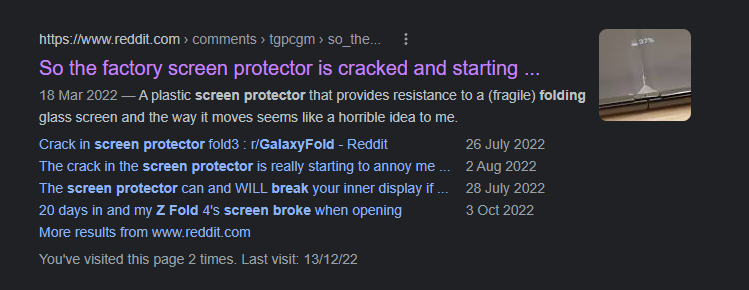
This occurred in both of my Z Fold 3’s, after about 7 months. To be honest, the physics checks out. If you flex a thin piece of material back and forth over and over again, it will eventually fatigue and begin to break. That’s essentially what you’re doing when you open or close the phone screen.
The real problem is that the protector starts to break in under a year on a $2000 device, and then rapidly gets worse. In Australia, Samsung replaces the first screen protector for free, but subsequent protectors are at your cost. Which is wildly unreasonable.
Why? Well, screen protectors are not consumable items. Consider: If you are using a normal phone, and you drop it and break the screen protector, or the protector gets too scuffed, you can make a decision to replace that protector. If you break it, you can replace it, otherwise, it will probably outlast the phone. That’s how screen protectors have worked ever since the dawn of phones.
The Z Fold has a key difference — the protector starts to break under normal circumstances, of the device being unfolded and folded. Worse still, this progressive degradation of the screen protector occurs right along the internal spine of the screen. In one case, the repeated folds along this broken protector eventually rendered my whole internal screen inoperable. For me (and at least one other person), it seems like the protector breaking somehow broke the digitizer, or whatever detects touching on the phone's screen.
Both of my Z Fold’s experienced this issue within the first nine months of owning the phone. Essentially, from the moment you open the phone new out of the box, you are just constantly moving towards the fact that at some point in the next nine months, you’re going to need a new protector. And if you don’t get it to it fast enough, it might break your internal display.
Perhaps this wouldn’t be so bad if the screen protector, which breaks after a short time during normal use of being folded and unfolded, isn’t literally applied to a technological marvel of a folding screen display. It’s awkward to point out, but did Samsung develop a folding screen that could withstand a bunch of folds, and then apply a protector to it that would withstand much, much less folding, in normal use? The mind boggles.
When it starts to break the second time and every time after, you foot the bill for their engineering inadequacy. It’s absurd.
But the hurting doesn’t stop there. As I said, the first screen protector replacement is covered by Samsung in Australia, which is grand but kinda feels like a stopgap solution for a problem that shouldn’t exist in the first place. Screen protectors do not exist as a subscription service — they are applied, and they are fit for purpose for a reasonable time. A screen protector applied to an iPhone would possibly last the life of the phone. In my experience, the factory screen protector applied to a Z Fold will not last the life of the phone, because Samsung evidently doesn’t know how to make a protector that does. When it starts to break the second time and every time after, you foot the bill for their engineering inadequacy. It’s absurd.
There are also other issues, like when the sensor that detects the phone being open or shut starts breaking, and when the audio stops working when the phone is folded open. Both of these problems happened to me, and at this point, it’s mind-blowing (and a little sad) that these problems are still hanging around in Samsung’s third run at a foldable phone. And people with Z Fold 4’s are experiencing the exact same range of problems and lack of support.
So, all in all, the thing is just brittle, and if you use it normally, you stand a good chance of breaking it, through no fault of your own. When you do, you’ll be subjected to the psychological horror of the Samsung warranty process (more on that later). In a sentence, it does fold, but within a year of owning it, something will probably break. A first-generation device, or second-generation device, perhaps that’s okay. But should these core issues still hang on into the fourth iteration? At what point do we start to wonder if they will ever be solved?
The software just ain’t it
The type of software that you run on your phone is largely a subject of taste. Some people like iPhones, some people like the Google Pixel range, and the list goes on. People might like iPhones because of their simplicity and reliability, while others might like the Pixel range for Google assistance, or call screening.
For years, for better or for worse, Samsung has been shipping their idea of what a phone UI should be, in the format of One UI. As I said, people's tastes differ in this regard, but I think One UI is, at absolute best, aggressively average. At its worst, it’s plain bad, as it reeks of design by committee, and any prettiness or good design has been absolutely throttled out of, ending up in a haphazard design that screams “a lot of people made a lot of compromises for us to ship this”.
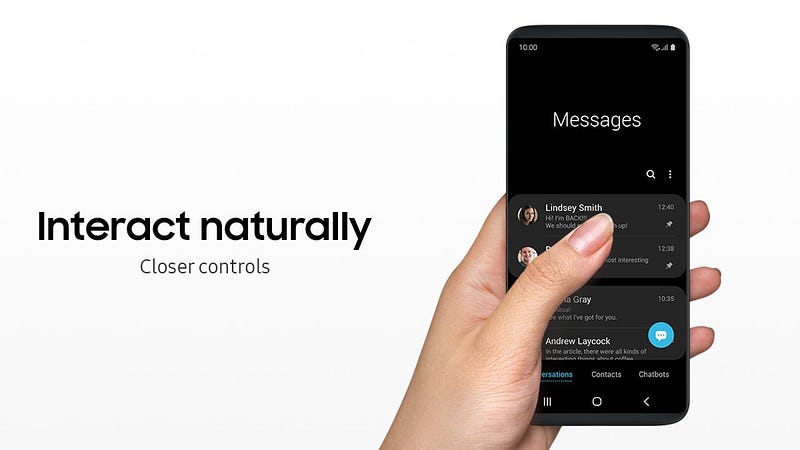
Take the below image for example. Why is a third of the screen wasted on “Messages”? Is not the context of the app strongly suggested by the content? Do we need a dedicated “chatbots” tab? What’s with the border radius on the groups of items? Even in this image, this poor left-handed user could not physically reach the search button or three-dot menu without dislocating their thumb.
If One UI was an absolute design smash-hit (and let's be honest, given how much money and research Samsung has done/could do around UI/UX, it very well could have been), then using One UI on a folding device would be standing on the shoulders of giants. Whether your device was folded or unfolded, the UI would carry the bulk of the load and lead to a single, beautiful, homogenous experience.
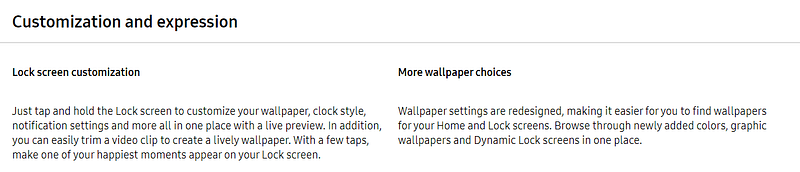
However, the reality is that One UI is just kind of bad. The greatest compliment that could be given to it is that it’s just bland and subsequent releases are doing nothing to change this. Case in point — with the newest release of One UI 5.1, Samsung is bringing revolutionary improvements to it like “Lock screen customization” and “More wallpaper choices”. You could not make this up.


This below-average approach to a UI is exacerbated on a device that folds. Using a Z Fold with the default launcher just feels like you’re going from a bad phone with a narrow screen to an average tablet. Apps randomly close, and things move around as the phone lurches through a fold/unfold event. Prompts turn up telling you that an app “doesn’t support” changing size, so you have to relaunch the app, losing your progress. There’s even a slightly wacky visual bug on the task switcher, that’s very slight but every time it happens it demonstrates the incredible lack of polish afflicting One UI. On a first or second-generation device, maybe this is acceptable, but this is still happening on the Z Fold 3.
There appear to be Fold-specific APIs that let apps manage the bigger space, and apps like Facebook take advantage of this. When you tap on the messaging icon in the app, for example, the Facebook app shrinks to half of the screen, and the Messaging app takes up the other half of the screen. Unfortunately, because so few apps do this, it just contributes to an inconsistent feel between apps.
But, these are just all minor UI oddities. Where the lack of inspiration really becomes evident is in the keyboard. You see, the Z Fold benefits from having a glorious, full-screen QWERTY keyboard, simply because it has the room to do so. Given the size of the keyboard, and haptic feedback, you should be able to tap out quite a fast message on the device.
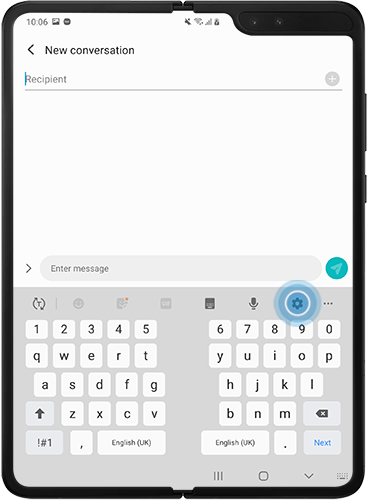
When you’re using the device in the open position, texting away at a high speed, it’s hard to hit all of the keys with 100% accuracy all of the time. Other input features like swiping over the keyboard to text work, but are impractical because you have to waggle your finger over the entire gigantic open display. So you normally have both hands on the phone and tap in messages with your left and right thumbs.
Normally, that’s not a problem. It’s something I’m doing now on my computer without even looking at the keyboard. A touch screen is different though, lacking the tactile feedback of a physical keyboard. That’s why we have autocorrect — to detect when we have possibly spelled a word wrong and correct it.
However, as you can imagine, in order for your thumb to hit the spacebar in a reliable fashion, your thumb has to pivot and stretch the furthest it will during typing. Most of the time, you hit the spacebar, but other times you will hit the “x”, “c” or other bottom-row keys. If you meant to write “The quick brown fox”, there’s a good chance you’ll get “thexquickcbrown fox”.
On more well-thought-out keyboard implementations, the auto-correct can detect what you actually meant, and can deduce the correct sequence of words that you were after, like on SwiftKey. Unbelievably, the built-in Samsung keyboard does not even try to work out what you mean, so it will happily let you write gibberish.
While SwiftKey is a lot better, it also suffers from other weird quirks. For example, one of the words I typo’d a considerable amount was “that”. My left thumb would occasionally hit the “s” instead of “a”, so I would type “thst” quite a lot. At first, SwiftKey gingerly replaced it with “that”, but before long, it observed I was typing “thst” so much, that it added it to the dictionary and stopped correcting it. Long pressing “thst” and removing it came with the message “SwiftKey will not predict this word again”, but within another couple of days or so, it once again thought it was a real word.
There is so much that could be done within the input space, on these devices, and I believe the biggest improvements on these devices will come from this area. Think about it — you know where the user is touching on the display, and you know what they meant to type from autocorrect. Combining the raw X,Y coordinate data from where the user is tapping and comparing it to the intended letters, it would be possible to grow or shrink individual rows or columns of letters. Over time, the keyboard could learn how you type, and the keyboard layout could evolve slightly over time to better fit your typing style. Someone is going to patent that idea, and revolutionize this space, and by now, it really should be Samsung.
Backing the wrong horse
Samsung produces two folding devices, the Z Fold, and the Z Flip. The Z Fold is the device that offers something truly new, by way of having a tablet on the go. The Z Flip has a cool form factor, but when unfolded, is largely the same as a normal phone.
One of the points of marketing is to show the biggest features of your device, and what’s possible with it. Think about the last time you saw a GoPro in a store. Above it would have been a TV showing people snowboarding or doing tricks on a bike. Things that you yourself would not do, but seeing people do those things would possibly motivate you to buy the camera. It also lends itself to a measure of confidence — if these people can don a wingsuit and throw themselves off Mt Everest, you can use it to film you doing a handstand at 120FPS.
Because no attempt has been made to show how these devices can resolve everyday problems … the Z Fold (and even the Z Flip) remain a niche device.
What kind of advertising campaign could you do with the Fold? Off the top of my head, imagine following a humanitarian worker through a day of their life, and all they have on them is the Z Fold. They use the huge screen to call home, look through spreadsheets, watch medical training videos, etc. In their quarters they plug their phone into a screen and use Dex to fill out a report. Imagine this as the opening shot.

Unfortunately, the team who runs the marketing for the Z Fold line of devices still appears to be stuck in a dimly lit room, in front of a whiteboard, with “Z Fold” circled twelve times. Weirdly, it’s the Z Flip that’s getting the lion's share of marketing, via visually impressive, but utterly nonsensical, promotional videos.
The amount of effort involved in modeling, rigging, applying fur to the cat, setting up the lights, and spinning up the render farm (amongst other things) would not have been insignificant. What do cats have to do with a phone? Oh, you can bend it and take photos from a certain angle. Life changing.
Because no attempt has been made to show how these devices can resolve everyday problems, apart from “cat may bat the folded phone”, the Z Fold (and even the Z Flip) remain a niche device. That designation makes sense for the Z Flip, as it’s essentially a regular phone that folds. But for the Z Fold, having such a big screen on the go is the biggest news that’s happened in the mobile space for some time. But with the poor hardware design, poor hardware quality, poor software quality, and even the advertising coming up short, it’s simply not enough to hit the device out of the esoteric sand bunker that it’s currently in. The only good thing about it is that it’s a device that folds, and that’s not enough.
But what happens when something goes wrong? It’s a premium, over $2000 AUD device, so that’s got to be worth something, right?
The support is terrible
My ordeal relating to support on the Z Fold 3 is somewhat localized to Australia. In your area, maybe Samsung has no stores, or maybe a little man comes to your house and kisses your hand, and replaces the device on the spot. Whatever the case may be, I accept that my experience in this regard could be limited to Australia.
When you have a problem with the Fold (which is probably your destiny, as a Fold owner), you can take your device to a few different “boutique” type stores. These are essentially little service desks in the middle of a shopping center. They look like this:
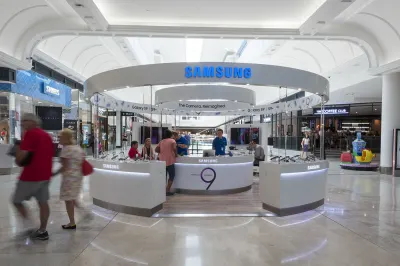
Just for comparison's sake, this is what a standard Apple store looks like:
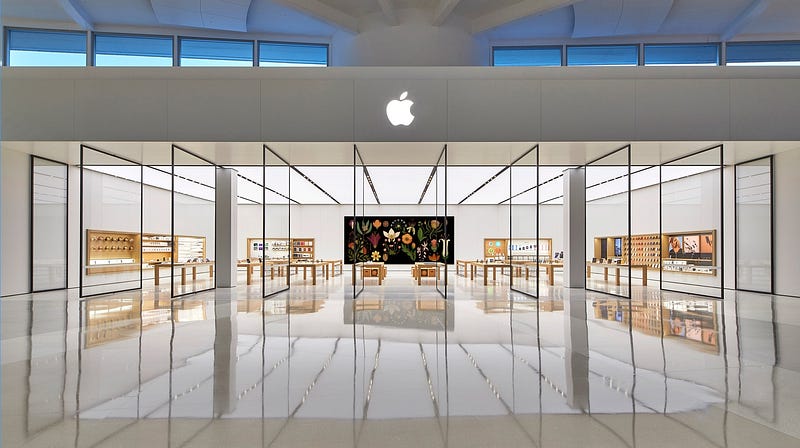
It’s a bit of a difference. Anyway, it doesn’t matter, right? Because Apple owns the Apple store, and Samsung owns the Samsung stores, so you’re going to get roughly equivalent support.
Except for one critical fact. Samsung doesn’t own and operate the retail boutique stores. They contract that out to a company called Retail Prodigy.
That’s a fairly critical difference, at least in Australia. Case in point — I purchased a Mac Mini a couple of years ago that had a problem with my monitor. It was kind of intermittent but it got annoying. I literally wheeled my entire setup (complete with 37" ultrawide screen) into an Apple and reproduced the issue in front of them. The support staff went and got the manager, to who I explained the issue, and they refunded me for the device on the spot. Because Apple owns the retail stores as well, they clearly own the problem and the warranty process. That’s right, Apple refunded a nine-month-old device because of an issue I could reproduce in front of them. An issue that could have been attributed to my monitor, misuse, or some other issue.
Whereas, over the course of owning two separate Z Folds, Samsungs warranty process was able to dish out these dismal customer experiences for yours truly:
- Apparently, you can’t just turn up at one of these booths and file a device for repair. You have to make an appointment. What’s this, you drove an hour to get here because you weren’t aware of the booking requirement, and because no other company makes you do this?* There’s the door.
- When the protector started to crack the first time, and then took the touch screen with it, I took it to Samsung, who said it’d be fixed in 2–3 days. Two weeks later they said they didn’t have the parts and it’d be a while. Escalated for refund. Two more weeks pass, and after doing enough of a dance for Samsung Voice of Customer (VOC), they refunded the device. The device refund took a full 30 days to process.
- On the second Z Fold, when the screen protector starts to fail. Come across a bona-fide Samsung store (not middle-of-the-shops boutique). The store advises they can replace it overnight and I can pick it up tomorrow. Attend to pick up the device the next day, and it has a very noticeable bubble on the screen. Inquire about the pre-existing damage on the protector, get told: “someone lent on the box containing the screen protectors and damaged them”. Ask for a replacement device, and get told no.
(* I am aware that Apple makes you book for support appointments, however, I’ve never had to book for warranty requests)
Keep in mind, all through this, I’m traveling an hour to the Samsung store. On some occasions, I’m driving there day after day. In the end, it seems like the Samsung stores can only put your device in a box and send it to the authorized repairer, which makes me question their very existence.
The Samsung VOC “escalation” is also a complete nightmare, as they seemingly operate at a glacial rate and contort themselves rather impressively to avoid taking the blame, or to even saying anything that makes it seem like they’re taking the blame. Getting replies to emails takes ages, so you’re stuck with a broken phone for weeks at a time.
In my experience with both of my Z Folds, the outcome is that while it is a tablet on the go and exactly meets my needs, the hardware cannot withstand a year of normal use without something going wrong, the software needs a complete reimagining, and the support is truly stressful and frustrating. Based on all of this, it seems like the Z Fold is not in a good place right now, and it’s hard to see how that will change any time soon.
What’s Xerox got to do with this?
What, you just read the 3,500 words above, and you’re still with me? Amazing. Well, here’s where it all comes together.
All the way back in 1981, Xerox created a revolutionary device. You probably own one inspired by the original — it’s the computer mouse. They attached it to their Xerox Star.
We can agree — the mouse revolutionized the computer industry. But was it Xerox who took it there? No. Apple licensed the mouse, made it a lot cheaper, made it more reliable, and shipped it with their Macintosh. The result? The Xerox Star was not successful, and, well, there’s a good chance you’re reading this article on an Apple device today 😅
Samsung may have introduced us to the idea of folding devices, an idea worth an incredible amount of money, but at the moment it seems like they are not realizing the potential these devices have. Having a big screen on you everywhere you go is an easy thing to say yes to if it worked well and the support experience was good.
Now, other devices are starting to crop up. The Pixel Fold is apparently still in the works, apparently releasing later this year. Oppo has already released a folding phone. Apple could also be getting into this space.
As more companies enter this space, it’s inevitable that one of them will learn from the Z Fold’s mistakes, and use that to improve their product. If another company were to give appropriate attention to how a folding phone should operate (and not just “I guess it’s a tablet when it’s unfolded”), make a screen protector that actually lasts as long as the display, and gives better support options, then it would be trivial to outshine the Z Fold as it exists today or even tomorrow. At the moment, this seems more like a “when”, rather than an “if”.
The Z Fold has spent the last four years with incremental improvements, however, the next four years will be absolutely critical to this form factor. So far, Samsung has largely squandered this lead with incremental upgrades and small hinge improvements and isn’t giving enough attention to hardware and software quality. If this continues, it seems inevitable that another player will more completely recognize the potential of a folding device, and will invest more heavily in the hardware, software, and support experience. If that happens, it’s hard to imagine how the folding devices that Samsung produces will come out back on top.
Samsung is having a hard time selling its mid-range devices, so it really needs its flagships and devices like the Z Fold to sell well. Will they be able to do that, or will we think the Z Fold was an initial attempt, which was then perfected by another company? Only time will tell.