How safe is the covid vaccine?
I’ve started seeing alarmist articles about the vaccine killing or harming people. I have friends and family who refuse to take it. I want to reassure them that it’s safe. It gave me no side effects besides a sore arm. But I also want to be sure I’m telling them the right thing, so I dug into this issue.
This post covers a few topics:
- I explain why alarmist claims like “25,000 vaccine deaths” are not true.
- I look into VAERS deaths, and whether there is a safety signal there.
- I look at some other vaccine side effects and compare these to the risks from getting covid.
- I give some suggestions for who should get vaccinated and which vaccine is the safest.
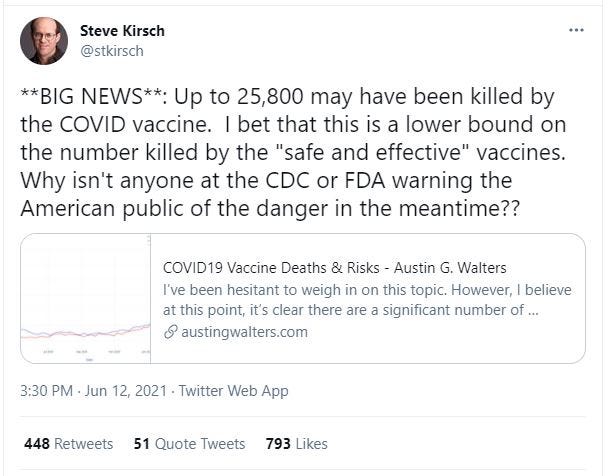
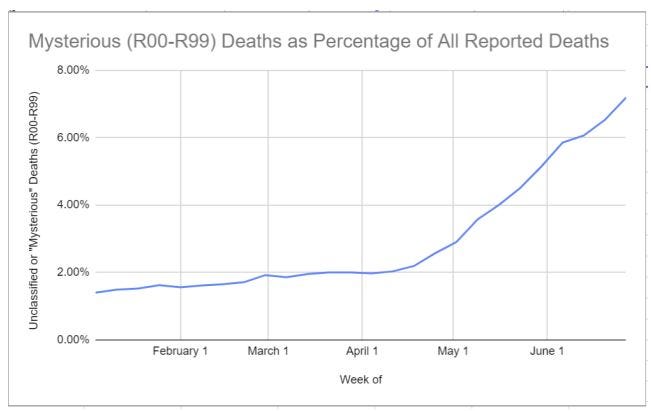
Steve Kirsch makes some of the most extreme claims about vaccine safety. In June, he said that the covid vaccine has killed 25,000 people in America. He linked to a blog post by Austin G. Walters, presenting the evidence:
Austin Walter’s argument is that there’s been a recent increase in uncategorized deaths, the CDC lists them in the R00-R99 category: “Symptoms, signs and abnormal clinical and laboratory findings, not elsewhere classified”:
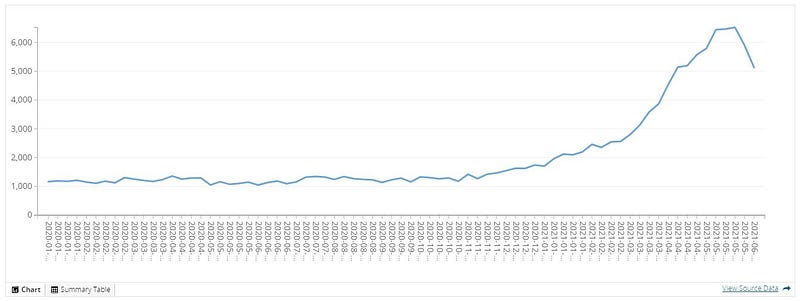
This cause is killing thousands of people in America every week. Austin assumes that these must all be covid vaccine deaths, concludes that the vaccine has killed 25,000 people and clearly, the government must be covering up the whole damn thing.
I’ll admit, reading that blog post scared me. 25,000 deaths, someone should be looking into this! Are the authorities lying to us?
After a bit more thought, I realized that these are uncategorized deaths. Maybe there’s just some time lag in how they determine cause of death?
I looked for older copies of the data. Here’s a snapshot from July 2020, it also showed a spike last summer:
Here are periodic snapshots of the data (courtesy of @Piercedgeek)
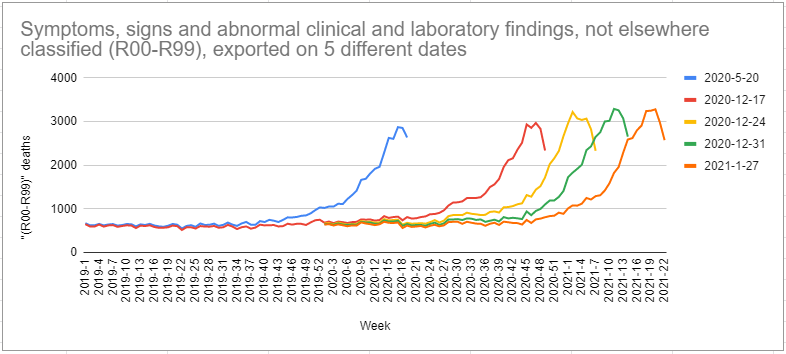
Okay, so R00-R99 is actually just miscellaneous deaths that have not yet been categorized. It’s a placeholder that gets changed as the true source of death has been determined.
There is no recent spike of mysterious deaths. It always takes the CDC about 8 weeks to classify how people died.
If a large number of people had died from the covid vaccine, you would see a spike in the graph of all deaths:
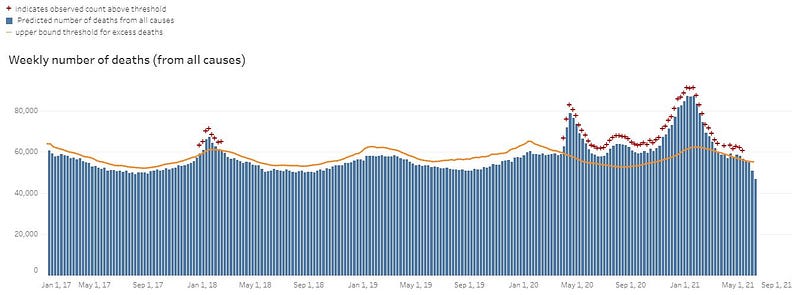
Looking at the last few years, we see the 2018 flu season. We see 3 waves of covid deaths. We don’t see any big spike of vaccine deaths. Steve says this should show up in April and May 2021.
Deaths in America actually went back to the normal average in April, after being very high through the whole covid pandemic:
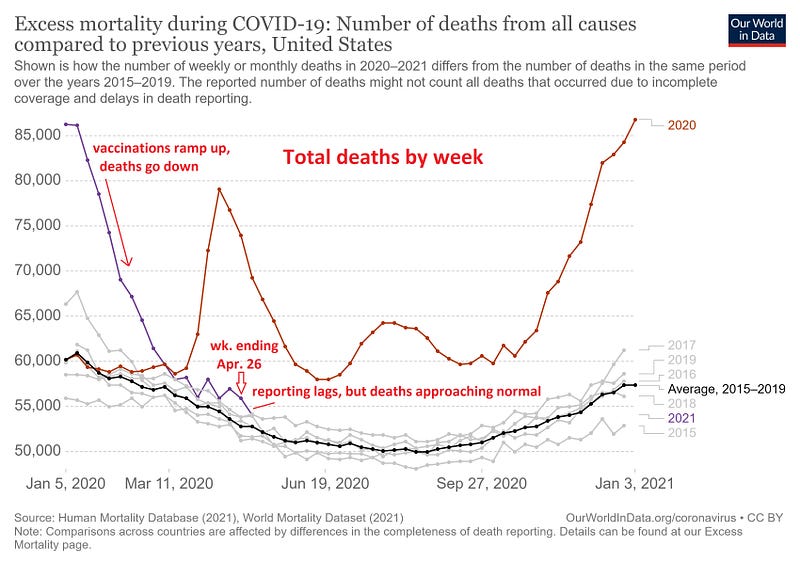
That graph is a little bit noisy. Here’s another way to look at it:
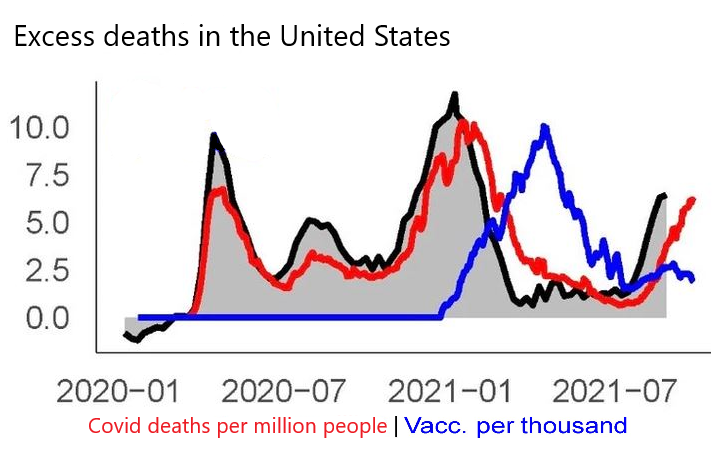
People died in the US (black line) while covid deaths were high (red line) but not while vaccines were being given out (blue line).
We can see the effect of vaccinations even more clearly in other countries that had less covid cases. Australia has made it through the covid pandemic with very few cases, there was only one wave of cases near Melbourne. Total deaths in Australia actually went down in 2020 during the lockdowns. Since the death rate is consistent over time, we should be able to see a big spike of deaths when the vaccinations begin. In reality, nothing much happened:
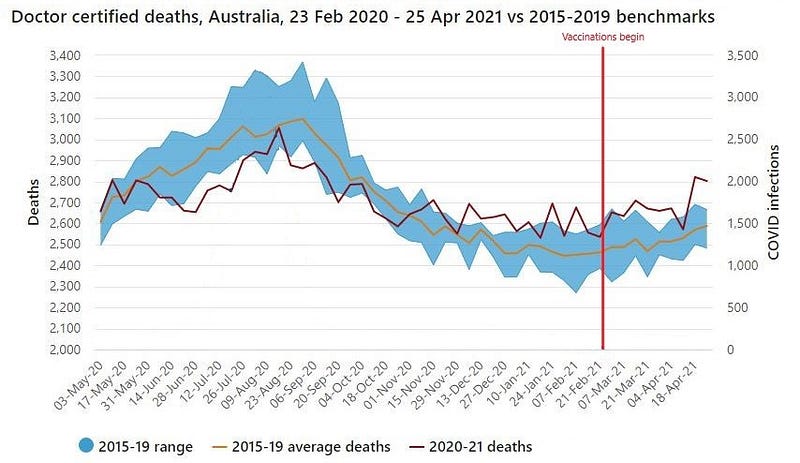
If the vaccine is as deadly as people like Steve Kirsch think, there would be a very clear spike in deaths reported in February 2021. The same thing can be seen in other low covid countries like New Zealand, Norway, Denmark, and South Korea. The vaccine just isn’t dangerous enough to kill tens of thousands of people.
Steve Kirsch got in a 5 hour debate about vaccine safety. Debate about the R00-R99 issue starts 10 minutes in and ends around 36 minutes.
Austin Walters quickly issued a correction to his blog post, after seeing this problem. Steve Kirsch took 25 minutes of debate to concede. He blamed Austin for getting this wrong. He said he had never heard this objection (I sent it to him on Twitter, other people sent it to him on TrialSiteNews). He finally gave a concession that this claim probably isn’t true. He did not update his own writing or videos, and continued to tell people that the vaccine is causing mass casualties.
Rather than learning from this mistake, Steve went on to find another bad argument, and now says that 150,000 people have died. It should be obvious that’s wrong, because that would show up in the excess deaths in the US and other countries. It would be hard to hide that many deaths. To be thorough, I’ve also debunked that claim, and also came up with a theory for why Steve believes the strange things that he does.
Fake news travels faster than the truth. Steve’s posts will scare a lot of people and my rebuttals won’t reassure as many.
I might as well debunk them anyways. The vaccine has not killed 25,000 people.
Pfizer’s trial showed the vaccine is not deadly for most people
Could there be a smaller number of vaccine deaths that are going unreported? How bad could the vaccine be, before anyone noticed?
We can look at Pfizer’s phase 3 trials. The trials vaccinated 22,000 people and kept 22,000 as a control group.
With that size, you can see risks as small as 1 in 22,000. The trials did detect a possible risk that the vaccine gives some people Bell’s palsy, with odds around 1 in 10,000.
During the Pfizer trials, 2 people died, among 22,000 that were vaccinated. One person had a heart attack 60 days after the second dose, I’d imagine that’s unrelated. One person died 3 days after the first dose. Pfizer says the death was unrelated. But the timing is suspicious, to be on the safe side I’m going to go with, “let’s say it could be vaccine related”.
Having 2 people die in the experiment is not suspicious. 4 people died in the control group, among people who didn’t get the vaccine. One conspiracy theorist asks, “why did Pfizer use a deadly placebo to hide the vaccine deaths?”
If you pick a random sample of 22,000 Americans, about 4 should die every week, for reasons unrelated to the vaccine. It’s hard to see the signal in the noise.
Suppose the vaccine has some rare side effects, and it happens to kill 1 person out of 100,000. The phase 3 trial would never notice those effects. The covid vaccine is an experiment. We’re giving a brand new drug to hundreds of millions of people. Pfizer doesn’t know what will happen. No one does. We have to monitor the situation and see.
The best we can say from the trial is that the risks are at most 1 in 22,000 for the population they studied. We’ve vaccinated 160 million people so far. That would put an upper limit on vaccine deaths around 7,000.
One caveat is that the rate of death (from all causes) among trial participants is lower than in the population at large. The Pfizer trial group is younger and healthier than the average American, it doesn’t include nursing home residents or terminally ill patients. If the vaccine were deadly to some very unhealthy population, the trial wouldn’t find that. To see the effects on the oldest people, we have to monitor it with tools like VAERS.
How serious are VAERS deaths?
6,000 deaths were recorded in VAERS, the US government’s tracking system for vaccine deaths and side effects. Every time someone dies after receiving the vaccine, their doctor or family can file a VAERS report.
(Edit: as of 11/5/21, the number in VAERS is up to 8,456 deaths in the US. You might also see a larger number quoted because VAERS now includes foreign vaccine deaths. The total number of reports from around the world is currently 18,461. I’ve restricted this analysis to the United States and I’m using the 6,000 deaths listed in June)
We don’t know if the vaccine caused all these VAERS deaths or if some were coincidences.
We’ve vaccinated 160 million people. On average, we should expect 4,000 of those people to die the day after they get vaccinated, for unrelated reasons. In the following week, we should expect 28,000 deaths.
I tried looking into the VAERS reports. The average age of death is 74.
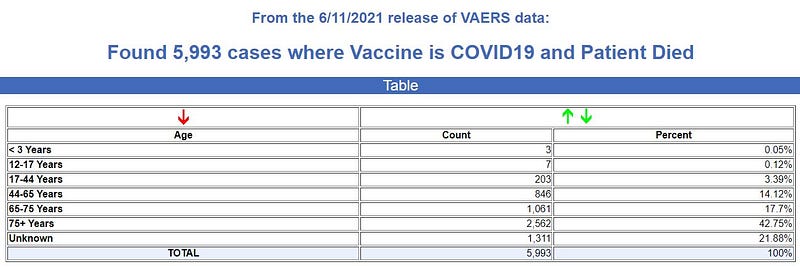
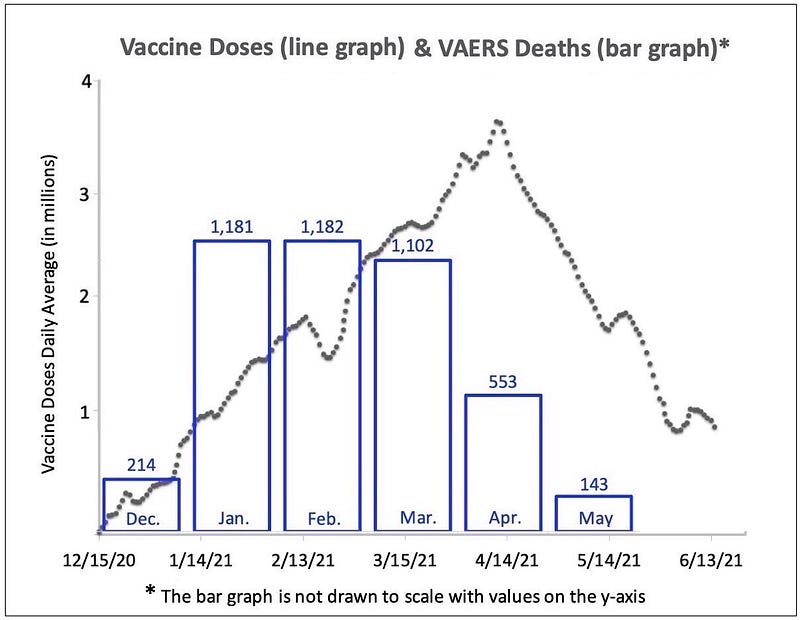
Most of the deaths occurred January through March, when elderly people were being vaccinated. We vaccinated even more people in March, April, and May, but VAERS deaths dropped off as we started vaccinating younger people:
For all of 2020, I listened to skeptical people ask 3 things about covid: “Is covid any worse than the flu?” “Did people really die from covid? or did they die with covid?” “Did they have other medical conditions?”
These are good, skeptical questions. We should ask the same questions about vaccine deaths.
We know that covid is worse than the flu. Covid has killed over 600,000 Americans. That’s 10 times worse than a bad flu year. For most age groups, your risk is 10–20 times higher of dying from covid:
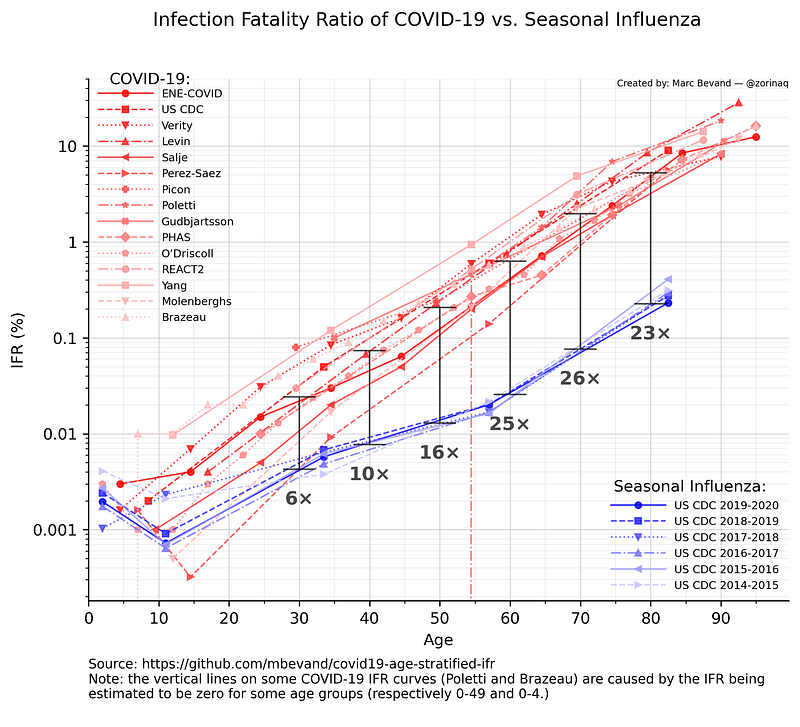
The one exception is young children, where covid and the flu are both about the same. Most kids can fight off either infection.
Let’s assume that all the VAERS deaths were caused by the vaccine. What does it look like if we put them in the same graph?
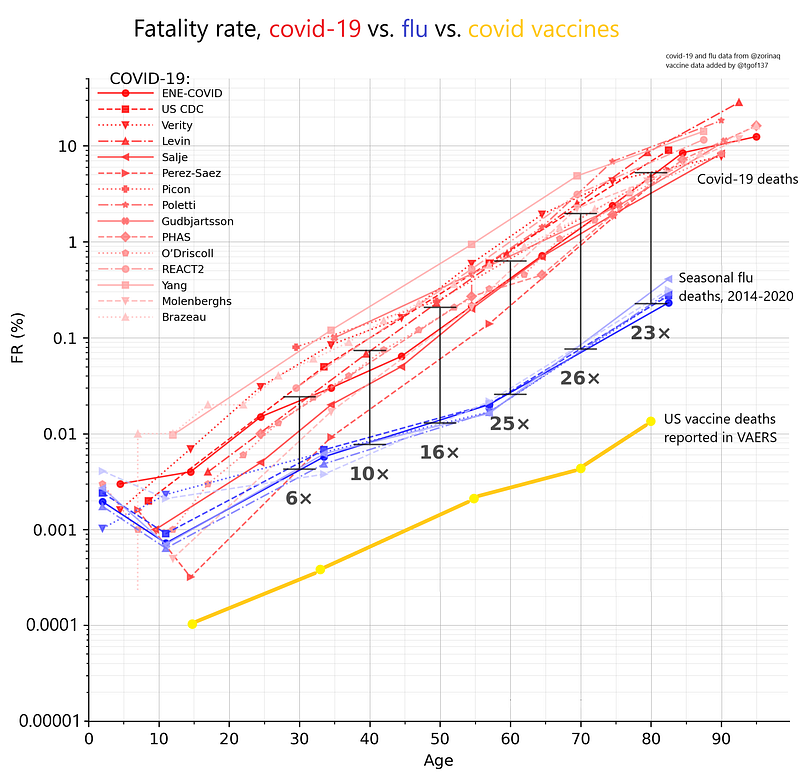
The vaccine might kill some people, but it’s about 20 times less deadly than the flu. It’s more than 100 times less deadly than getting covid.
That’s assuming that all 6,000 people died from the vaccine. Did they?
We know that most covid deaths were from covid, because 600,000 more people died than in a normal year. We don’t know if most people died from the vaccine, because there isn’t the same big spike in excess deaths.
Let’s try just reading some of the case reports.
The first case on the list is a 66 year old man at a senior living facility. He got the vaccine on 12/23 and died 2 days later. He was… not exactly healthy:
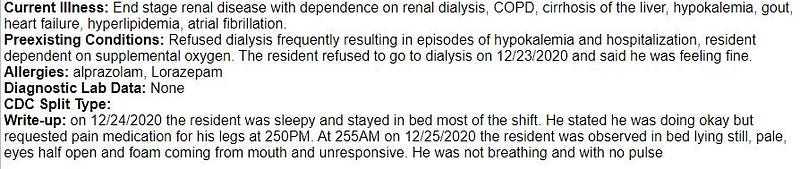
The next few cases are similar. Several are people in their 80’s with dementia. Many of the reports claim that there’s likely no connection to the vaccine, they’re just reporting the death to be on the safe side. Here’s an 89 year old woman who died 5 days after vaccination:
Write-up: Resident in our long term care facility who received first dose of Moderna COVID-19 Vaccine on 12/22/2020, only documented side effect was mild fatigue after receiving. She passed away on 12/27/2020 of natural causes per report. Has previously been in & out of hospice care, resided in nursing home for 9+ years, elderly with dementia. Due to proximity of vaccination we felt we should report the death, even though it is not believed to be related.
This sounds like a lot of old people that “died with the vaccine”, not “died from the vaccine”.
I don’t have time to read all 6,000 cases. I’ve read one study that looked at the first 250 reported deaths. 95% of these patients had comorbidities. More specifically, 14% were bedridden with a serious illness, which was the most likely cause of death. 81% had comorbid conditions, so it’s not clear if the vaccine caused the death. For 5% of the cases, the vaccine was the most likely cause of death.
From that analysis, the true number of vaccine deaths could be only 300.
We can compare the VAERS deaths to the average rates of death from all other causes:
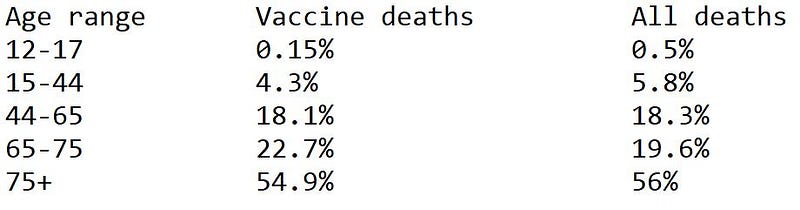
Looks pretty similar. The deaths could mostly be random and unrelated.
Let’s look at the cases for children, to see if those stand out as unusual.
VAERS lists 7 deaths between 12 and 17 years old.
2 of those 7 died from suicide. Does the vaccine make kids kill themselves? Or is this just grieving parents that want an explanation for why it happened?
2 of the others seem seriously unhealthy. One 15 year old girl got the Moderna vaccine and died 4 days later. Her preexisting conditions include:
“Trisomey 21, Atrioventricular canal s/p repair, hypothyroidism, asthma, obstructive sleep apnea, cervical spine instability, hypotonia, scoliosis, feeding difficulties, renal dysplasia, autism, chronic constipation, bronchopulmonary dysplasia, mixed conductive and sensorineural hearing loss, binocular vision disorder, gastroesophgeal reflux”
And then there are 3 young people that died from heart failure that seemed otherwise healthy. 1 is speculated to have had blood clots related to birth control pills.
The VAERS database lists 3 deaths among infants. Infants are not getting the vaccine, so this should be suspicious. 2 of these look like data entry errors where the age was entered wrong — one is a suicide by gunshot.
The only report that looks real is an infant death reported by a breastfeeding mother:
Write-up: Patient received second dose of Pfizer vaccine on March 17, 2020 while at work. March 18, 2020 her 5 month old breastfed infant developed a rash and within 24 hours was inconsolable, refusing to eat, and developed a fever. Patient brought baby to local ER where assessments were performed, blood analysis revealed elevated liver enzymes. Infant was hospitalized but continued to decline and passed away. Diagnosis of TTP. No known allergies. No new exposures aside from the mother’s vaccination the previous day.
Does the vaccine get into breastmilk? The first two studies said no. A third, more sensitive study said yes, in tiny amounts (2 parts per billion), which probably shouldn’t be a big deal. The antibodies that a mother makes do get into the breast milk. The usual effect of this should be positive, it should help protect a baby from covid. I don’t know if those antibodies could instead cause the symptoms listed above, in some rare case.
So the vaccine might have killed one baby and 3 teenagers. I’m not sure. It’s hard to prove one way or another.
Is there anything else we can say, statistically?
One thought is that we’re using 3 different vaccines and each one should have a different risk profile. The Pfizer and Moderna vaccines use the same technology (messenger RNA). Pfizer and Moderna use different doses, the Moderna dose is 3 times as large. Moderna had twice the rate of minor side effects, like headache or fatigue, as Pfizer did, during trials. If mRNA is harmful, you might expect to see more deaths from the larger dose in Moderna. The Johnson and Johnson vaccine uses a different technology, you’d expect it could have a different death rate.
We’ve given out more Pfizer vaccine than any other:
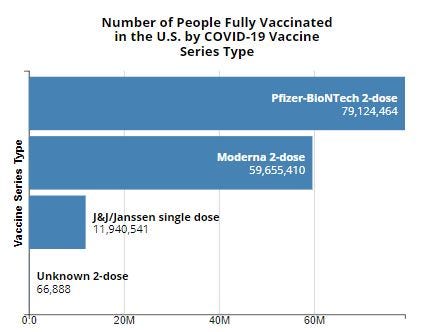
If all of these deaths are random, then the death rate for each vaccine should be proportional to the number of times it was used.
Pfizer accounts for 53% of people vaccinated and 55% of the deaths. Moderna is 40% of the vaccines and 38% of the deaths. Johnson and Johnson is 7.9% of the vaccines and 6.9% of the deaths.
So, Pfizer and Moderna have about the same death rates. There’s no dose dependence, no signal that higher dose Moderna is more dangerous.
There’s a small question here because Johnson and Johnson uses only one shot and the other vaccines used two shots. Should we count by shots or by people vaccinated? I counted people, not shots.
This kind of analysis is useful when it comes to looking at side effects. There are some rare side effects, and those show up more often with one vaccine than with another. But it seems unlikely that 3 different “deadly vaccines” would all be equally deadly. It seems more likely that the deaths are random events that aren’t related to vaccination.
I can’t give exact explanations for each of the 6,000 deaths. The people were generally old with comorbidities. It’s likely that most of the deaths were not caused by the vaccine. Even if all 6,000 were vaccine deaths, getting the vaccine is 10 times safer than getting the flu and 100 times safer than getting covid.
It would take a careful scientific study to get a better answer than that. The only thing I can say for sure is you’re not going to find that careful study on Youtube.
Edit (12/21/21): if the vaccine is deadly to elderly people, you would expect another large wave of VAERS deaths when we started giving them booster shots. That did not happen:
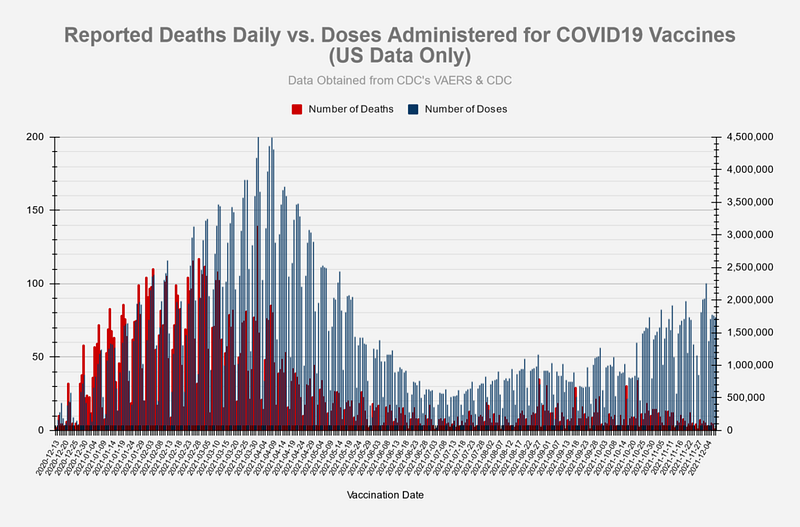
The majority of VAERS deaths were reported during the original roll-out of vaccines. There was not a second wave of VAERS deaths when the booster shots came out, but there are still a few death reports trickling in.
This supports the theory that most of the VAERS deaths were coincidences and not caused by the vaccine. But there may still be some vaccine deaths hidden in that data.
Vaccine side effects:
The vaccine does have side effects, that’s certain. 19,000 people ended up in the hospital after taking a vaccine. Some of these could also be coincidental. But many of the cases are allergic reactions that are obviously caused by the shot. Here’s one 55 year old woman:
Write-up: 5 minutes after the Pfizer Covid-19 vaccine administration, the patient developed flushing, hives, felt warm and eventually short of breath. She started to wheeze and was wheeled into ER c/o “I can’t breathe while holding throat and thrashing with facial flushness noted. PT took 2 Benadryls and had several Epi shots. She was then discharged from the ER and later on that day, started to feel short of breath again. In the ED today she was audibly gasping for air, however had no wheezing, had a normal saturation and a normal blood pressure. She had taken another dose of her EpiPen IM and diphenhydramine 50 mg by mouth prior to coming. She was then admitted to the hospital for further observation. While on the floor, she started to feel short of breath again (about 9 am on 12/18/2020), which required an RRT . Patient received another dose of diphenhydramine IV, methylprednisolone 125 mg IV and several doses of IM epinephrine. She also required oxygen. She was then transferred to an ICU for further care.
People can get allergic reactions to any vaccine or drug. That’s why they make you sit and wait for 15 minutes after getting the shot, so you can get prompt treatment if you have a bad reaction.
Other than that, we know that some people get blood clots after taking the Johnson and Johnson vaccine. The CDC says the odds are about 1 in 100,000, and it’s about 10% fatal if it happens. Australia is claiming the same rates. So, 1 in a million chance of death. The risk is lower than from many prescription drugs. And it’s much lower than the risk of getting blood clots from covid.
We also know that some people get myocarditis (inflammation of the heart) after the Pfizer and Moderna vaccines. Young men under 30 are at the highest risk.
The exact odds vary based on your age and gender:
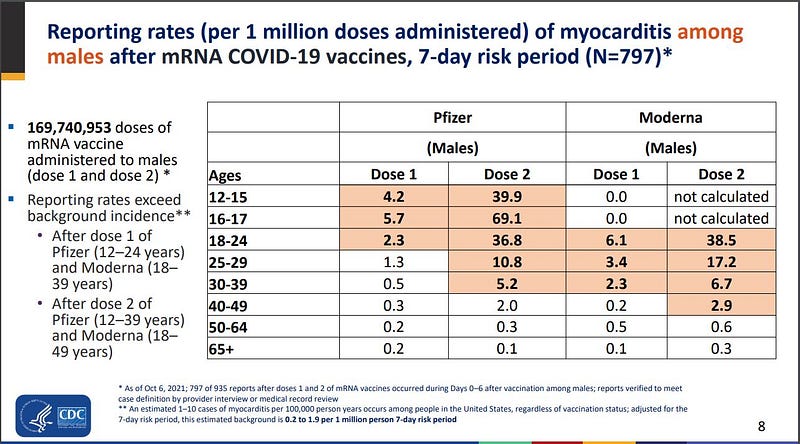
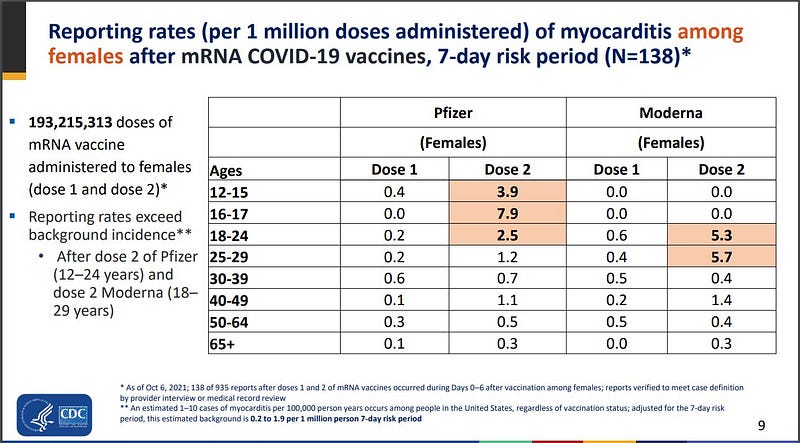
We know this is from the vaccine because it happens more often than by chance (for every highlighted cell in these tables, the risk is higher than the annual risk you’ll get myocarditis for some other reason).
We can also see that most of these reactions happened after the 2nd vaccine dose. If it were random, it would happen equally after both first and second doses. We can also see some dose dependence here — the higher dose moderna vaccine has roughly twice the risk as the lower dose pfizer vaccine. This should give us more confidence that the VAERS deaths are mostly not caused by the vaccines, since there is no dose dependence there. VAERS deaths are reported equally for Pfizer and Moderna.
Either vaccine is still safer than covid, which can also cause myocarditis. For most people, covid is much worse than the vaccine. For teenage boys, the myocarditis vs. covid risk is closer, but getting covid is still worse by a factor of 6.
I’m not sure the best way to balance these risks. For all age groups, getting the vaccine looks safer than getting the virus. But for young men and teens, it might make sense to get only 1 covid shot and skip the second dose. It also makes sense for young men to choose the Pfizer shot over Moderna.
There’s a small risk of Guillain-Barré syndrome after the Johnson and Johnson and AstraZeneca shots. That’s a pretty awful disease that causes temporary paralysis with a long recovery. The odds are low, about 1 in 100,000. You can also develop the same disease after getting covid. The odds are 4 times higher that you’ll get it after covid than after the getting the vaccine.
Should you take the shot?
When we talk about safety, we can’t just look at the risk of the vaccine. We need to compare it to the virus. The whole reason we’re taking the vaccine is to prevent that disease.
Covid has killed 600,000 Americans after infecting only 30% of the population. Without a vaccine, we’d see two to three times as many deaths before we get herd immunity. Maybe we’d get more than that, since immunity doesn’t last.
Vaccinating the whole country now should save at least 600,000 lives.
Even if all 6,000 VAERS deaths are real, using the vaccine would be a hundred times safer than letting everyone get the virus. In reality, the vaccine is probably more than a thousand times better.
Society is taking a calculated risk that this is the best option. We don’t have a lot of other choices. No one has the patience for lockdowns. Masks help a little but covid is still spreading.
If anything, the bigger tragedy is that we waited as long as we did to use them. If we had tested or approved the vaccine one month faster, we would have seen all the same side effects, but we would have prevented 100,000 covid deaths. We could also save a lot of lives by testing drugs faster.
As an individual, you also need to make a calculated risk. The known risk of vaccine death is 1 in a million. There’s a small chance of serious side effects. We don’t know if the vaccine has some unexpected long term effects, but most vaccines don’t.
In my analysis, getting the vaccine is much safer than getting covid, for everyone aged 12 and up. I have not run an analysis for children younger than 12, as the data is still coming in.
I would suggest getting the Pfizer vaccine instead of Moderna, because the dose is lower. The Moderna vaccine does work slightly better to prevent covid and it lasts a bit longer, so there are benefits to the higher dose. If you’re not afraid of side effects, it may give you better protection. Both will keep you from getting hospitalized from covid, both are fine if you don’t have a choice. I would personally choose to take the smaller dose with less side effects. Some countries have made the same conclusion, Sweden went as far as banning the Moderna vaccine for anyone under 30.
For teenage boys and for young men, it might be safer to get a single shot of the vaccine rather than two. That would give some protection against covid without much risk of myocarditis. Some countries have made this choice, Taiwan halted second shots for teens as of November. The US health authorities still recommend two shots for everyone.
If you’re pregnant or breast-feeding or worried about fertility, I would read this FAQ from Dr Viki Male, who’s rounded up all the studies we have on covid vaccines and fertility.
If you’ve recently had covid, I don’t think you need the vaccine at all. You should have natural immunity. Neither vaccine immunity or natural immunity will last forever. For most other coronaviruses, immunity only lasts about a year. So you might want to get a booster shot 6–12 months after you get covid, if you don’t want to get covid again.
If you are forced to get the vaccine because of mandates, I’d suggest you just get it instead of losing your job. Unless you hate your job anyways, in which case I’d suggest you quit. Life is too short to work a job you hate. It’s also too short to worry about 1 in a million risks.
I encourage people to be skeptical of the government and do their own research. But, if your alternate sources start telling you that the vaccine has killed 150,000 people, you need to be equally skeptical of that.