
How safe is nuclear energy?
The aftermath of Chernobyl
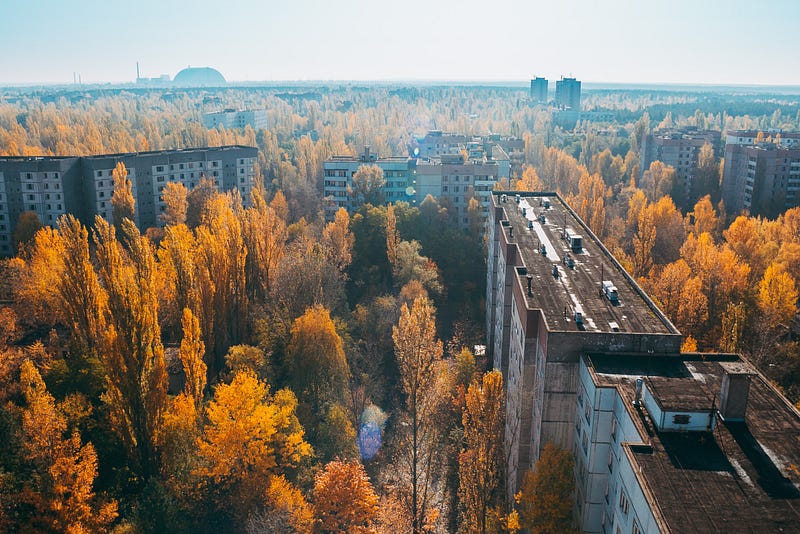
We know all the damn silly things we’ve done for a thousand years, and as long as we know that and always have it around where we can see it, some day we’ll stop making the goddamn funeral pyres and jumping into the middle of them. We pick up a few more people that remember, every generation. (R. Bradbury, “Fahrenheit 451”)
In 1986, I was 6 years old and living in ex-Yugoslavia, visiting my grandmother for the May Day (Labor Day) holidays, when the Chernobyl nuclear disaster happened. The event probably wouldn’t have registered at all with me at the time if my mother hadn’t called and, in what I recognized as an urgent and scared voice, ordered me to play indoors, and my grandmother to keep me inside the house at all costs for a couple of days.
She tried to explain that there had been a horrific explosion in the Soviet Union and that there was a cloud of contaminated air over us. It didn’t make much sense to me. I distinctly remember looking out the window as we were talking, taking in the perfectly sunny, bright blue sky, with no sign of any trouble, and thinking, What is she talking about? I can’t see anything.
I protested as much to my mother, who again tried to explain that there was radiation in the air— not that I understood what that meant — but it was invisible, and therefore all the more dangerous. The word invisible seemed to work on me, though, calling up ideas of adventure and danger, so I did remain indoors for the rest of that day, but I think I was back outside the very next day. Who could resist the glorious spring weather?
Apparently, most people in the area around the Chernobyl Nuclear Power Plant thought the exact same thing at the time. Apart from the explosion and subsequent fire at the plant itself, not much else seemed to be amiss. Preparations for the all-important May Day celebrations were underway, crops needed to be harvested, relatives were coming for a visit over the bank holiday, and the weather was just gorgeous.
So after 3 days, when roughly 50,000 people living in the vicinity were finally told about the radiation and that the 10-km area around the power plant needed to be evacuated — later, the exclusion zone was widened to 30 kilometres, and another 68,000 people were forced to leave their homes—their reaction was like mine: bewilderment and disbelief. The danger was invisible and its consequences were not immediate, so it was very difficult to acknowledge and accept.
Death lurked everywhere, but this was a different sort of death. Donning new masks, wearing a strange guise. Man had been caught off guard, he was not ready. Ill-prepared as a species, our entire natural apparatus, attuned to seeing, hearing and touching, had malfunctioned. Our eyes, ears and fingers were no longer any help, they could serve no purpose, because radiation is invisible, with no smell or sound. It is incorporeal. (S. Alexievich, “Chernobyl Prayer”)
From 2016 to 2019, I was working at the Oil & Power division of Siemens in Germany as a Business English trainer. One of the big discussion topics among my students was the looming shutdown of all nuclear power stations in Germany. This topic inevitably also brought with it a few conversations about the disasters at Chernobyl and Fukushima.
My students organically separated themselves into two camps. Most believed that nuclear energy, together with the waste it produced, was an unmitigated ecological disaster, exacerbated by the fact that some countries were also using it to create and store nuclear weapons. But a few students argued that, in both economic and ecological terms, nuclear power plants were still the most efficient and cleanest solution to the world’s rising demand for electrification.
A solid argument, I would say. And yet. Out of curiosity, I always asked the people in the second, smaller camp how they would defend their position in light of what happened at Chernobyl and Fukushima. Invariably, they told me that we could learn from previous mistakes, and that with the new technologies at our disposal today, we could ensure that nuclear power plants remained safe.
This is because our world is firstly about power and only secondly about knowledge. (J. M. Ledgard, Submergence)
These answers reminded me that it is hard for us to relate to catastrophes that didn’t happen to us directly and didn’t affect our lives. WW2 is something that happened well before my time, and if you tell me that roughly 80 million people died in it, this fact is ultimately just a number to me — I cannot really conceive the magnitude of it, nor fully understand the realities of that time, simply because I wasn’t there and it didn’t happen to me.
And that is precisely why we need history and literature. The imagination has supped its fill of horrors, as George Steiner would say; a barrage of bad news and (dis)information attacks our perception from multiple screens on a daily basis, so our minds instinctively close against the pain and the fear. We need writers to help us navigate through a sea of horrors, to try to find words for the unspeakable — for what lies beyond the pale.
Chernobyl, like the extermination camps of WW2, is beyond the pale. As Svetlana Alexievich notes, it is a cataclysm for the mind. To think about it is to reach a dead end, for what remains after a nuclear reactor blows up? It was an event that threatened to obliterate the entire planet. The fallout will not go away for several billion years. And like the extermination camps, what remains of Chernobyl, and of the abandoned atomic city of Pripyat, stands today as a reminder and a warning of what we are capable.
A feeling arose in all of us — whether voiced or unvoiced — that we had touched on the unknown. Chernobyl is a mystery that we have yet to unravel. An undeciphered sign. A mystery, perhaps, for the twenty-first century; a challenge for it. …
The historian Serhii Plokhy and the journalist Adam Higginbotham wrote two excellent books giving us, respectively, a historical-political context and a blow-by-blow account of how and what happened in the spring of 1986. Lots of numbers, lots of facts. Most recently, HBO helped us visualize some of that terror and impossibility.
But it was the Belarusian writer Svetlana Alexievich who, in the 1990s, went beyond the numbers and the facts and collected the thoughts, feelings, and testimonials of people whose lives were directly impacted by the catastrophe. She asked them to find words for the unimaginable.
I was searching for those shocked people. They were speaking in new idioms. Voices sometimes broke through from a parallel world, as though talking in their sleep or raving. Everybody near Chernobyl began to philosophize.
For people who lived through the catastrophe and witnessed its aftermath, it blew their minds wide open. So when they speak, they don’t just recount their experiences: some try to articulate their feelings, some dwell on implications and repercussions, others attempt to place the event in the larger history of Russia, or in a specifically Soviet mentality.
Chernobyl filled my life and my heart grew bigger … but it aches. It’s like a secret key. After suffering great pain, you talk, you find you speak well. I did …
Curies, rems, sieverts — that doesn’t add up to understanding. It’s not a philosophy, not an outlook. In this country, man comes either with a gun or with the Cross. That goes right through our history. There has been nothing else. There still isn’t.
Chernobyl has blighted our imagination, our future. We are running scared of the future. But if that’s the best we can manage, why did we bother coming down from the trees?
A young woman was sitting on a bench by her house, breastfeeding. We tested her breast milk and it was radioactive. The Madonna of Chernobyl.
Chernobyl Prayer blew me away for the simple reason that I had never read anything like it. I cried at certain points. Hundreds of voices recreating history, breathing life back into their memories, stepping outside time to retrieve pieces of themselves. Alexievich understood that
remembering is not a passionate or dispassionate retelling of a reality that is no more, but a new birth of the past, when time goes in reverse. Above all it is creativity. As they narrate, people create, they “write” their life.
This is what allowed her to move the goalposts for what can be done with fiction. It allowed her to step outside the framework of a novel. She’s not a ventriloquist and she didn’t create characters with voices coming from “somewhere else.” Alexievich substituted characters for people and let them speak for themselves.
Some will say that, ultimately, every encounter with a book is entirely subjective. We interpret things differently, and every reading, as an act of interpretation, is therefore valid.
Still, I would like to say that, if you read Chernobyl Prayer and do not come out on the other side of it as a slightly changed person, you only read it to check it off the list. Or, as George Steiner put it, you “read only with the blindness of physical sight.”
I also propose Chernobyl Prayer as an answer to statements about the safety, cheapness, and “greenness” of nuclear energy.
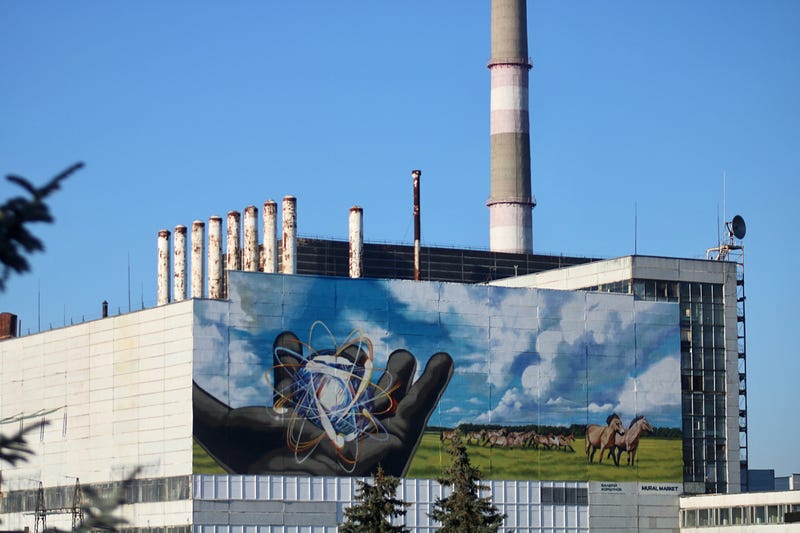
Further reading and/or viewing:
Svetlana Alexievich, Chernobyl Prayer: A Chronicle of the Future (2016)
Serhii Plokhy, Chernobyl: The History of a Nuclear Catastrophe (2018)
Adam Higginbotham, Midnight in Chernobyl (2019)
Kate Brown, Manual for Survival: A Chernobyl Guide to the Future (2019)
HBO series Chernobyl (2019)


