
How Russia’s Moldy Hamburgers Are Becoming Symbolic of a New Cold War
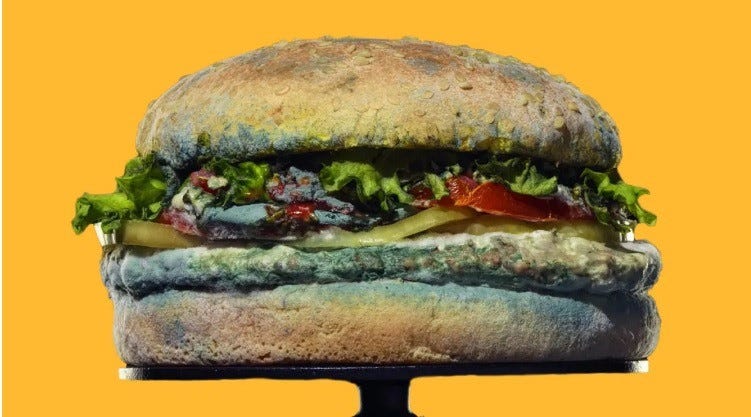
Businesses worldwide are pulling out of Russia to convey to its government that they do not support its aggressive policies. This is now considered a “trend,” and it nearly gives the impression that organizations sense some form of social control to the point where they feel forced to retreat to avoid losing face with the general public. Russia’s answer to McDonald’s withdrawal is the hamburger establishment called ‘Vkusno & Tochka’, which reportedly sells moldy hamburgers. Whether true or false, it does feel like Cold War propaganda.
Due to Russia’s invasion of Ukraine, thousands of western corporations have either reduced their presence in the country or completely pulled out due to the isolation Russia is experiencing due to this development.
Ironside recognized that their withdrawal could result in the loss of employment for thousands of individuals working in food service and agriculture; nonetheless, some people in Russia are seeing a silver lining in this cloud.
Mcdonald’s is one of the companies that is pulling out of Russia. Still, everybody loves a tasty burger, and businessman Alexander Govor, who previously had owned 25 Mcdonald’s restaurants, saw market potential and opened Vkusno & Tochka, which translates to “Tasty & That’s It.”
He could do this because the official Mcdonald’s establishments he owned gave him access to the ingredients used by Mcdonald’s.
Since when does the entire world care about mold in hamburgers anywhere in the world??
Sir.. there’s mold in this hamburger.. On the first day that it was open, Vkusno & Tochka reportedly sold 120,000 hamburgers. Almost immediately, reports began to arise on the internet with accusations of mold growing on the hamburgers and torn-apart bugs or insects in the otherwise excellent fast food.
The question immediately comes to mind is, “Since when does the entire world care about mold in hamburgers anywhere in the world??” Regardless of their integrity, these stories bring to mind the spread of misleading information during the Cold War.
Information War It wouldn’t be the first time that false information was distributed to bring an organization, regime, or entire nation into disrepute. During the Cold War, the CIA and the KGB were responsible for spreading false information about their adversary to create uncertainty and distrust within a country and between allies.
Officials who had retired from the CIA confirmed that several nations members of NATO were involved in sharing such ‘active measures.’
It is sound knowledge that the KGB was responsible for spreading the rumor that the United States of America produced the disease AIDS in their laboratories and that the government was involved in the assassination of John F. Kennedy. The United States, for their part, painted a picture of life in the Soviet Union as being primitive. The people behind the Iron Curtain were subjected to a brutal and autocratic way of life.
“Active Measures” was the name of these strategies, and the Soviet Union invested $3 billion to develop them. Officials who had retired from the CIA confirmed that several nations members of NATO were involved in sharing such ‘active measures.’
Blockbuster material? One would be tempted to ask, “Hamburgers…really? What with all the blockbuster movies that dramatize the tensions between the United States and Russia by depicting even more dramatic incidents. Is this the propaganda they put out?”
Degrading the enemy’s government, way of life, culture, and belief system is the primary goal of psychological operations
The answer to that question is yes. Degrading the enemy’s government, way of life, culture, and belief system is the primary goal of psychological operations (also known as psychological warfare). The accumulation of all of these factors will push an overall emotion more towards the negative. Because “our group” is so awesome, this seems like a safe bet. “We are the greatest nation on the face of the earth,” and “those people over there are insane!”
This collective cognition feeds greater polarization, enabling governmental control of the public’s opinion, which justifies additional actions, possibly even military ones.
Conclusion No matter how innocuous it may appear, distributing propaganda on innocuous incidents (such as potentially these misshapen hamburgers) does alter our perception of a country.
The information age officially began with the proliferation of the internet. Old-school propaganda from the 1950s has evolved into full-fledged psychological warfare to the point where multiple companies are making significant profits by working in this field.
Do not let yourself be misled by the media and be conscious that every piece of information we take in has been “synthesized,” which means that it has been meticulously crafted with a plan to persuade one person to have a particular viewpoint.
Our governments are well aware of the fact that sometimes the power of the pen can be more effective than the sword.
A new story every Friday 10AM CET
Follow me on Medium for more about: → Cancel Culture → Strategic communications → Persuasive campaigning → Campaigning in the modern/digital world → Behavioural sciences → Digital Targeting in communications
Follow me on Twitter Follow me on Instagram Connect with me on LinkedIn