
Spirituality
How Religion is Helping My Trans Journey
Search for truth and meaning
Wait, I can’t be serious about that title, right? This is some kind of joke, right? After all, antagonistic religion is one of the most common gripes in the trans community, right?
Well, please enter my story with an open mind and heart.
I’m a wanderer and searcher in spirit. I’m on an endless quest to find peace between my mind, heart, soul, and body.
I was raised subscribing to the tenets of Catholicism: the trinity, the virgin Mary, Jesus’s suffering for our eternal salvation. I soaked it up and got the confirmation blessing from the archbishop; I was now solidly with the true and holy flock and therefore eternally saved — which to me was one less thing to have to worry about.
But when I left my quaint (white, Christian, midwestern) hometown for college, I could not ignore the incongruence between the values of my youth and the outside world. I befriended people quite different from those of my youth: people of different colors, different beliefs, and different orientations and attractions. These were real and good people; people inherently worthy of love and of grace. My ingrained bias would judge such people as different and therefore not worthy; a cancer imprinted on my mind which took years to properly identify and years to mitigate.
At about the same time, I witnessed my best friend, a devout Catholic, die a horrific death to leukemia, a death that was framed by a priest as, “God’s design”. I, like everyone else on the planet, have seen wars and systemic murder of millions of people in the name of one deity or another, and I have seen (and apologetically was one of) god’s “chosen” neglect the homeless on the street and turn away from ugly injustice in the world. Vile, disgust, and despair of both me and of the world clouded my spirit for years.
Gradually I emerged, and had heartfelt discussions with those of different belief structures: of Jewish, of Muslim, of Buddist, of Agnostic, and Humanist. I would be invited to Seder and Iftar meals, and to meditation at the local Buddhist society. I would learn of the commonalities that bind us as human beings and value such commonalities beyond the prohibitions imposed by my youth. I was humbled, shaking even, when I became fully aware of my inherent brokenness, and resolved to find a theological system, of ethics, of morals, and mindset, which resonated with my mind, my heart, and my experience.
Ever since that epiphany, any remaining seeds of Catholicism dissolved. I assumed I would figure things out on my own.
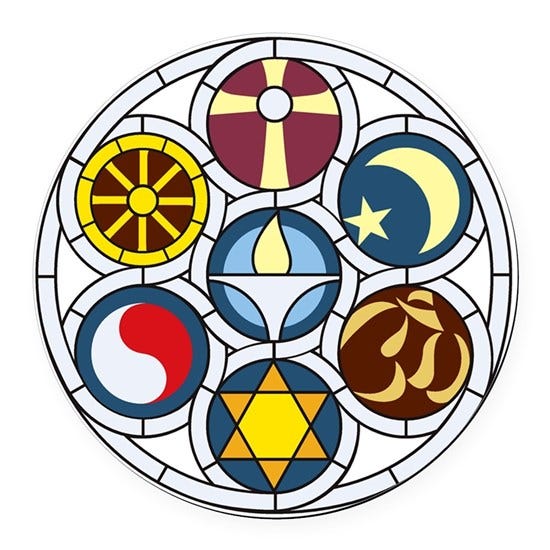
I stumbled my way, through the sage advice of a good friend, to the Unitarian Universalist (UU) church. The organization has basic principles, listed here; to me, these can be simmered down to three main points:
- Inherent worth and dignity of every person, regardless of race, creed, orientation, etc.
- Respect and protect the environment and the interdependent web of existence.
- Actively work for a more just, equitable, and compassionate world.
That’s it. No mention of God, Jesus, or the Bible. No mystical tales, threats of hell, or promises of salvation. The UU does not preclude these (indeed there are many UUs who also identify as Christian, Jewish, Muslim, and Hindi), nor confirm these (there are many UUs who are agnostic, atheist, and/or humanists).
UUs work together to share our individual experiences and traditions, with the hope of connecting many of the barriers that separate us. For example toward the end of each year UUs typically celebrate Diwali, Hanukkah, Christmas, Yule, and Kwanzaa, as all have commonalities of rebirth and light in times of darkness; we also acknowledge and embrace Lent, Ramadan, and Rosh Hashanah / Yom Kippur and their shared commonalities as days of reflection, contemplation, and repentance.
This philosophy was congruent with my heart and my experience. Universal acceptance and ‘salvation’ (which could be defined in a multitude of ways) seemed both fair and logical. Through deep reflection and community with like-minded people, I was able to start erasing my learned preconceptions and strive to love people without prejudice (forever will be a work in progress). We’re all worthy of love and grace, period.
Now mind you, this journey was well before my trans egg even started to crack, although a narrative could probably be sewn that such feelings were interconnected, albeit dormant, in my psyche. But when my egg did crack, I was equipped with the intellectual and spiritual tools from which to discern preconceptions of myself and my upbringing and to investigate, embrace, and love myself regardless of the path ahead. Much of the hard work of defeating the biases of my upbringing was already crushed; traversing residual rubble is a considerably easier task. And not only that, but I can now reasonably expect love, support, affirmation, and acceptance from my church in the path forward. Again, love and grace.
To those who are struggling with rectifying your religious heritage and teachings with your current identity, I urge you to check out Unitarian Universalism as, if nothing else, a temporary stepping stone for which you can steady your heart and spirit while figuring out the myriad of issues in your life. They are incredibly supportive of the LGBTQIA+ community.
To those who are reading this who are of solid faith traditions that I may have disparaged (particularly Catholicism), please keep in mind I speak of my own journey; I support others in their spiritual journey wherever it may lead them, so long as it does not disparage me, or others, of the love, grace, and dignity that we all inherently deserve. The world today needs fewer barriers and more shared humanity and humility.
Peace to you, always. Amen
-nova grace 💜