
How Psychedelics Destroyed My Chronic Fear and Helped Me Live a Freer Life
Why opening your mind to psychedelics’ potential is worth it
In 2014 my best friend said, “I took LSD a couple of times,” and I wanted to ignore him for the rest of my life.
Then 21, I was scared of all drugs except for alcohol and weed. I had heard horror stories about addictiveness and people dying from bad trips. So my strategy was to avoid all people who take these drugs, including my best friend.
But I couldn’t say goodbye and ignore him. We were on a houseboat in the middle of a mountain lake in Northern India. There was no escape.
And so happened the potentially most impactful turn in my life so far — I had to listen.
Science on the Danger of Psychedelics
Just like my younger self, many people hold fixed beliefs about drugs different from alcohol. Some beliefs are right. Heroin, crack, meth, and cocaine, for example, are highly addictive, cause physical damage and social harm.
Yet, other beliefs are wrong. As Michael Pollan writes:
“A lot of what both scientists and the general public think they know about the potential risks of psychedelic use comes from the first wave of research and experimentation in the 1950s, 60s and 70s. But this body of knowledge includes studies that wouldn’t meet today’s scientific standards; urban legends; and sensational, unsubstantiated news stories.”
The Lancet, one of the best-known peer-reviewed medical journals, published two studies by David Nutt — an English neuropsychopharmacologist specializing in drugs research. At the time of the study, he was also chief drugs adviser to the British government.
In the first study from 2007, psychiatrists and independent experts rated each substance regarding three factors
- the physical damage (physical and health) to the individual that the drug can cause;
- the potential extent of the individual’s dependence on the drug;
- the possible effects of drug use on the family, the community, and the society in which drug users live, i.e., social harm.
In 2010, the research team published a follow-up study with improved methodology. The damage potential now consisted of 16 weighted individual factors distributed among the groups of physical, psychological, and social damage within the dimensions of self-harm and external harm.
These are the results from the study:
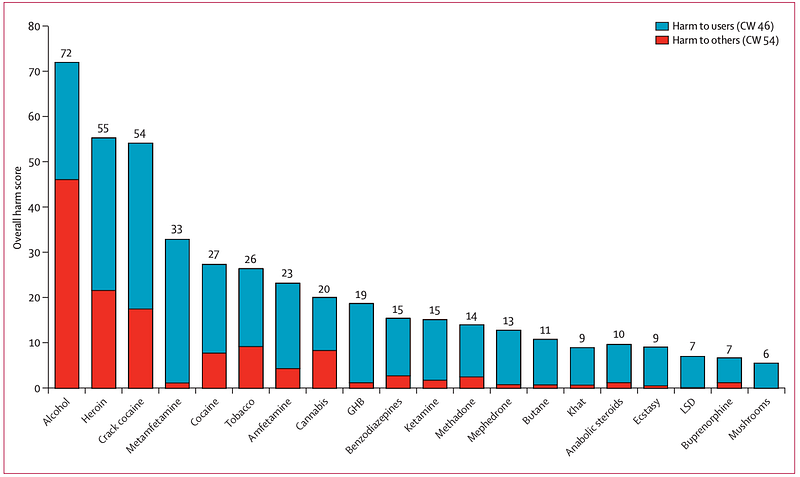
Do you see what’s striking? Alcohol and tobacco are legal yet among the top ten most harmful drugs.
Alcohol is ten times as harmful as LSD or mushrooms.
After the study, Nutt criticized UK drug politics and suggested stopping the artificial separation of alcohol and tobacco as non-drugs. He said LSD is less harmful than alcohol and tobacco. In his words:
“No one is suggesting that drugs are not harmful. The critical question is one of scale and degree. We need a full and open discussion of the evidence and a mature debate about what the drug laws are for — and whether they doing their job”
But it’s not only Nutt and the research team around him that attest to the safety of psychedelics. In 2017 Matthias Liechti, a professor for clinical pharmacology and internal medicine at the University of Basel, published a study in Nature, another peer-reviewed scientific journal.
The study reviewed all LSD research from the past 25 years. Liechti writes in all of the clinically controlled settings, the subjects’ experience of LSD was “predominately positive.” He found no severe adverse reactions to LSD.
How Psychedelics Can Change Your Mind
Psychedelics are not only not as harmful as most people think; they can change the minds of both healthy and ill people. The evidence is vast.
In 2016, the New York Times wrote about psilocybin cancer studies at Johns Hopkins and New York University. A breath-taking 80 percent of cancer patients had significant reductions in anxiety and depression.
In How to Change Your Mind Michael Pollan explores psychedelics in psychotherapy and explores three aspects: dying, addiction, and depression. What I took away from these chapters is really close to the following synthesis from the Multidisciplinary Association for Psychedelic Studies:
“Psychedelic psychotherapy is showing great promise for the treatment of post-traumatic stress disorder, or PTSD, depression, social anxiety, substance abuse and alcoholism and suicide.”
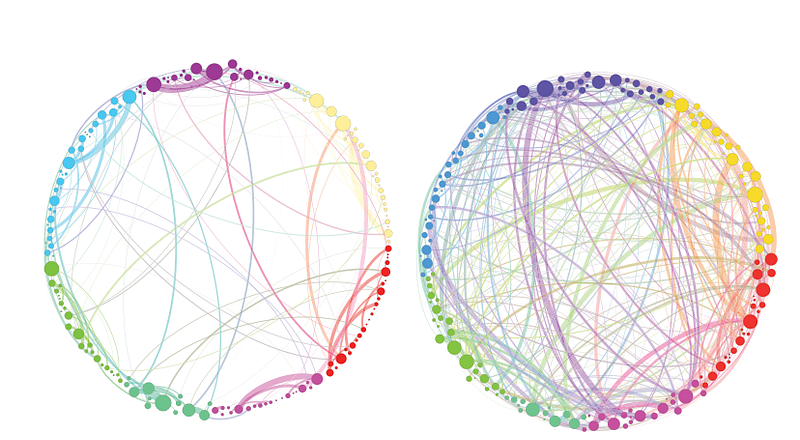
Another study compared the brain’s internal communication during normal waking consciousness and after a psilocybin injection (psilocybin is an active component in magic mushrooms).
As the image shows, your brain forms thousands of new connections. Psilocybin boosts your mind’s diversity. It links brain regions that normally don’t communicate.
Researches from the University of Amsterdam reviewed existing studies on psychedelic drug use in healthy individuals and concluded:
“When used appropriately, psychedelic drugs have been shown to have positive effects among healthy individuals, with single doses capable of producing lasting changes in wellbeing and purpose.”
And even though the research is detailed, I spent two years exploring the topic before touching a single psychedelic. I read books like the one from Michael Pollan, Outside looking in, and The Cosmic Serpent. I watched documentaries on Albert Hofmann and The Nature of Ayahuasca and talked to experts in the field.
How Psychedelics Changed My Life
It’s a late Sunday morning, and I’m happy. I just returned from the city I studied for spending a long Easter weekend with my parents. With some boiled eggs in my hand, I walk towards the table in my parent’s garden.
I’m excited because it’s one of those breakfasts where there’s everything you love, and I don’t know yet that I won’t eat a single bite at that table. So I’m still in this feeling of excitement when I sit down and try to take my first sip of coffee.
But I can’t take the cup to my mouth. Instead, I spill the coffee and jump out of the chair. My heart starts beating faster, and all excitement is gone. I’m panicking. I run to the house and close the door behind me. I hear my family's laughter, but once I know they can’t hear me, I start to cry.
I cry because I’m mad. Why do wasps ruin even the best of mornings?
Now the bigger problem — it’s not only wasps. I’m fucking afraid of beetles. And crickets. And moths. And spiders. I’ve got a chronic fear of all insects. When I see one of them, I jump and run as if I were Super Mario and just found a star.
Fast forward to a year later. I’m lying in the grass, tripping. And what I see scares me to death. My entire body is covered by insects. Spiders, beetles, wasps are crawling upon my skin.
I feel them. I hear them. I even smell them. I want to run away, but I can’t.
When you’re at the peak of a trip, you don’t know you’re tripping. You lose your meta-cognition. What happens seems like reality. And this insect experience felt a hundred percent real for me.
I understand when people avoid psychedelics because they fear bad trips. For what felt like hours, my trip was freaking frightening.
But after these dark feelings, I had an epiphany. I don’t remember the transition. But what I remember is this clear, bright thought:
All existence, plants, animals, insects, mountains, lakes, humans share the same origin. God is nature. We were created for peaceful coexistence. When our paths cross, it’s no coincidence. I can accept these crossroads for what they are — proof of the power of nature. We will go on with our lives as if we never met but within the same nature.
Insects were still crawling on my body, but the fear was gone. I looked at all of them and felt pure astonishment. I was relaxed and at peace. And most of all, grateful.
All my experiences with psychedelics (Psilocybin, DMT, LSD, Ayahuasca, and San Pedro) have in common this feeling of gratefulness and a deep appreciation for nature.
If I had to name a similar non-psychedelic feeling, it’d be the day after 10-days of silent meditation. History and the future lose their relevance. What remains is trust in the world and yourself.
Since this experience, I no longer fear insects. I enjoy brunch with friends and wasps. I feel amazed by beetles and spiders. Now, I don’t love them. But I respect and accept them as part of nature.
Final Thoughts
Are psychedelics the only way to cure addictions or fears? No. Should everyone try psychedelics? Hell no.
But if you’re among the people who heard stories about the dangers of psychedelics and accepted them as truth — just like I did until 2014 —I invite you to question them.
“Psychedelics are among the safest drugs we know of.”
Doubt what you know and look for answers to what you don’t know. A flexible mind is your most valuable asset. Because in the end, learning and exploring the world isn’t about affirming your beliefs but evolving your beliefs.
Disclaimer: This article is provided for informational and entertainment purposes only. Please use your own judgment in deciding what to do with it. Be aware that psychedelics are illegal to possess and consume in many countries.


