
How Psychedelics Could Help Cure Various Mental-Health Disorders
How hallucinogens might be a better option than conventional treatments for anxiety and depression
“I did my psilocybin trip and immediately afterward I was able to see my cancer in a box beside me on the floor instead of this black cloud hanging over me all the time.” That’s what Laurie Brooks said in a 2020 interview for CBC Canada, a year after her colon cancer returned again. For Brooks and three other Canadian patients, which had been prior diagnosed with terminal illnesses, psilocybin was probably the only left option for them to cure their followed anxiety and depression. These four individuals, back in 2020, received official approval from the Canadian government for an exemption from drug laws that had initially made the hallucinogen illegal in the ‘70s.
One other patient out of the four was Thomas Hartle. What he told CTV News back then was that his thoughts about the future triggered his existential anxiety, resulting from his terminal cancer diagnosis. The problem was that these common side effects could not be treated by conventional anti-anxiety medication, according to Hartle. During a webinar he spoke publicly about his first encounter with the hallucinogen:
“I have had anxiety for so long, I had sort of forgotten what it feels like to not have it. To experience the lack of anxiety I have had this week is beyond words. It’s amazing. I have no idea how long this particular benefit will last, but so long as it’s here, it’s really, really amazing and good.”
It’s amazing how psychedelics — from being initially known as the ‘party drugs’ and excessively being connected to the ‘underground’—are now seen as a possible long-term treatment for various mental health issues, such as depression, anxiety, and PTSD. Although the craze is probably most pronounced in the USA, other countries such as Australia and Canada are not far away from fully, legally recognizing hallucinogens as an alternative, working solution to some mental disorders.
In recent years, the demand for the so-called psychedelic-assisted therapies has started to risen up, as conventional therapeutic sessions and standard anti-anxiety and anti-depression pills are no more being seen as the only (and optimum) solution. Elizabeth Matthews was one of the people that underwent such an up-and-coming therapy:
“The MDMA assisted therapy allowed me to communicate the truth of my experience while remaining connected to my therapist. Before MDMA I couldn’t tell my story without being rocked for days by the shame that surfaced in the telling.”
Last year, a small Silicon Valley investors group donated $30 million towards a psychedelics research — conducted by both the Psychedelics Science Funders Collaborative (PSFC) and the Multidisciplinary Association for Psychedelic Studies (MAPS) — called Capstone Campaign. The research’s initial target was to seek approval from the U.S Food and Drug Administration (FDA) for using MDMA-assisted psychotherapy by patients who suffer from PTSD. Although not finished yet, the research, if approved, would become the first-ever legalized psychedelic-assisted therapy practice in the USA.
Also, multiple $1 million donations were poured into the research by some of the psychedelics’ most renowned advocates, one of which is Tim Ferriss. “Ferriss played a significant role in the fundraising campaign’s success, helping to secure an initial $10 million in philanthropic donations for a challenge grant.” The owner of GoDaddy, the world’s largest domain registrar and web hosting company, Bob Parsons is known for also donating around $2 million. In the midst of all of the research that had been going on around MDMA and its potential of curing patients with PTSD, Parsons was explicit:
“Psychedelic research has been thought of as ‘fringe’ for a long time. But there’s nothing ‘fringe’ about PTSD.”
In overall, around 2500 individual investors helped the research see daylight. Here are some of the most notable contributors, according to MAPS:
- Bob Parsons, founder of GoDaddy ($2 million)
- Blake Mycoskie, founder of TOMS Shoes ($1 million)
- John Gilmore, co-founder of Electronic Frontier Foundation ($1 million)
- David Bronner, CEO of Dr. Bronner’s ($800,000)
- Joby Pritzker, managing director of Tao Capital Partners, board member of Marijuana Policy Project, and cousin of Illinois Gov. J.B. Pritzker ($3 million)
- Steve Jurvetson, board member of SpaceX and Tesla ($2.6 million)
- Tim Ferriss, tech investor, author, and podcaster ($1 million)
In regards to MDMA and its implications within the mental-health industry, the social entrepreneur and co-founder of the Psychedelic Science Funders Collaborative Joe Green was one of the many to also approve such a venture:
“Winning FDA approval of MDMA-assisted therapy for PTSD could ultimately help millions of people, and that alone is a world-changing impact.”
In the graph below you can clearly see the increase in clinical trials involving the use of psilocybin, MDMA, and LSD:
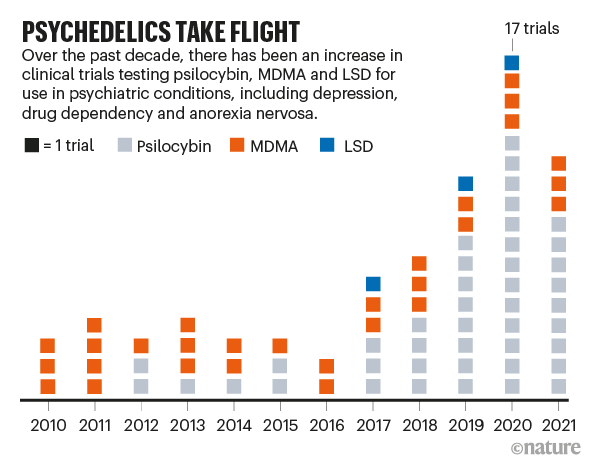
It’s important to note that all these treatments are within the scope of psychotherapy and are in conjunction with it. Hence comes the term psychedelic-assisted psychotherapy.
Brief History
The possible benefits of psychedelics are not an entirely new discovery, though. Although there had been some isolated small-scale scientific studies that took place at the beginning of the 20th century, interest in such unknown substances was considerably low until the discovery of LSD — the first synthetic psychedelic.
Some papers on the matter could be traced as far back as the 1950s, where LSD was used to treat patients who suffered from alcoholism. The psychiatrist to conduct all these studies was Humphry Osmond — the person who came up with the term psychedelic, which meant “to manifest one’s mind.” Unfortunately, his trials didn’t last long — they ended in the mid-60s due to social and political issues.
Another psychiatrist in the 1950s, Ronald Sandison, who was the first one to introduce psychotherapy and other methods that involved art and music, was doing similar tests with LSD in the United Kingdom. Sandison’s paper from 1954 involved the study of 36 people who were given doses of LSD over a period of a year. The outcomes were quite promising — it was believed that the psychedelic could indeed aid patients in the treatment of psychoneurosis and other different mental illnesses. The following year, Sandison, riding the wave of his prior research success, opened the first LSD therapy clinic.
The significant findings that were published by Sandison and Osmond were slowly starting to enter the wide public’s eye. Between the beginning of the 50s and mid-60s, around 40,000 patients had been prescribed LSD, either as a therapy or as a treatment for different mental illnesses. However, due to LSD primarily being seen as something harmful and being associated with anti-war students’ demonstrations, the U.S. banned its use in the late 60s.
Going even before the Osmond and Sandison studies, psychedelics had been used for thousands of years. Certain carvings in South America suggest that the so-called Magic Mushrooms have been used since before 1000 B.C. However, the effects sought by psychedelics users have drastically changed since then. If three thousand years ago hallucinogenic plants were being used mainly during tribe rituals and societal bondage, today, the reasons vary greatly. I’ve spoken to people who say they used it to alleviate their depression, anxiety, and fears. Others say they use it for fun — wanting to just experience the trip itself, without thinking about any other benefits or drawbacks.
Present & Future
Matt Stang, the co-founder of Delic Corp, the first psychedelic wellness company in Canada, argued that he had started his company as he was starting to see “a tipping point” in the psychedelics industry where “people would see and accept this as an alternative route to wellness,” he told Toronto Sun, and:
“That acceptance has been escalated by COVID-19 and its parallel pandemic of mental illness, high anxiety and PTSD. The need is greater than ever for these modalities to be developed. Ketamine is just the tip of the spear. MDMA and psilocybin are in clinical trials approved by the FDA.”
It’s astonishing to see how rapidly the interest has grown towards both psychedelic-assisted therapies and, micro-dosing, and just occasional recreational doses (which, taken in the right amount and under the right supervision, could yield positive effects). Such is the story of Kirk Rutter. He participated in a study in the Hammersmith Hospital in the UK, where he took a powerful psychedelic — a trip, which was guided by the psychologist and neuroscientist at the Imperial College of London Robin Carhart-Harris.
According to Nature, Rutter was qualified for the study, as he previously suffered from anxiety and none of the conventional pills had helped. On the day of the trial, Rutter was given two pills of synthetic psilocybin and lay down after being given headphones and an eye mask. Then his recovery started.
The growing interest in psychedelics is also growing from an institutional aspect. Baltimore’s Johns Hopkins University, the University of California, and Imperial College London are just some of these organizations, which have opened their own psychedelics research centers. Although the studies conducted there so far have not been on a large enough scale, they nevertheless are promising.
I can assume that the growing popularity of psychedelics and psychedelic-assisted therapies will only continue growing. As new trials on hallucinogens are appearing more and more often than before and as these substances are endorsed by various celebrities and well-known scholars on a daily basis, we could be sure (or hopeful) that in the years to come we will have a better and clearer understanding of how psychedelics could open a new, better dimension in our lives.
Thank you for reading.
If you wish to explore more written by me, please check my Medium page:
If you are further interested in psychedelics and mental-health, I recently wrote about whether smoking can damage your brain cells, and how psychedelics could become the “new weed.”


