
Post Critical Theory
How Plutocratic Capitalism Takes Everything From You as if It Is a Norm
And whether you have to agree to this

Skyrocketed exponent
Let’s summarize the preliminary results.
First, take a look at this graph:
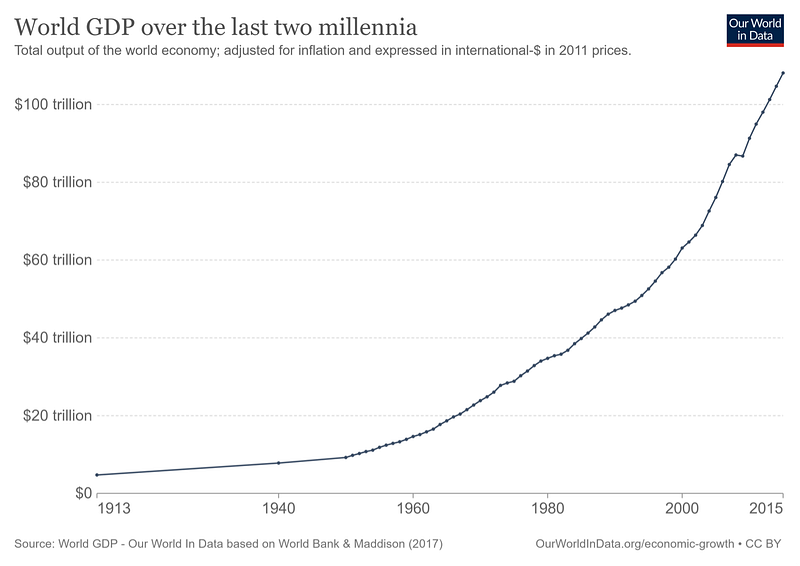
This is an illustration of the progress declared since the beginning of capitalism.
This progress is more than evident. This type of growth is called exponential. Neither the Great Depression nor the two world wars disrupted it.
Only the 2007–2008 crisis had some impact on it, mainly due to the global interconnectedness of those it affected.
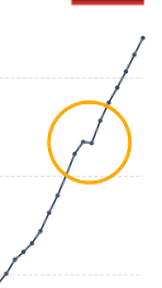
But it was just an episode, and soon the trend continued.
This skyward growth raises certain expectations.
One could expect that citizens of countries experiencing this growth would enjoy its fruits. Their lives should have significantly improved.
“Significantly” means their living standards changed within 1–2 generations. What was once perceived as a luxury would become affordable; what seemed desirable but hard to achieve would become commonplace.
Something similar happened in the second half of the 19th century. Within a few decades, the working day was reduced from 16–14 to 10–8 hours. Social security and trade unions emerged. Workers’ rights, care for the public welfare, and fair distribution of public goods became the focal point of the political agenda. It became the norm of judgment that people should not be subjected to ruthless exploitation and live in poverty.
So, what new life standards could be expected from the unrestrained GDP growth in the Western world? Without insisting on proportional growth of prosperity, one could hope for:
- Eradication of poverty
- The right to education accessible to all strata of society
- Free basic healthcare services
- Guaranteed right of citizens to homeownership
- Reduction of the working day length
Again, let’s remember that we are not talking about utopian fantasies. We are basing our assumptions on the dynamics of GDP growth and the Western public ideology, stating that the highest value is humans.
Defective People
Now, let’s see how many of these expectations have been met.
Has poverty been eradicated?
Not really. Of course, defenders of the current order will argue. They will say that no one in the West dies of hunger anymore.
Yes, that’s true, but poverty is not just malnutrition. Malnutrition means destitution, not poverty. Poverty is the inability to meet one’s material and social needs at a level sufficient to maintain human dignity.
You are poor, not when you can’t afford junk food. You are poor when you feel diminished because you cannot afford the minimum that society promises you as a citizen. You know that society does because it can afford it. But it doesn’t deliver.
They will tell you that it’s not a social problem. That you are either lazy, irresponsible, or stupid, in the words of M. Thatcher — it’s your personality defect.
Really?
Alright then. Maybe I am lazy, irresponsible, or stupid. Maybe I am an idiot, and you are too. But what about the rest? Is the majority of the population in Western countries like that? Are all these people defective?
Or are they not poor?
Then where does this feeling of inferiority come from?
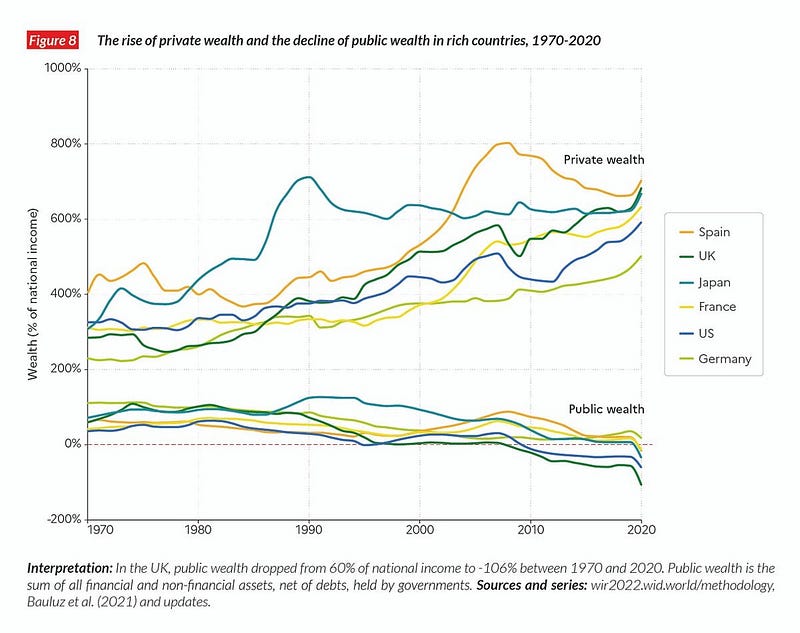
The answer is obvious — from the ever-growing inequality. Western society is increasingly divided into the super-rich and everyone else. And when there are super-rich, everyone else becomes poor.
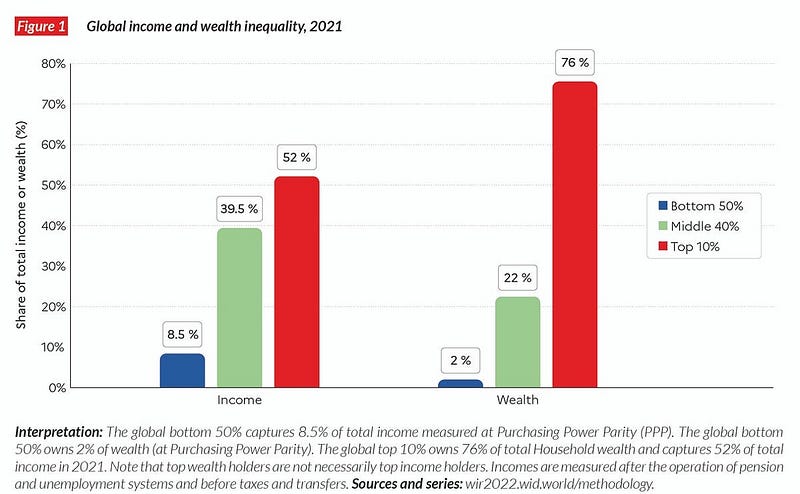
Where did the societal wealth go?
Income Inequality
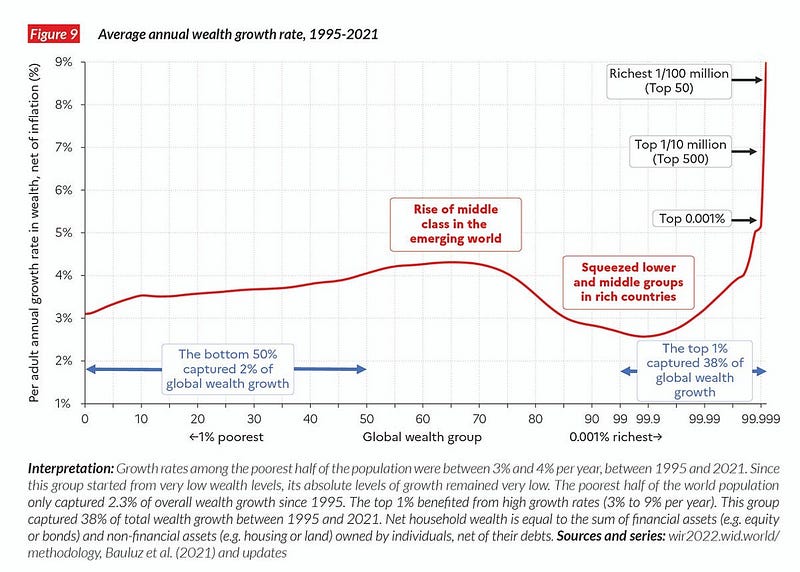
And they are objectively becoming poorer. Look at this graph:
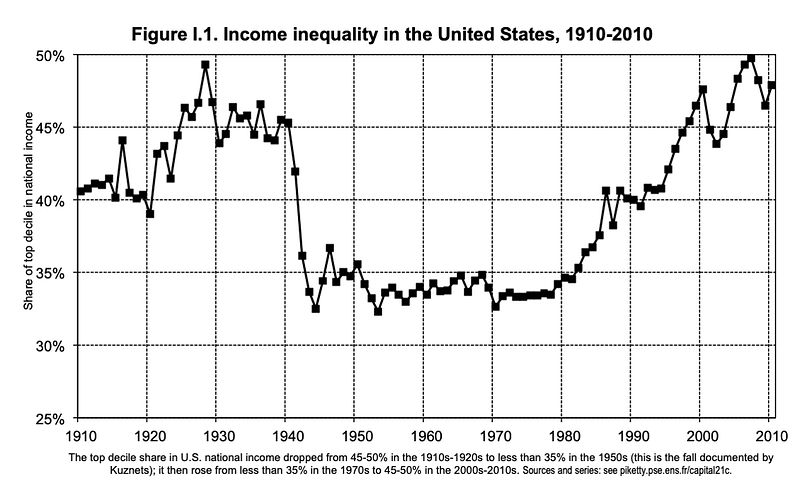
It is interesting for several reasons.
1. The plateau in the middle of the graph corresponds to the period of the so-called “Great Compression,” which lasted from after WW II until the beginning of R. Reagan’s conservative reforms, which ultimately buried the idea of the Great Society. In Europe, the same situation was observed during the Glorious Thirty. It ended with the rise of the conservatives, led by M. Thatcher, to power in the UK. Her policy, now known as “neoliberalism,” was later adopted by all Western countries, including the USA.
2. The periods before and after the Great Compression have surprisingly much in common. They reflect an extreme level of inequality. The first period is known as the “Gilded Age” or “Wild Capitalism,” and the second is neoliberalism.
3. The dynamics on the right side of the graph are also exponential and resemble GDP growth. If you are wondering where the produced growth of societal wealth has gone, there is a clue.
And here is another hint:
How about education?
The situation varies in different Western countries, but with rare exceptions, we cannot speak of education accessibility. Recently, I had to conduct a practical study related to my application for a master’s program. The prices for bachelor’s, master’s, and doctoral degrees shocked me. It is evident that no average-earning individual can afford such costs. I failed to find any university where the tuition fee for one semester was less than $4,000. More often, I came across values ranging from $8,000 to $12,000.
As you know, the student loan debt situation in the United States has become so acute that it has turned into a political problem.
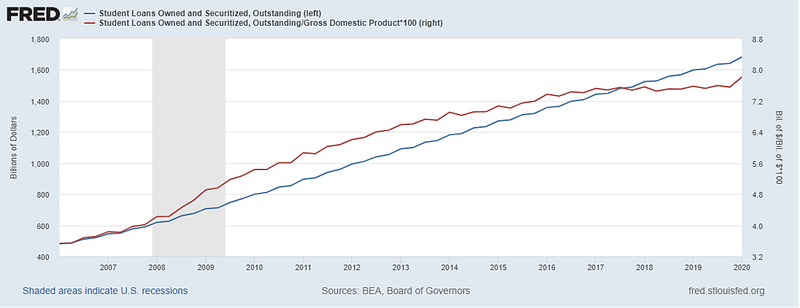
The same question keeps haunting me: Does modern society need educated citizens? If so, why do they have to go into debt for half their lives to obtain an education that benefits not only them personally but also their country? Is this really normal?
Healthcare
The common practice in the Western world is to acquire medical insurance. It works until something extraordinary happens to a person or when they need medical services that insurance companies deny to cover. It doesn’t necessarily have to be something complex like a neurosurgical operation. Even covering dental services can be subject to significant restrictions.
The reason is simple: In commercial healthcare, the goal of both medical and insurance companies is not the patient’s health but profit. Thus, the patient is regarded as a means to achieve business objectives—accordingly, the more sick people, the greater the profit.
This is a universal principle of capitalism. Consequently, there will be no reduction in the number of patients or the cost of medical services soon.
Homeownership
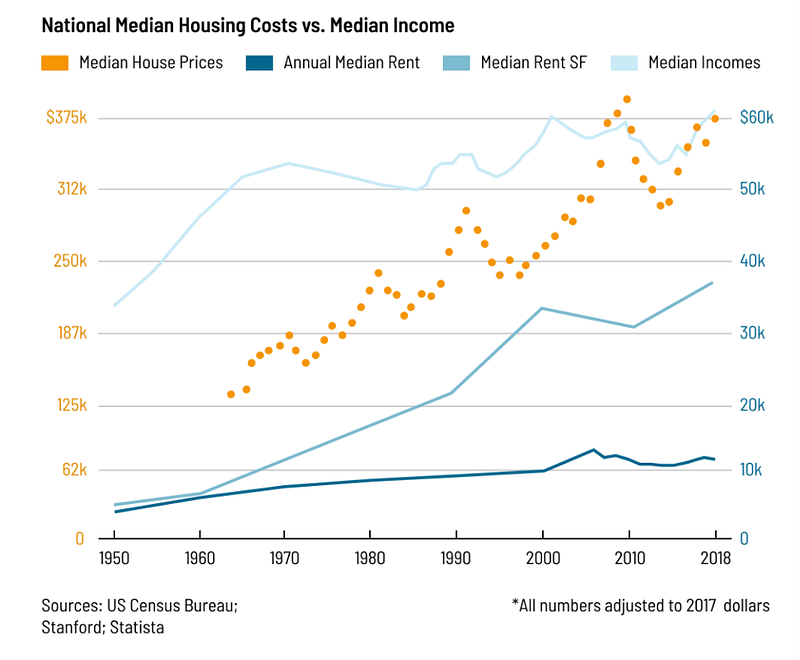
The times when the middle class could afford homeownership are gone. You can only revisit them by watching movies from the 1960s-1970s. After that, housing prices started to rise, significantly outpacing the income levels of the population.
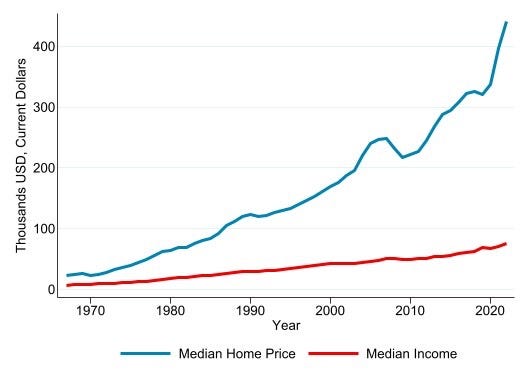
Payment for working hours
One of the main factors contributing to sustainable GDP growth is productivity increase:
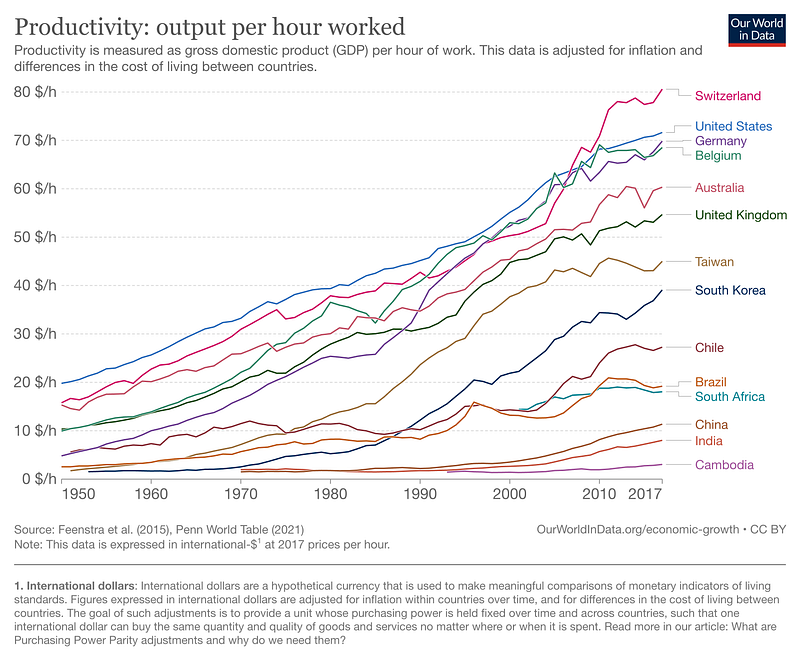
It would be logical to expect this growth to lead to increased payment for working hours or their reduction while maintaining the same wage. As I mentioned earlier, it happened in the second half of the 19th century. However, in the era of neoliberalism, this rule no longer applies.
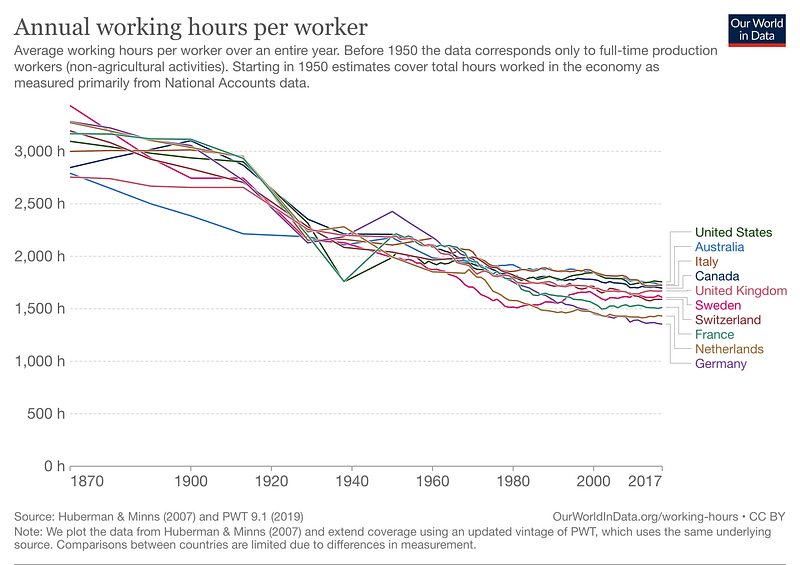
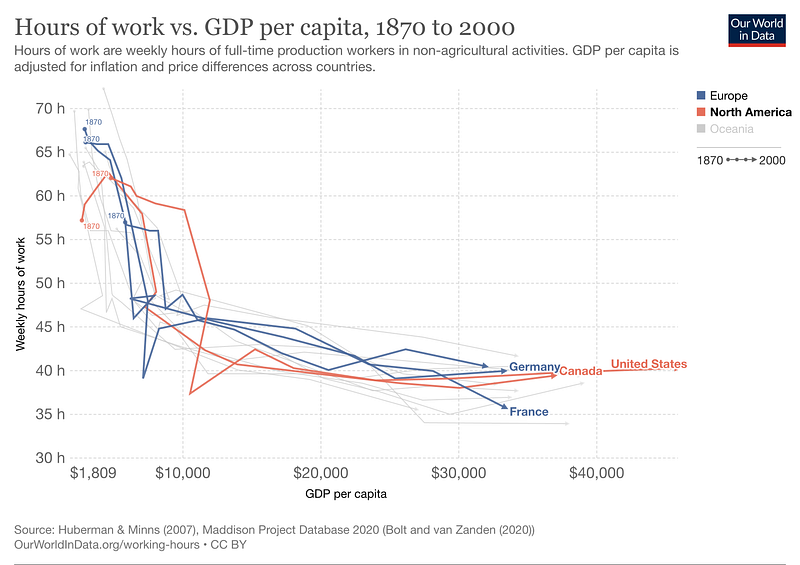
Productivity continues to rise, generating increasing profits for businesses. Still, the length of the working day remains the same, vacation duration doesn’t grow, and wages stagnate.
Normalized pathology
You don’t need to study all these statistics to realize that something went wrong in Western society. But why did that happen?
It is hard to imagine now that life was once different, but it was. Big business was impelled to serve society. Corporate taxes reached up to 90%, trade unions were a powerful political force, and an average family (husband, wife, two children) could sustain itself with just one working spouse, owning a home, paying for their children’s college education, and maintaining a decent standard of living.
I’m not suggesting to impose the abovementioned tax on large businesses or that the trade union movement was not corrupt. I am asserting that the current situation is a normalized pathology.
It became possible due to decades of relentless corporate capitalism encroaching on the foundations of civil society. The reasons for the success of this encroachment are too complex to be explored in a single article (I will continue on this topic in future publications). However, it is crucial to have a revealing understanding of the arguments made by those who defend the policies of the modern anti-societal plutocratic system.
In a struggle for survival
These arguments are based on the myth that society will inevitably prosper if businesses are freed from social obligations. Neoliberals convince people that this will lead to competition among capitalists for consumers, thus allowing people to obtain goods and services of the best quality at the lowest price.
However, the problem is that as soon as the capitalist is relieved of social obligations, they first rid themselves of competitors and then discard the rule of law.
Capitalists hate competition, and their real goal is to eliminate competitors. The struggle for consumers is a forced measure applied until the primary goal is achieved. If a capitalist succeeds in becoming a monopolists, there is no need to fight for consumers anymore. They will use any means to achieve this goal — dumping, discrediting their business rivals, bribery, blackmail, poaching valuable employees — whatever works without repercussions.
Only a naive idealist or a fool would believe that capitalists work for the benefit of society. They are not working in that direction at all. They are engaged in a ruthless fight with each other for existence. In this game, the winner takes all, and the loser disappears into oblivion (Blockbuster, Kodak, Nokia, Compaq, Polaroid, Pan Am, Borders Group, etc.). It’s nothing other than Darwinian natural selection within the business ecosystem.
So why would these bloody predators respect consumer rights, public laws, or other childish nonsense?
Naturally, they will abolish the free market as soon as possible, turning it into a fiefdom of monopolies. This will significantly facilitate collusion between them. As Adam Smith famously put it,
People of the same trade seldom meet together, even for merriment and diversion, but the conversation ends in a conspiracy against the public, or in some contrivance to raise prices…. But though the law cannot hinder people of the same trade from sometimes assembling together, it ought to do nothing to facilitate such assemblies, much less to render them necessary.[1]
Wealth Pump
Naturally, capitalists are astute enough to anticipate societal measures against their actions. Hence, they make a preemptive move by colluding with those in power. In the US, the dominant force of globalized capitalism, this can be achieved through legitimate means like lobbying. When allowed, it ultimately replaces the free market with oligopoly and democracy with plutocracy.
Afterward, capitalists can do whatever they please. And what they want is to take everything into their own hands and extract money from people for anything. Because their sole objective is the infinite accumulation of capital. The modern capitalist system (as Peter Turchin expressed in his latest books) is a wealth pump.
Stopping this mechanism’s operation is impossible. It doesn’t have an “off” button. It will drain everything convertible into money from its environment. Naturally, it has no intention of leaving any resources accessible to anyone else. Seizing and retaining them allows corporate capitalists to effectively eliminate the likelihood of competition and put the well-being of wage earners at the mercy of their loyalty to the corporation.
Fake beliefs
To keep the current pathology normalized, capitalists, with the ruling class’s support, implant two types of false beliefs into citizens’ minds.
The first belief is that the structure of modern society is the only guarantee of freedom, growth, equal opportunities, justice, and respect for human dignity.
The statistics presented earlier prove that all of this is a lie.
Modern society proclaims these goods, but their realization is effectively blocked by the alliance of oligopolistic capital and a corrupt ruling class.
The second belief is that only corporate capitalism can ensure the existence of such a society. Because it allegedly commits to social responsibility and is based on high standards of meritocracy.
Of course, all of this is also a lie.
Capitalism only agrees to bear social responsibility in words. In practice, it seeks to be free from it. It views society as its milking cow rather than a partner.
As for meritocracy, one lie is piled on top of another here.
Meritocracy means appointing management roles to those who can best fulfill assigned duties. But first of all, not all corporate members are genuine meritocrats. Among them, there are enough incompetent and often limited individuals whose function is to follow instructions and require no creative thinking or high skills. They only need to be part of the caste close to the company’s top management. Many have no relation to productive activities and solely perform supervisory functions.
And secondly, meritocracy doesn’t care about any universal values. It doesn’t aim to achieve justice, equality, or public well-being. It simply works for the boss. And when the boss of meritocracy is plutocracy, the skills and talents of the best professionals are used to serve not society but those who care only about wealth and power.
Conclusions
1. The current neoliberal order facilitates the corrupt entwining of monopolistic capitalism and the ruling class. As a result, capitalists appropriate the growth of public wealth generated by the societal infrastructure and the labor of its people.
2. Neither the GDP growth nor the increase in productivity benefits most of the population in Western countries. Their wages, working hours, and social assets remain practically the same as at the beginning of the era of neoliberalism.
3. The living standards of citizens in the Western world gradually decline due to the actual increase (accounting for constant inflation) in the cost of essential social services such as education or healthcare.
4. During the neoliberal age, the relationship between capitalist and societal systems has been redefined. Currently, the former exploits the latter as a resource for enrichment.
5. Corporate capitalism’s commitment to social responsibility serves as an ideological cover to preserve the existing order.
6. The current situation poses a vital threat to democracy and a free society.
Resume: A Different Future
I do not consider capitalism evil if it refers to the right to conduct private business. However, we now have its malignant mutation, discrediting the idea of free entrepreneurship, threatening democracy, and demeaning human dignity.
A free democratic society cannot and should not tolerate the presence of this parasitic organism on its body. This organism exists only because most people are not aware of its true nature and what actions to take against its dominance.
Many do not believe that anything can be changed. However, more and more people realize that things cannot go on like this. Among these individuals are those directly suffering from this system and numerous public figures and politicians. It is noteworthy that more conservatives are joining liberals and centrists. Nowadays, the division of political forces is less about left/right and more about responsible/corrupted.
The fact that even political opponents see society’s subjugation to uncontrolled capitalism as a common problem gives hope. Coming to a shared understanding of what is happening, people can envision a better future than the lifeless neoliberal desert. We must believe in this different future and let others see it.
And then, it will inevitably come.
[1] The Wealth Of Nations, Book IV Chapter VIII, v. ii, p. 660, para. 49.
Related stories:
Dear reader, subscribe to my updates and share your best thoughts on justice and virtue.