How Ping Pong Diplomacy Changed the Course of Cold War
The story of two rival nations becoming allies- the USA and China
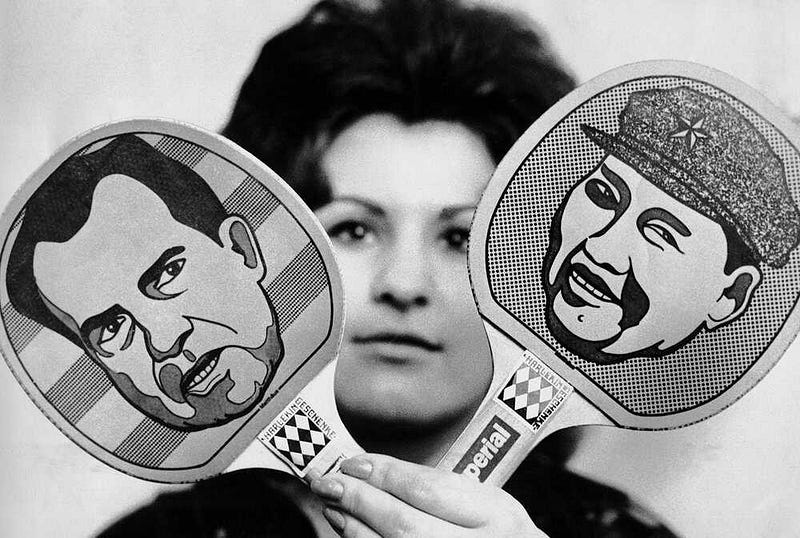
The word ping-pong refers to the sport of table tennis in Asian countries. This is a story and lesson from Pingpong Diplomacy, an important part of cold war history.
The People’s Republic of China, as we know, was formed in 1949 by the Communist Revolution. It was earlier called the Kuomintang Republic of China under the Nationalist party, which later faced a civil war ending with a Communist victory. After the loss, the Nationalist Party fled to the Island of Formosa, also known as Taiwan. It called itself the Republic of China.
For a very long time, both the countries contested with each other on who is the real China. The United States recognised the Republic of China as the real China, mostly opposing the spread of Communism and supporting the democratic govt. in Taiwan.
For a long period, close to twenty years, the Republic of China enjoyed a lot of perks, including the UN Security Council Seat. On the other hand, the People’s Republic of China sided with United Soviet Socialist Republic (USSR) as they were ideologically compatible. That has been the benchmark of Mainland China’s foreign policy. Similarly, China supported USSR in spreading the idea of Communism not only within their borders but also in the neighbourhood. We can see an increased Chinese role in Korea, Vietnam, and Cambodia.
Cold War
Since the end of World War II following the Long telegram from the US Ambassador in Moscow, George Kennan, to President Harry S Truman, which said about the USSR trying to enter into a confrontation with the US-based on Communism vs Capitalism, this was followed by the Berlin blockade and the official start of the cold war. As discussed, China started to side with USSR and officially became part of the Communist bloc.
Then on, we can see Chairman Mao and Joseph Stalin pursue interests that benefit their geopolitical interests and also policies which help them domestically. For a long period of time, Mao tried to emulate Stalin’s way of functioning as the USSR was then the model for Communism. Post WW2, USSR was also performing quite decently compared to the rest of the European countries. Automatically there was a capitalist-communist split. A lot of countries were thus interested in Communism.
The US, after the telegram, was ready to take on USSR. The first step for the same was to constrain countries from taking the help of the USSR for reconstruction after the war and stop them from being part of the communist bloc. Then the US revealed its first weapon- The Truman Doctrine under the leadership of President Harry S Truman, i.e. to provide aid to Greece and Turkey, which were going through a lot of internal issues, and this aid was to help them prevent jumping to USSR for any help.
President Truman later expanded Truman Doctrine to curb Communism anywhere in the world and that was the starting of foreign interventions across the world. This idea was developed after the emergence of the Domino theory, which meant countries would fall one by one into the hands of the communists like a domino of cards. This was followed by the Marshal Plan, which was a massive expenditure by the US to send aid for the reconstruction of Europe and bring it back to the pre-war period. Apart from that, nuclear, space and science were the critical areas of confrontation between the superpowers.
As time passed, USSR and China also worked in their respective domestic politics to strengthen their hold over their respective countries. We shouldn’t forget the role of Soviet Russia in fighting Imperial Japan during World War II and also its involvement in the Communist Revolution in China. In 1950, Mao Zedong and Joseph Stalin signed the Sino-Soviet Treaty of Friendship and Mutual Assistance. This treaty formalised the relations between both Communist countries. In addition, the USSR also pledged $300M military aid to China. But later on, differences within both the models followed by China and USSR started to fall apart.
The Great Leap Forward under Mao, which tried to replicate the Soviet Industrial model, miserably failed. Then came Five Year Plan in China, which again didn't see the needed benefits. After the death of Stalin, the world was waiting to see the new head of the superpower. Nikita Khrushchev took control of the Soviet Union and went ahead with Cold War and almost all the policies of Stalin. But with China, Mao and Nikita didn't share many commonalities. They disagreed on a lot of issues, ideologies and a lot more.
In 1956, Khrushchev focused on the Destalinsation of the USSR, removing the cult personality culture that followed earlier, and tried to mend the relations with China. There appeared a crack in the Communist Eastern European bloc, whether the idea of Destalinsation was good or not. Mao instead decided to continue the Marxist-Leninist policies that Stalin followed.
From 1958 onwards, the relations between the People’s Republic of China and the Union of Soviet Socialist Republic started to deteriorate. The main reason was how China under Mao was failing domestically as well as failing to project its power in the region. At least, it needed to reach some settlement with Taiwan. For this, China started to demand more help from the USSR, including nuclear technology, military aid, armaments, naval ships and much more. This was followed by Chinese provocation in the Taiwan strait, where Mao single-handedly tried to invade Taiwan, failing to reach its objective.
Nikita Khrushchev, alarmed by Chinese provocation, decided not to support China and instead started to follow a stance of peaceful coexistence. USSR believed it should not get into a confrontation with neighbours involving the US, as it had deployed nuclear weapons in Taiwan. With the same, he cancelled the proposal to grant atom bombs to China. This was also when US President Dwight D Eisenhower was focused more on nuclear weapons and reducing tensions with the USSR. The best decision for USSR was not to interfere.
Mao, on the other hand, wasn’t happy with Khurschev’s policies on tackling the US. He wanted USSR to be more aggressive in day-to-day affairs. The interpretations of Marxism were one of the areas of contentions.
Read about the Cuban Missile Crisis
During the Cuban Missile Crisis, as Nikita Khrushchev had to remove missiles from Cuba, it was actually his point of humiliation. Mao also took it as a humiliation for the entire Soviet Bloc, and he wanted USSR to confront the USA, maybe even in a direct war. This was, for Mao, a red line. Mao’s China severed ties with USSR. Khrushchev hit back, saying that China’s policies are nuclear escalation in East Asia.
Post the Cuban Missile Crisis, we can witness the Partial Test Ban Treaty emerging from negotiations on both sides, which would limit the testing of nuclear weapons on air, water and space except for underground testing. For the PRC, it was a big hit as their nuclear programme was in an infant stage, the Soviets didn’t help them, and for them, Treaty was for containing their atomic expansion. Mao unveiled Three World Theory, for he put both US and USSR in the first world, and he believed that First World was trying to control the rest of the two worlds.
Both PRC and USSR tried to path up the relations between both countries in Bucharest Negotiations in Romania, but they never saw the desired results. In the 1963–64 period, both countries’ parties came head to head, and their relations broke down. In 1969, a significant confrontation emerged between both on their border called the Sino-Soviet border conflict. Now there was a massive division in the Communist bloc.
The relations between PRC and US were never a great chapter at the start of the cold war. Ever since the formation of Communist China, the US has maintained its embassy in Taipei, Taiwan. Consular officials, though, were present on the mainland. US and China, as mentioned, were indirectly fighting each other in several East Asian countries- Korea and Vietnam.
The US even though had extreme enmity with USSR, there were a lot of areas where both countries could work out as well as negotiate. Most Arms Control agreements came up in that way. Even after the Cuban Missile Crisis, the de-escalation of conflict led to the detente period, where both superpowers engaged more. Leaders of both countries were willing to do that, unlike Mao.
US-China Relations Shift
On the other side, Kennedy and Johnson believed that China was more dangerous than USSR; hence it was better not to engage them was the line followed. This idea mainly came up from Vietnam War, where China was supporting the North and US was supporting the South. This made China completely untouchable at the International level. China had also invaded India in 1962 and captured some territory.
The change came only in 1968 when Richard Nixon was contesting the US Presidential Election, and he initiated Triangular diplomacy where he promised to engage with both Moscow and Beijing, the archrivals in addition to Vietnam. The Vietnam war was then at its peak, and at the same time, the US wanted to take advantage of the Communist rift.
The US under Nixon and Kissinger thought that having China on board was the best to counter the Soviets that too by a country on its borders. Once close partners are now enemies and the right time for the US to start breaking the ice with China. We also need to remember the fact the US was going into a Balance of Payments Deficit with its allies; maybe it needed more allies.
Ping Pong Diplomacy
The year 1971 had World Table Tennis Championship in Nagoya, Japan, and both the US and Chinese teams were present at the venue to participate in the competition. Glenn Cowan of the U.S. team and Zhuang Zedong of the Chinese team met, and that grabbed the eyes of the world community. Chinese welcomed Glenn to their bus as he had missed his. This incident was followed by an invitation from the Chinese for the US team to come to China.
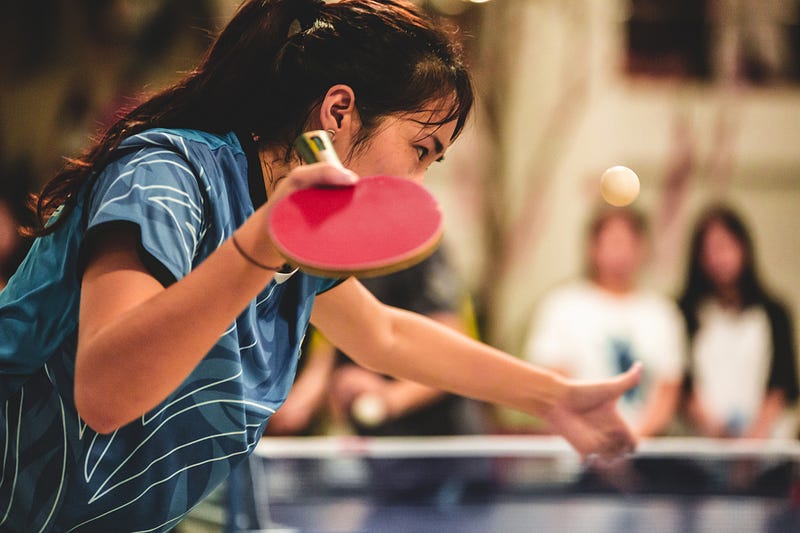
The US gladly accepted the invitation and sent an eleven membered delegation. The team first left for Hong Kong and then crossed into China. They were given a grand welcome and played a couple of friendly matches. They also had the opportunity to visit various landmarks, including The Great Wall of China, Forbidden City, etc. Their photograph also came up in Time Magazine.
Many things happened during this trip, including cultural exchange, hospitality, sports, Chinese propaganda etc. The entire plan in the US was put forward and strategised by Secretary of State Henry Kissinger, a well-known Foreign Policy and International Relations expert. Everything was part of the more significant Nixon Doctrine to move beyond ideology and form relations even with adversaries, what we know as Realpolitik. Interests matter more than ideology.
All of this wasn’t known clearly to the public and happened via the backchannel. The contact between Washington and Beijing went through Islamabad. Pakistan was then a strong ally of the United States. After Ping Pong diplomacy, Henry Kissinger also made a secret visit to Beijing from Pakistan. Issues like Taiwan and Vietnam were also part of the discussion.
Similarly, in 1972, the Chinese team received a reciprocal invitation to the US for Table Tennis Competition. They visited Long Island, Disneyland, Hollywood, and Memphis in addition to a friendly match. Also, Kissinger made his second visit to China, followed by President Nixon. President visited Great Wall, Shanghai, and Hangzhou, in addition to the capital Beijing and met with Chairman Mao.
Aftermath
In 1973, after Nixon's resignation after the Watergate Scandal, the improvement of relations with China slowed but moved consistently. With the advancement in US-China relations, Japan-China relations became better with a joint communique being released. The US now recognised PRC or Communist China as the real China. This downgraded US relations with Taiwan. The embargo on China was also lifted.
China now got the UN Security Council Permanent Seat after Taiwan was removed. With the death of Chairman Mao and the elevation of Den Xiaoping, he brought in tons of reforms, namely the Liberalisation of China, that brought China on the world economic map. China never had to look back then. Till the end of the Cold war and even till China’s entry into WTO, US-China relations prospered.
Relevance to the Present and Lessons Learnt
Amidst the cold war, Nixon was bold enough to start a new chapter in US diplomacy. He wanted to mend relations when his predecessors tried to continue the normal cold war politics of escalating tensions. Whether it worked or not is different, but the idea of Realpolitik came up and is still relevant today. The US woke up to the reality that China is a potential ally.
Ping Pong diplomacy paved way for the Rise of China as we see it today. Once an adversary, then an ally and once again the rivalry for global supremacy; the US has played its cards on China and now it's facing a new challenge. Maybe the world needs another Ping Pong to settle everything between both the countries.
In less than 30 years, from being a failed communist country under Mao, China became the primary rival to the US on Economy, Technology and Military. Will China beat the US in its own game or will the US partner with more allies to counter China; it is yet to be seen. Already US involvement in the Asia-Pacific has been to contain China. Unlike during the cold war, there are no specific allies of China which pose any threat to the US.
Post Invasion of Ukraine, Russia is getting weaker and China is vigilant not to make any mistakes. It is an undeniable fact that the biggest beneficiary of globalisation, free trade and a market-based economy has been China. No way, China would like to decouple itself from the rest of the world.
The recent invasion of Ukraine by Russia is a grave violation of International Law and the distortion of the post-WW2 world order. In this situation, we must rewind to the days of the cold war, when both countries exercised maximum restraint, namely the Cuban Missile Crisis. The leaders were sharp and had an incredible presence of mind which helped them avert conflicts and raise a helping hand.
Future of US-China Relations
It is one of the most looked after diplomatic relations in the world, perhaps after the breakup of the USSR. Both countries despite high tensions had strong diplomatic frameworks. The end of the 2000s saw a peaceful Rise in China and since the early 2010s, US policy started to shift to a containment strategy. Since the pandemic, China is the new adversary of the US and a lot of new initiatives have come up like the Quad which is aimed at cooperating with Allies against China.
Experts believe we are about to see a new cold war between US and China. Who will have the upper hand? Who will triumph in the end? are essential questions we will see in the coming months and years.
GPS- An area of Contention
Conclusion
International Relations has been a dynamic field, tactics and strategies keep changing, but fundamentals remain. We must try to learn the best and try to work for a better future. Post-cold war we have understood that war benefits none while peace benefits all unless you make money in the war. All the countries should strive to have good relations with all the other nations and hence it will not only be mutually beneficial but also improve the lives of people. Why should people suffer just because two countries are at odds?
Key to Abbreviations
US- United States of America PRC- People’s Republic of China ROC- Republic of China/Taiwan USSR- United Soviet Socialist Republic UN- United Nations WW- World War WTO- World Trade Organisation
References
- The Myths and Realities of Ping-Pong Diplomacy. (n.d.). History Today. https://www.historytoday.com/miscellanies/myths-and-realities-ping-pong-diplomacy
- N. (2022, February 1). Ping Pong Diplomacy: Artifacts from the Historic 1971 U.S. Table Tennis Trip to China — National Museum of. National Museum of American Diplomacy. https://diplomacy.state.gov/artifact-collection-highlights/ping-pong-diplomacy-historic-1971-u-s-table-tennis-trip-to-china/
- Revisiting Kissinger’s Secret Trip to Beijing | US-China Institute. (n.d.). USC Annenberg. https://china.usc.edu/revisiting-kissingers-secret-trip-beijing
- Team, T. (2021, August 11). Henry Kissinger’s secret visit in 1971 contributed to China’s economic rise, experts say. ThePrint. https://theprint.in/softcover/henry-kissingers-secret-visit-in-1971-contributed-to-chinas-economic-rise-experts-say/710462/
- Wikipedia contributors. (2022, June 8). 1972 visit by Richard Nixon to China. Wikipedia. https://en.wikipedia.org/wiki/1972_visit_by_Richard_Nixon_to_China#:%7E:text=government%20of%20China.-,Readiness,strong%20diplomatic%20channels%20with%20China.
- Wikipedia contributors. (2022b, June 17). China–United States relations. Wikipedia. https://en.wikipedia.org/wiki/China%E2%80%93United_States_relations#:%7E:text=Currently%2C%20the%20United%20States%20and,and%20human%20rights%20in%20China.
- Wikipedia contributors. (2022a, April 4). Ping-pong diplomacy. Wikipedia. https://en.wikipedia.org/wiki/Ping-pong_diplomacy
Join Medium through my referral link, which will give you access to tons of articles.
