How Our Healthy Longing for Awe Gets Exploited by the Truly Awful
There’s a difference between awe and excitement. These days, we mostly get the latter.

Once we dispense with shame, we are liberated to experience the full, sacred, unlikely wackiness of being human. We are confident enough to leave the safety of the private computer simulation and jump into the wet chaos of social intimacy. Instead of marveling at the granularity of a VR world or the realism of a robot’s facial expression, we open our senses to the taste of the breeze or the touch of a lover.
We exchange the vertigo of the uncanny valley for the exhilaration of awe.
The state of awe may be the pinnacle of human experience. It’s what lies beyond the paradox. If humans’ unique job in nature is to be conscious, what more human thing can we do than blow our observing minds? Beholding the panoramic view from a mountaintop, witnessing the birth of a child, staring into a starry sky, or standing with thousands of others in a march or celebration, all dissolve the sense of self as separate and distinct. We experience ourselves as both the observing eye and the whole of which we are a part. It’s an impossible concept, yet an undeniable experience of power and passivity, awareness and acceptance.
Psychologists tell us that the experience of awe can counteract self-focus, stress, apathy, and detachment. Awe helps people act with an increased sense of meaning and purpose, turning our attention away from the self and toward our collective self-interest. Awe even regulates the cytokine response and reduces inflammation. New experiments have revealed that after just a few moments of awe, people behave with increased altruism, cooperation, and self-sacrifice. The evidence suggests that awe makes people feel like part of something larger than themselves, which, in turn, makes them less narcissistic and more attuned to the needs of those around them.
Unfortunately, opportunities to experience awe in modern society are becoming more scarce. People spend less time camping or in nature, the night sky is polluted with light, and participation in the arts and culture is down. Art and outdoors classes in public schools have been jettisoned in favor of those that prepare students for the standardized tests on which schools are judged. There are no easy metrics for awe.
Like any extreme state of being, awe can also be exploited. Movies use special effects and giant spectacle scenes to leverage awe at specific moments in a story arc. Dictators hold huge rallies to exhilarate their followers while avoiding any reasoned debate. Even shopping malls attempt to generate a sense of awe with high ceilings and giant fountains. For a moment, awe overwhelms the senses and wipes the mind clean, making it more open to new input. This helps a person take in new information but also makes them more vulnerable to manipulation. And once burned by someone manipulating awe, we are twice shy to open ourselves to it again. We become jaded and cynical as a defense against being wonderstruck.
Still, just because awe can be abused doesn’t mean we should give up on its humanizing potential. There is a difference between real awe and manipulated excitement — between staring out onto the expanse of the Grand Canyon and standing in a sea of true believers at a nationalist rally. The manufactured brand of awe doesn’t unify; it divides us into individual consumers or followers. We become fragmented, each imagining our own relationship to Dear Leader. True awe comes with no agenda. It’s not directed toward some end or plan or person; there’s no time limit or foe to vanquish. There is no “other.”
True awe is timeless, limitless, and without division. It suggests there is a unifying whole to which we all belong — if only we could hold onto that awareness.
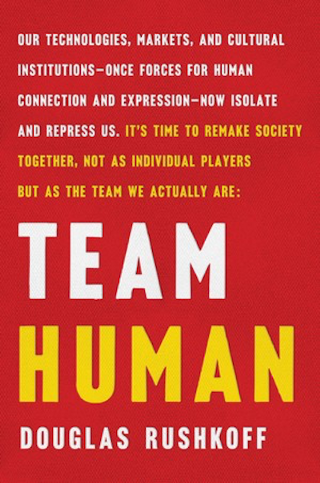
This was section 66 of the new book Team Human by Douglas Rushkoff, which is being serialized weekly on Medium. Read the previous section here and the following section here.