
How Our Desire To Explore Space Could Seal Us on Earth
Here is what we can do about it
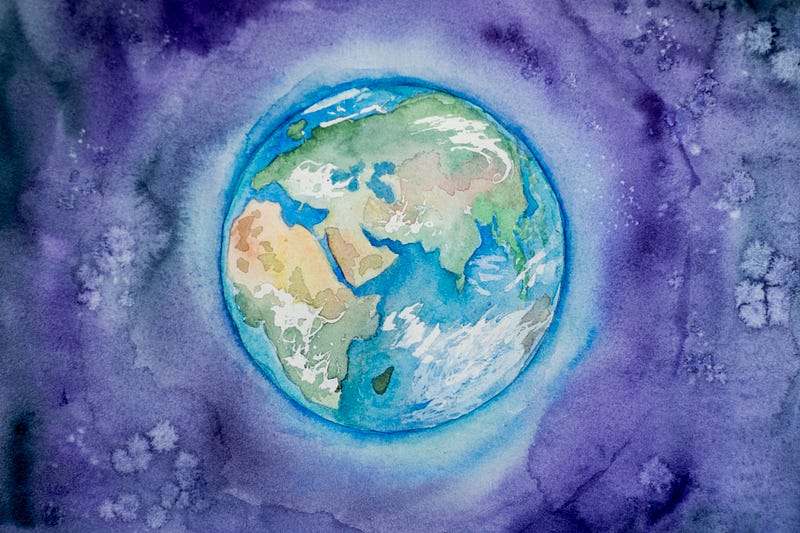
As a civil engineer, I am among the camp that believes climate change is real. During my environmental engineering lectures, I had the chance to learn and read about the impacts of our activities on the earth and I know that there are some people that don’t believe in the reality of climate change but that doesn’t mean it isn’t happening.
I am also a curious person just like so many people out there. My curiosity led me to develop an interest in learning about space and how far humanity has advanced in our space exploration efforts.
Since 1957 when Russia first launched a satellite in space, we have come a long way in terms of what we’ve been able to achieve in that field. (I write as if I’m part of it lol…)
But there is a zone that spans from about 160kms to 1000kms from the earth and that zone is called the low earth orbit. To understand why some people like me are worried about potentially being sealed on earth and the dangers of that, we have to first talk about what this zone is and what's happening there.
The Low Earth Orbit (LEO)
As already mentioned, the low earth orbit is the zone that spans from about 160kms to 1000kms from the earth where the gravitational pull of the earth still acts but just enough to keep objects in it spinning around the earth.
The objects in the very low end of the LEO zone can also gradually fall back to earth when the gravitational force pulls them or when they encounter friction but they often just burn up on re-entry into the earth’s atmosphere which we can sometimes see as shooting stars.
This zone is where governments and companies send most of the satellites that help us with things like GPS, internet, weather forecasts, and so on. This is great because it has made our lives easier as you know how all these technologies have changed our lives.
The Problem
Unlike satellites in the GEO zone that must always orbit along Earth’s equator, satellites in LEO do not have to follow any path. They can follow any path they want. For a satellite to stay in this zone, however, it has to move at a speed of about 28000kph. That's 8km per second. That's really fast. That's 10 times faster than the speed of an average bullet which helps these satellites circle the earth 16 times per day.
To put it simply, when an object in space is moving at this extremely high speed, it has a lot of kinetic energy so much so that even if it is as small as a needle, it can cause significant damage when it collides with any object.
Satellites too move at that speed but they are significantly much bigger(like school-bus-size kind bigger)increasing their chances of collision and damage when they do so.
When they collide with other satellites like they sometimes do, they disintegrate into several parts and tiny particles which also then move on their own with these terrific speeds.
There is also another problem, satellites that are decommissioned, or those that stop working are not always removed and many are left there because it is simply economical to do so.
So when you combine all those factors, you have a situation of a lot of space junk moving at really high speeds in the low earth orbit together with functioning satellites.
The Impact
As of 2021, there are about 6500 satellites in space, and 3,170 are inactive — aka space junk.
Of all the satellites in space, there is little to no oversight about the space traffic as well which increases the chances of having accidents that create more space junk that no one is willing to clean up. It is also estimated that there are millions of pieces of junk floating in the low earth orbit at these ridiculous speeds.
Companies and governments can launch one rocket with hundreds of satellites at a time and they do this multiple times a year. With the space rush in which many people and countries are making sure they don’t miss out on the action, there is a chance we will have a lot more, like tens of thousands or hundreds of thousands of satellites before the end of the decade.
If things remain with little to no oversight on space practices of countries and governments, and companies, then we will definitely have a lot more accidents and possibly billions or trillions of space junk
The Dangers of Space Junk
Space junk can interrupt the normal functions of the operational satellites when accidents occur although this isn’t the only problem.
Space junk can also create a space border which can pose a real navigational problem up there if even a tiny piece can cause so much damage. This will definitely increase the things we have to worry about in our space exploration efforts and cost us even more to achieve less.
The Kessler Syndrome may become real. This is a scenario in which a NASA scientist called Donald Kessler predicted that there may come a time when space around the earth is full of satellites and debris that will be unmanageable resulting in so many collisions and causing a chain reaction which would render many orbits out of use for several generations.
There is also another issue of unforeseen challenges and disasters that space junk may create to our earth’s environment while at the same time trapping us here with nowhere else to go. I for one don’t think there is zero price to pay for having a blanket of debris floating just above our atmosphere. — I can’t imagine earth processes just ignoring that reality.
What We Can Do About It
There is a lot to be done. It is an exclusive industry because the price to play is really high. But more and more people are getting involved and with this, it is hard to assume that these people will maintain healthy business practices when they have competitions to beat in an industry with almost no oversight.
Cleaning Efforts
We can all put measures on how to better manage the traffic but there is an inevitable activity we have to do and that is finding a way to remove satellites and junk that no longer have any reason to be there.
There are agencies out there who are currently trying to remove the junk but this is an area that needs more investment so that those efforts to clean space match or exceed the rate at which satellites are being put there.
Space Traffic Management
We have invested a lot in making air traffic really efficient because there are so many people’s lives directly involved and it has significantly reduced the accidents. Space traffic should also follow. Companies that are currently managing their traffic up there are doing so only because they want to avoid collisions and maximize their profits.
But this leaves a question as to what happens when there are no profits to be sought after. Look at research satellites that may not have investors to impress. There should be a system to manage the traffic properly regardless of whether there are profits to be made or not.
International Cooperation
Countries like China are in the process of building their own space stations. Many countries are trying to do their own thing. So are businesses and private individuals. Doing this in a highly unregulated industry creating unhealthy competition which will suffocate the efforts to organize and clean up space.
Without cooperation, we can’t achieve much and we risk causing more damage and further delays to our space exploration progress.
Conclusion
The space exploration industry has contributed so much to the advancement of human technology and its capacity has not been reached.
With a healthier interaction with our low earth orbit, we can do so much more in terms of the advancement of human civilization while also keeping our earth’s systems functioning properly.
I was inspired by Jonny Harris to read and write more about this in hopes of raising awareness of this issue. He made an amazing video that explores this topic and I would advise you to go watch it if you want a visual explanation of what I was talking about.


