
How One Man Decided To Save His City Following A Tragedy
The extraordinary contributions of a selfless man to saving thousands of lives.

Gangadhara Tilak Katnam saw a bus hit an auto-rickshaw from behind killing an innocent life. He understood that it was due to the unrepaired pothole. Someone’s life may have been saved if the pothole had been repaired.
Filling potholes in the metropolitan city of Hyderabad, India became his mission statement. Gangadhara Tilak Katnam, a 70-year-old is making all the differences that a government should do. He worked as a senior section engineer for Southern Railways. He was born into a farmer’s family in the West Godavari district hamlet of Yernagudem. He visits the United States on occasion to spend time with his son Ravikiran and his family. His daughter, Sarala, resides in Hyderabad.
Once he was driving to an office where he was working as a software consultant post-retirement, he drenched some school children. He felt bad for them. Hence, he decided to complain to the concerned authorities but it was all in vain. It was at this moment Katnam had decided to fill the pothole all by himself with his own money. This was followed by many such instances.
When Ravikiran went to see his father, he realised that his father’s desire to help people had become an obsession. He then assisted his father by developing a website and a Facebook page called “Shramadaan,” which includes a hotline for people to contact and report potholes in various locations.
Shramadaan has become a full-fledged non-governmental organization.
“Hole-by-hole, road-by-road, we will make a difference!” — Mission statement for Shramaddan.
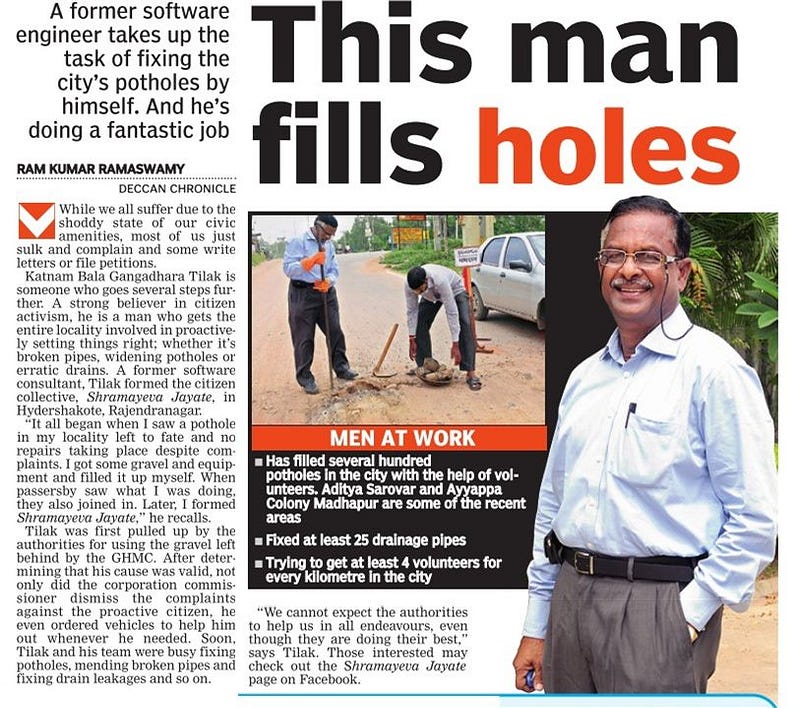
Katnam is also known as the “Pothole Doctor.” His work has also been recognised in Japan, Germany, Pakistan, Bangladesh, Belgium, Vietnam, and at a road safety symposium in London. People from many walks of life have volunteered to aid him. His photo and information about his work have featured in two calendars, and he has given a TED Talk in Mumbai.
He has made a lot of sacrifices as well. He spends 75% of his pension amount on filling the holes. But he decided not to take donations from people.
“There are thousands of NGOs who have been accused of misusing funds raised. I believe I must do what I can with friends and relatives. We need intention and not power or money to do what is necessary. I have intention and a will to deliver, and that I am doing.”
— Katnam on his stance on not taking donations
Today, Katnam’s car always has a couple gunny bags full of tar and gravel, mainly obtained from roadside ditches, in the backseat. When he can’t locate discarded gravel beside the road, he buys it from contractors out of his own cash.
He has inspired many individuals in India’s other big cities, including Mumbai and Bangalore. Katnam’s tale exemplifies how, with the right motivation, one man can move mountains.
References:
- ‘Ramp’ man: ‘Doctor of Roads’, who drives around fixing potholes
- The man who uses his pension fund to fill potholes
- This Retired Railway Employee has used his Pension to fill more than 1100 Potholes in Hyderabad
If you liked reading this, then you might also find the below stories worth your time.


