
How Not to Get Crushed by the Elephant in the Room
Hint: Call it out. When it’s still a baby

It’s 9:00 on a typical Monday morning.
You, VP of the product division, are heading towards the meeting room on the 5th floor filled with the leaders of your organization. This is your bi-weekly leadership staff meeting, and the goal of this meeting is to review the progress of the business, highlight key issues, and make decisions that can help the organization move towards the goals.
As you head to open the room door, you can hear a loud buzz permeating from inside — it’s not loud enough for you to tell what the topic is. Probably just the usual small talk — the weather, the weekend, or a bunch of equally insignificant topics.
So you think.
As you open the door to enter, the buzz disappears suddenly — as if a pause button was pressed on the ongoing conversations, in the middle of the sentences.
You make your move to your usual position across the table, and you can feel dozens of pairs of eyes watching as you do that.
9.05 am.
You call the first item in the agenda, which is to review progress and hear updates from each of the leaders. Each of the leaders take turns to share updates from their respective teams and sub-groups — what progress was made, what the teams are focused on for the coming quarter. The usual grind.
9.55 am.
With 5 minutes remaining, you ask the question: “Any hot topics that we need to discuss today? Any impediments that we need to be aware of?”
Silence. You look around the room, and you see blank faces. Eyes that are avoiding contact. Half-hearted head shakes.
“Okay, sounds great. I’ll see you all again in 2 weeks.”
You walk out of the room, and as you exit the doors the familiar “buzz” picks up again. Apparently the resume button was clicked. Probably the usual small talk — the weather, the weekend, …
So you think.
Harboring Elephants in the Room
The story I’ve shared above, albeit exaggerated, is not uncommon. In fact, I’ve witnessed similar situations in the past. I’m sure many of you would have as well.
But this begs the question: so what?
The story above illustrates a culture, a situation, an environment that might appear to be normal, but is in fact far from it. I argue that there are one or more elephants in the room, who are not just being ignored, but simultaneously being nurtured, and they’re growing with every passing moment.
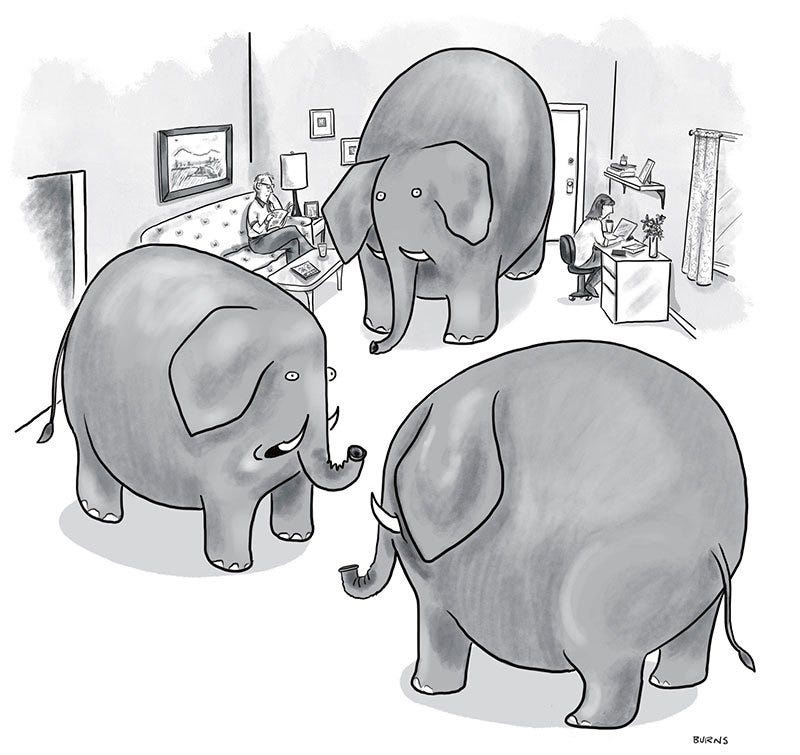
What’s with the elephants?
Side note: When my 7 year old heard me talking about elephants in the room, he reminded me of the children’s puzzle which asks about how you would put an elephant in the fridge. The solution to that puzzle is: you open the door, empty the fridge, put the elephant in the fridge, and close the door. Simple.
Having an elephant in the room is a metaphorical expression that refers to a significant issue or problem that everyone is aware of but chooses to ignore or avoid discussing. If you entered a room that had an elephant, would you not see it? Of course you would. The elephant is a symbol of the problem that is significant, easy to observe, yet everyone chooses to ignore it or not talk about it.
Identifying the Elephants in the Room
Okay, we can see literal elephants in the room. But how do we find the metaphorical ones? Here are 2 telltale signs that suggest there might be an “elephant in the room”:
#1. Unaddressed tension and nonverbal cues
There is an evident undercurrent of tension or discomfort in the atmosphere, but no one is openly acknowledging it. Observing people’s body language can reveal signs of discomfort or unease. Fidgeting, nervous glances, crossed arms, or avoiding eye contact are all potential indicators that people are aware of the elephant but are choosing not to acknowledge it openly. People may even engage in passive-aggressive behavior.
In the story above, you can feel that tension as you walk into the room, as the buzzing falls off suddenly. You can feel the tension through the body language and visual cues, such as avoidance of eye contact, hopeless shrugs or half-hearted head shakes.
#2. Avoidance of a particular topic
There is a specific subject or issue that people actively avoid discussing, even when it would be expected or relevant to the conversation. It’s as if there’s an unspoken agreement to steer clear of that topic altogether.
In the story above, when you invited your leadership team to call out any important blockers or topics, nobody did. All you got was silence, or at best half-hearted head shakes. Those are clear signs that your team is avoiding a particular topic.
Conclusion: Become an Elephant Spotter
“When there’s an elephant in the room, introduce him.” ~ Randy Pausch
As a leader, what steps can you take in order to avoid harboring elephants? The one that I’ve found most useful is to introduce the elephant while it’s still a baby. It’s hard to miss the elephant once it’s been called out. This can be done by anybody in the meeting, but I think the boss should take the lead in this case — that demonstrates willingness to discuss the issue, and makes the rest of the team comfortable talking about it. If someone else brings it up instead, the boss should immediately add in a vote of support to discuss the topic.
You may have read or heard the story of Pinocchio when you were young, or watched one of the films based on his story.
Pinocchio’s nose would grow with every lie he would say.
Similarly, the elephant in the room grows larger with time, and the more you avoid him, the larger he grows. The only way to make the elephant shrink or disappear is to introduce him. And do it early, as you don’t want to be crushed by an oversized elephant!
So, have you been in meetings which had elephants in the room? Share your stories and suggestions for dealing with those situations in the comments below!
Like my writing?
If you liked this post, I would appreciate some claps👏 as a form of encouragement. Thank you!
To read similar content you can follow me (Gaurav Jain) and subscribe to get these posts delivered directly to your Inbox. Check out my profile for other ways to connect with me.
Feedback is a gift! I would love to hear your thoughts and suggestions in the comments below 🙏