
How Not to Die
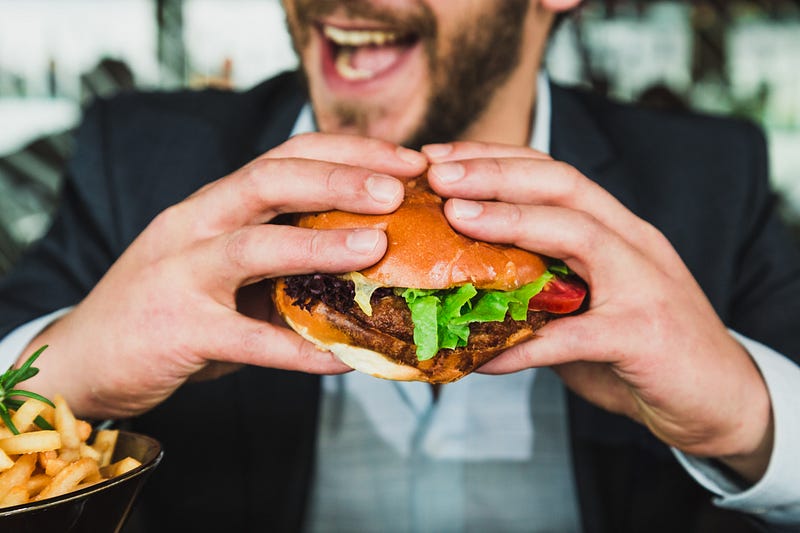
I climbed on the scale and, just like Homer Simpson, I saw an “E” for error appear between my big toes.
I stepped off, reset the scale, and tried again. This time it read 331 pounds. I soon consulted a body mass index calculator which recommended that I either lose 166 pounds or become 8-foot-4.
When I was a lean teenager who played baseball and did 250 push-ups a day, frozen pizzas, sandwich cookies, and fried chicken were mainstays of my diet.
As I neared 40, I watched baseball, never did push-ups, and frozen pizzas, sandwich cookies, and fried chicken continued to be mainstays in my diet.
Having durable genetics, the garbage I ate never registered in my yearly blood work until this year.
I visited my doctor for my free check-up (thanks, Obama) and a couple days later she sent me a letter saying my cholesterol had ventured into the high range. The printout said under 200 was healthy and mine was at 218.
With hopes of living to see the parade at America’s tricentennial, and with the resiliency of youth starting to fade, I realized I needed to make some changes.
I also have lower back pain. My doctor prescribed me some gigantic ibuprofen and muscle relaxers I take daily, but she said the best remedy for the pain would be losing weight.
Off To the Bookstore
I’d heard a story on NPR praising the Mediterranean diet as the world’s healthiest and was searching the diet section at Barnes & Noble for a how to that didn’t involve complicated recipes.
Instead, I found a different how to. Or I should say, how not to.
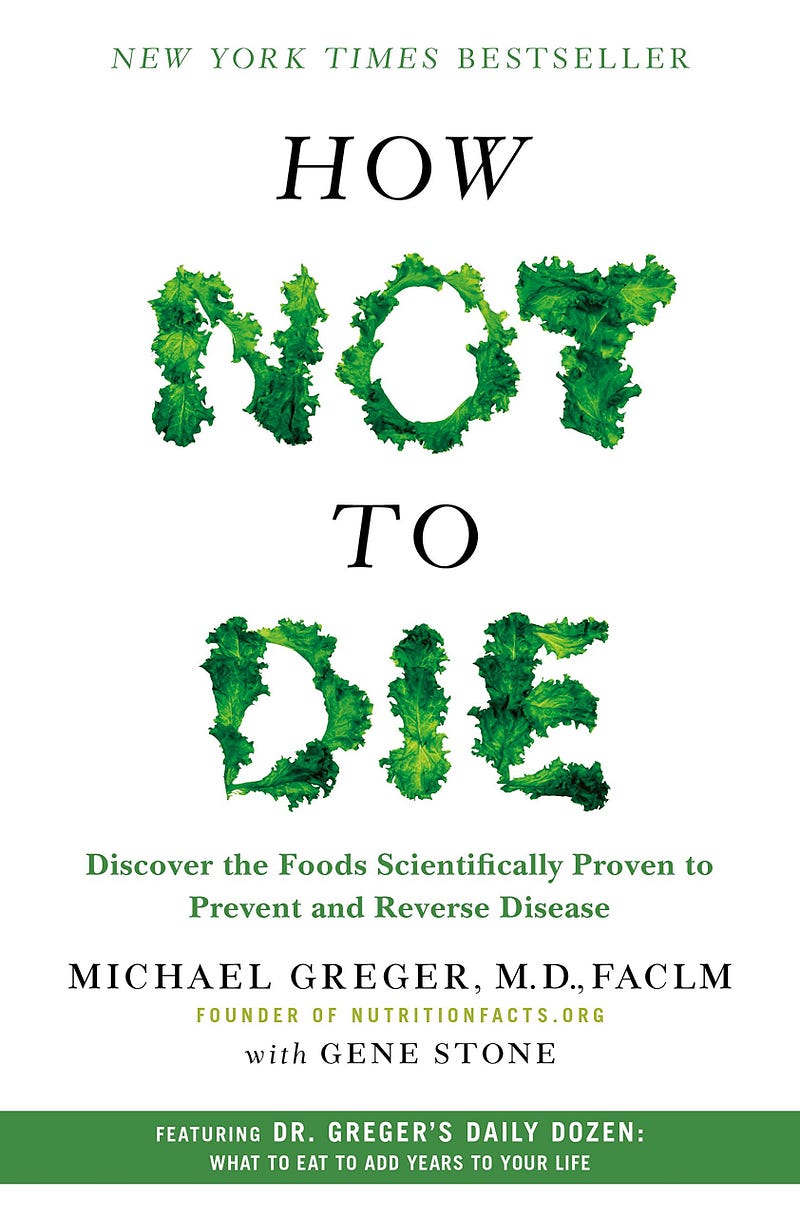
Not dying sounded like something I’d like to know how to do, so I took Dr. Greger’s book to the counter, along with a book of Garrison-Keillor-approved poems and a paperback novelization of a Star Trek the Next Generation episode.
The first chapter alone is pretty convincing.
Greger’s stated idea in the book is to take a new approach. Instead of choosing a diet (Mediterranean, Atkins, Keto, etc.) and then setting out to defend it against any competitors and detractors, why not start at the beginning and build a diet based on study results alone.
As a 331-pound guy on the outside looking in, the oddly fit did seem to break into separate religious denominations, so this approach made sense to me.
As gimmicks go, a diet built on study results is a good one. It’s an orthodoxy that does not resist change, but operates in anticipation of improvement as research is continuously conducted.
Chapter 1
The author opens with the story of his ailing 65-year-old grandmother who was told that medical science could do nothing more to repair her heart. Death, she was told, awaited her in the weeks ahead.
She lived on for 31 years thanks to a doctor who had the idea that a healthy diet could reverse heart disease.
The core of the idea is to stop damaging the body long enough for it to heal itself.
Greger, soon a bright-eyed medical student, discovered that in spite of a tremendous amount of evidence supporting the paramount importance of diet, doctors were barely trained in nutrition.
As the book explains in detail, pharmaceutical companies can’t make money from blueberries, and doctors can’t get bonuses from pharmaceutical companies by prescribing them.
If your Spidey sense is buzzing, don’t worry. We are not headed down an anti-science path toward ancient elixirs and healing crystals.
The good doctor applauds the many seemingly miraculous, life-saving procedures and medications that medical science has created.
He is merely sounding the alarm on a mostly neglected aspect of health — diet. Though there are countless books and videos on the subject, it is neglected by the group of professionals who should be in the lead — doctors.
In a pre-Star Trek society like our own, money is our invented motivator. The money in prescribing diets is not at the doctor’s office, it’s at the bookstore and in paid programming on Sunday afternoon television. Packaging a fad diet, to compete with existing fad diets, mostly requires a simple logline and a trendy name — not research.
So why does Dr. Greger’s motivation seem a little different to me than the creators of those fad diets?
Greger’s website, nutritionfacts.org, claims that everything on the site is free. “There is no members-only area where additional life-saving information is available — for a price.” The site does not accept advertisements and survives on donations. Greger does get a salary for running the site, though the profits from his books, speaking engagements, and videos are split between funding the website and donations to charities contributing to better health.
As to the issue of why I write that doctors are neglecting nutrition, let me ask you a question. How much of a medical student’s education would you estimate is spent on the study of nutrition? My guess was about a third.
According to the book, only a quarter of medical schools have even one dedicated course on nutrition. Greger mentions that the only doctor he remembers who asked him about diet was his family’s veterinarian.
Remember, doctors and pharmaceutical companies don’t get a piece of the action when you buy a bag of frozen blueberries.
Greger became a crusader, giving over a thousand lectures around the world, at the cost of a marriage, on the importance of nutrition.
I am at the beginning of my new, frozen-pizza-free phase of life. Though I was cranky at the beginning, I do feel better now. Instead of craving junk food, as I did in the early days of following the How Not to Die Diet, I now crave my daily smoothie packed with berries, seeds, nuts, and a banana.
Though I’m not any taller yet, my weight is down to 307.
Twenty-four pounds down and 142 to go.