
How Nord Stream 2 Emboldened Russia to Invade Ukraine
By Michał Górecki
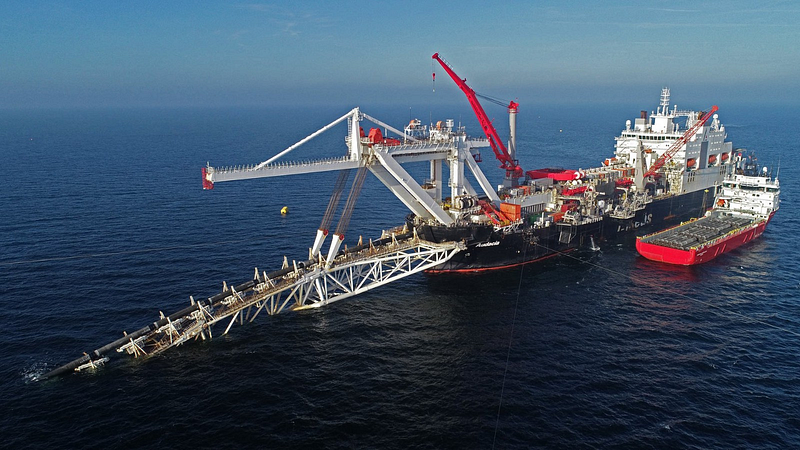
Nearly seven months into the war in Ukraine, the political background of the conflict seems to have become more unclouded. With old decisions now embedded in a broader temporal context, we can attempt to draw initial conclusions about the most significant political mistakes the Western politicians had made before the full-scale Russian invasion took place.
Many leaders had warned years earlier that the day of Russian aggression might come. Several others had disregarded such claims, but this is not the time for the former to triumph, nor should the latter self-castigate. It is time for all to analyze these past actions and draw constructive conclusions so that the next war in Europe does not occur. Although the number of mistakes committed is substantial, Nord Stream 2 (NS2) is the most contentious facet of the economic cooperation between Western Europe and Russia as it has played a significant role in the ongoing war.
Background
To fully comprehend the controversies around NS2, we have to go back to 2014 to the annexation of Ukrainian territories. Shortly before the annexation, pro-Russian Ukrainian President Viktor Yanukovych was removed from office after he refused to fulfill the will of the people who declared its pro-Western course. In response, Russia decided to reprimand Ukraine for such an open announcement of its Western ambitions. Russian forces entered Crimea, while Russia-backed separatists took control over the eastern territories and established the so-called People’s Republics of Donetsk and Luhansk. Although the West imposed sanctions on Russia, it did not coerce the Kremlin to withdraw its separatists and ‘little green men’ from Ukrainian territories. Additionally, such a gross violation of international law did not preclude some EU member states from returning to business-as-usual relations with Russia or even enhancing their economic cooperation within the energy sector. This cooperation gained a new dimension in 2015 when Western European energy companies signed an agreement with Gazprom to build the NS2 gas pipeline.
Nord Stream 2
NS2 is an offshore natural gas pipeline designed to run at the bottom of the Baltic Sea from Russia to Germany, circumventing the territorial waters of Central-Eastern European states, which raised their concerns about the project from its beginning. Following the 2015 agreement, the German government in 2018 granted permission to construct and exploit the pipeline, further enhancing the cooperation between Russia and Western Europe. These decisions were taken not even five years after Russia had invaded Ukraine and while the Russian troops and separatists remained stationed in the occupied regions of Ukraine.
Many politicians have argued that Russia interpreted these decisions as a sign from Western European states led by Germany that they decided to turn a blind eye to the war in Eastern Ukraine. Putin started to believe that Western Europe would tolerate his aggressive policy towards Ukraine, no matter what he did. He felt unpunished, which strengthened his confidence and encouraged him to continue upon this course since Western Europe showed it would still cooperate on major strategic projects with Russia. In other words, not only had Russians been unpunished for their aggression, but they were also granted a new pipeline — NS2 with new money flowing into the Russian economy.
Undermined Solidarity
But the pedagogical aspect of these decisions was not the only negative consequence of NS2. These decisions undermined solidarity within the EU and NATO. Central-Eastern European states, along with the US and the UK had warned its Western European partners that NS2 was not an economic but primarily a strategic project that would strengthen the Russian position in Europe.
The Baltic States and Poland, states that experienced energy blackmail from Moscow in the past, argued that the project would increase the dependency of Western Europe on Russian gas supplies. In effect, it would facilitate the Kremlin to use its energy resources politically and influence governments in Western European capitals. However, the politicians supporting the project dismissed these arguments.
The decision to kick off the pipeline’s construction undermined Western unity in the two most important alliances of the West. Within the EU, NS2 created suspiciousness of Central-Eastern European states towards their Western European partners, whereas, in NATO, NS2 put a wedge between the US accompanied by the UK and Central-Eastern Europe, and Western Europe. The tensions within NATO escalated further in 2019 when the US imposed sanctions on the pipeline. Such circumstances and internal divisions within NATO and the EU were conducive to Russia’s political objectives, which as the ongoing war proves, can be more easily achieved if the West is divided.
Problematic Dependency
The crisis of Western unity caused by NS2 resulted in frustration in Washington. However, Berlin remained unbothered as, even without launching the pipeline, it has increased its dependency on Russian gas from 37% to 55% of its total supplies coming from Moscow throughout the last decade. Speeches of Chancellor Scholz, who is forced by the decisions of his predecessor to continuously transfer vast amounts of money to Moscow, show how problematic this dependency is. In addition, even if Scholz wanted to punish Russia economically for its recent aggression, he could not hit where it would hurt Russia the most because such a move would greatly hurt an average German as well.
Such unhealthy energy dependency has brought Germany, and other Western European states, reputational damage. The entire world is watching how Western Europe has become hostage to Russian energy blackmail, with massive amounts of money flowing into Russia every day. This situation might result in a leadership crisis in the EU since Western European, particularly German, political and moral leadership within the Union, has been undermined by their ongoing transfers to Moscow and inability to predict the consequences of the energy dependency.
Conclusion
The decision to launch NS2 contributed to the creation of a given perception in Moscow. A perception that Western Europe tolerates Putin’s adventurism in Ukraine and turns a blind eye to the violation of international law. A perception that the pipeline managed to divide the West. A perception that even if the West were willing to respond economically by targeting Russia’s most precious and vulnerable market, it would dance to Moscow’s tune. These three factors contributed to an aggregate perception in the Kremlin that Russia could get away with a potential invasion with no or insignificant cost.
The ongoing war demonstrates that the West is the strongest when it is united and that Russia endeavors to take advantage of the fractures it purposefully creates within Western alliances. Therefore, Western European governments must wholly abandon NS2 not to let Russia further undermine Western solidarity. Russia turned out to be an utterly unreliable economic partner that utilizes its vast natural resources as political leverage. In addition, it changes contractual provisions at a whim, for instance, by cutting off gas supplies to Poland and Bulgaria or requiring its customers to pay in rubles. Hence, all European states must reduce their dependency on Russian energy supplies.
Lastly, the case of NS2 proves that concerning the West’s eastern politics, Western Europe should rely more on the advice of their Anglo-Saxon and Central-Eastern European partners. Particularly on the latter, which due to historical events and geographical proximity, have more experience in the evaluation of Russian intentions and objectives.
European Horizons welcomes open and innovative analysis on relevant and occasionally controversial transatlantic issues. The viewpoints expressed in Transatlantic Perspectives do not necessarily reflect an institutional position.