
How Myanmar’s Democracy Was Set Up for Failure.
By Charles Forman
Myanmar is a country on the coast of the Indian Ocean, situated north of Thailand and south of India. Before World War II, the country was under rule by the British Empire. The British took control of Myanmar, which was then called Burma, by brute force. Raiding, killing, and burning down existing infrastructure to take control. They maintained a hold on Burma from the early 1820s till World War II.
During World War II, Burma originally helped the Japanese soldiers on their various campaigns in the southeastern pacific region. However, later in the war, they helped the allied countries with their victory. In 1948, per the Panglong agreement, Burma was officially an independent nation.
Things were okay for around 14 years until the military seized control of Burma in a coup. Then from 1962 until 1988, the military had complete control over the nation. This led to Burma becoming one of the world’s poorest countries, with a severely struggling economy. The state of the economy led to mass protests that were often submerged with violence.
In 1988, after these protests had gotten severe, there was another coup, and democracy began to be restored. However, since then, elections that have seen alleged mass fraud has led to the military largely keeping power. In 2015, national elections gave the NDL party (the people’s party) a majority in the parliament’s upper and lower houses. However, despite having a majority, the military occupies 25% of the chambers’ seats, giving them veto powers on any change to the constitution.
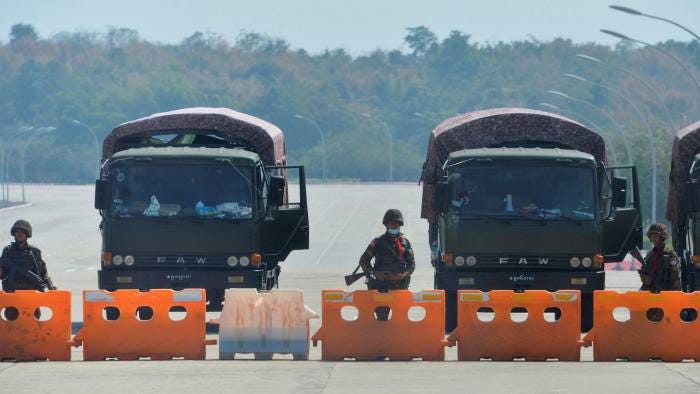
As of January 31st, The leaders of the NDL, along with the state chancellor (a role similar to Prime Minister), Aung San Suu Kyi, were arrested as part of another coup by the military. Like the United States, Myanmar had the election results contested, with unsupported allegations of fraud. Instead of a peaceful transition of power, the military seized control of the country once again.
Myanmar’s democracy was set up for failure. The fact that the military controls 25 percent of the upper and lower houses meant that at some point, a conflict would arise that would cause deadlock. This kind of system impedes progress, and it is a shame to see it happen. The White House has called the alerts of the coup “alarming.” They have yet to order any military action against the nation.
It is unlikely that President Biden will order any action, as it does not go directly with his agenda. In the past, China has tried to make Myanmar a satellite state of the mainland and now could present the perfect opportunity to do so. If they strike on the chance before the United States and other N.A.T.O. nations have a chance, things could take a turn for the worse in the fragile democracy.
We are still in the early stages of what will happen in Myanmar. The hope is that the country does not repeat its sorrowful history of poverty and famine. Hopefully, steps can be taken by outside parties to ensure that democracy will prevail in Myanmar.
I am a writer of law, tech, and pop culture. Blogging via medium Microblogging via Twitter and Facebook