
Family/Parents/Marriage
How My Dad Met My Mom
According to my dad.
Many men told me how they met their wives with excitement and pride. Often, I listened to my partner tell people on the phone how he met his wife and heard him tell the same story to his children a million times — and wondered why men like to broadcast how they met their wives.
Do you know?
My dad did the same, and I have yet to hear it from my mom.
Before the internet, most Nigerian marriages were business deals between families or clans. A woman was not consulted until the day the potential groom’s family paid an evening visit to the woman’s family.
According to my dad and aunts, my dad was the hottest bachelor in town, and many families wanted him as a son-in-law, but he had his own mind.
Why?
He lived far away from his state and didn’t want to marry a foreign woman. That was the culture in those days. His elder brother, sister-in-law, and sisters tried their best to choose a woman from the group of villages. Still, he always said no to all of them without an explanation.
I asked him why he didn’t choose a wife from many of the women the family selected for him.
I did not expect a surprise answer until I asked the question.
My dad, Papa J, narrated his story.
As a teenager, I followed Papa J. (his elder brother, Johnson, who was his father figure) to court for a land dispute. The land dispute was between our village and the village of Eka Okon (his sister-in-law). My brother had influence, money, and laws on his side, but the problem was the village he was dealing with — his in-laws. We don’t question our in-laws or make trouble with them. They are always right.
My brother gave his rights and half of the land to his wife’s people, which they didn’t deserve. After the court case, I learned a powerful lesson and promised never to marry from the villages that make up our clan.”
Anytime I was on holiday, my sisters and Eka Okon would bring young women from the same villages in our clan, and I’d say no. On one of those holidays, I liked one tall, slim girl; the problem was that she was from Eka Okon’s village. My elder sister was furious and asked me for an explanation because she was excited about that young woman as she knew I’d like her. I told her, ‘She is the kind of woman I wanted, but she is from the wrong village.’ My sister warned me not to say that to anyone. ‘It’s a taboo,’ she concluded.
My thought was, “We are all humans with preferences. Men have choices, and women have too.”
My dad continued his story.
I left that holiday without choosing a woman for a wife. Before I left, I told my elder sister I’d be back in three months, and I’d find my wife. My sister responded and advised, ‘I believe you. Please don’t marry a foreign woman.’
I returned to the village in less than three months, and Eka Okon was surprised that I was back in such a short time. I slept late because I was thinking of my future wife and how to meet her. I had an idea to walk for a few miles in the morning. The next group of clans was a mile from my left and about ten miles from my right. I chose left and walked. As I entered the main road, I saw three girls and one woman. One girl in front, two behind her. The woman walked behind the two. I walked faster and said good morning to the girls and the woman. The woman (your grandmother) stopped to talk to me. The two girls stopped, and she signaled them to mind their own business.
I teased him, “How did grandma signal them to mind their own business? “You know what I mean,” My dad responded.
He continued his story.
I introduced myself, and she smiled and resumed walking. She told me she had done business with my brother. And that my brother is a friend of her brother-in-law. She told me she was heading to the market and had to go. I asked who the three young women were. She smiled broadly and said, ‘My first daughter is in front, and the two are my workers.’ I have already looked at and taken a picture of your mom in my head. I smiled and wished her good luck in the market.
What shocked me was your mother didn’t care who was talking to her mom. She ignored me after making eye contact, and I’m unsure if she said good morning. I told myself at that moment, ‘I found my wife. She is my wife.’ I keep playing in my head, ‘Three girls carried five gallons of palm oil on their head so early in the morning.’ Your mom’s business consciousness sealed the deal. I was a businessman and needed a woman who could count money (he smiled).
I interrupted him, “You were right about that.” “Of course,” he agreed and continued his story.
“I turned and went home, and Eka Okon was not happy because I didn’t tell her where I went so early, and she was worried. I was so excited, and I told her about my wife. And I requested that she pass the information to my brother. Yes, she has to do the talking. In our culture, if you want a man to do something quickly for you, go through his wife. I knew his wife was about to pepper him to come home and get the wife’s business done.
“I left and went back to my workstation.”
According to Eka Okon, my brother arrived after the market day and took the family to meet your mom’s family. They gave my people trouble and introduced your aunt to my family. Eka Okon caught them on their track and told our spokesperson they were there for a tall girl. The spokesperson for her family came clean and said to them that the first daughter was not available to be married to anyone living outside the southern state. She was her mom’s business partner and must live a few miles from their village.
“Was that true?” I asked. He replied, “Somewhat. First daughters were very expensive and as powerful as the Clan head. They can build or ruin your life. So, the family prefers to keep them nearby.”
The man concluded his story.
“My family left frustrated. My brother sent a telegram, and I was disappointed, but I knew I could do anything to get my wife. I knew that the girl I saw that day was my wife.”
“Quickly, I returned to my hometown before the next market day and met with your grandmother in her palm oil mill, and we struck a deal.”
“What was the deal?” I enquired.
“It’s a secret I’ve never shared with anyone, including your mom.”
“Why ?”
“It’s a secret. In our culture, our word is our bond. Son-laws always have their mother-in-law’s back, and likewise, mothers-in-law.”
When my father died, the slenderly built woman she rejected visited, and my aunt confirmed the story. She was like my mom’s twin sister with a powerful presence. I shook my head and smirked. The man seemed to have had his preference. I believe women have their preferences, too.
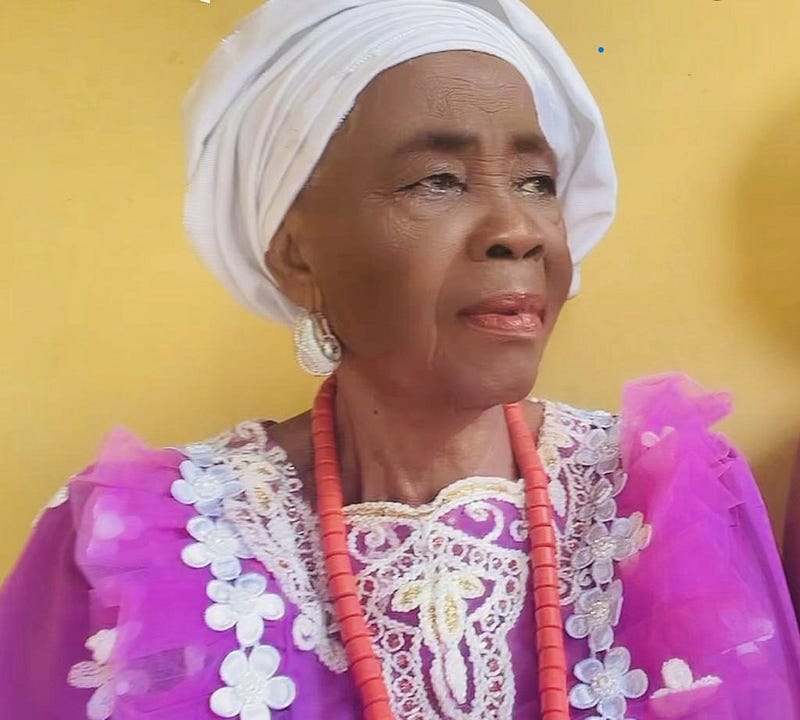
Grace and Jerry were married until the man died. My mom is in her eighties.
Follow me here.


