
How My ChatGPT SEO Articles Survived the Latest Google Apocalyptic Update
This is how to use ChatGPT to rank on page 1 and get sh*t loads of free traffic to your content

The internet is an emotional rollercoaster.
When Google announced that they wouldn’t penalize AI-generated content, everyone was going nuts and generating articles like there’s no tomorrow.
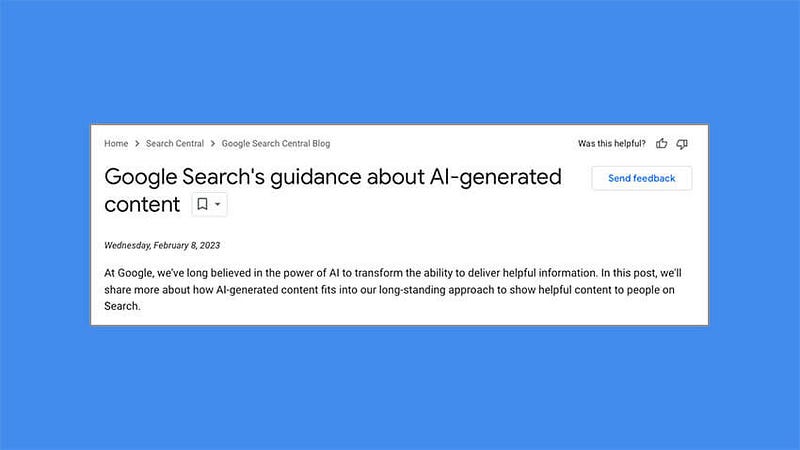
7 months later, Google announced their helpful content update. As a result, many sites using ChatGPT got slaughtered.
The reason? They’ve all been using ChatGPT the wrong way.
On my end, I’ve been silently using ChatGPT to not only write content that ranks but also that keeps the ranking long-term. Not saying this to brag. Simply to show you that the evil ain’t ChatGPT, but the humans who’re using it.
Use it right—say hello to more free traffic, faster. Use it wrong, and your website will tank like a sinking anchor.
Here’s the process I’ve been using so that you can start getting SEO traffic while writing faster. The best part? This works even if you have a brand new website.
Stop drawing conclusions like a junkie
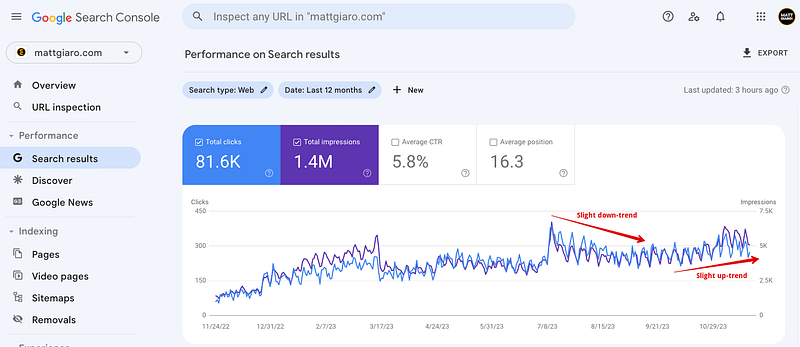
I don’t like to draw quick conclusions, especially when it comes to SEO updates.
I went through dozens of them over the past decade. And I know that sometimes it can be quite brutal, like a kick in the balls: which means that you can see a huge drop or a huge increase.
But then (usually after one month), the dust settles, and you actually see the real impact. The last Google update has been no different.
Sure, I had a little slowdown in traffic. But it quickly resorbed itself.
Do your damn research
Keywords are the lifeblood of SEO.
Choose them right, and the chances of ranking on page 1 increase by 531% (I have no actual data that backs up this specific number, but you got the point.) Choose them wrong and say hello to wasting your time writing articles nobody will ever read.
The problem is that most people suck at picking the right keywords. They choose keywords they have no chance of ranking for, especially with brand new websites.
The cure for this dilemma? Be a sniper, not a scattergun enthusiast. Generic keywords? Please, that’s for beginners. You’re not here to play in the kiddie pool.
Instead, go long-tail. While others claw over generic terms, you’re slipping through undetected, capturing your niche. It’s not just smart; it’s strategic.
Now, let’s talk about finding these keywords with ChatGPT.
ChatGPT has been trained with 500B characters. So, if you want to find new keywords, use prompts like this one:
My website targets [enter your audience here].
Please help me brainstorm 30 long-tail keywords relevant to the audience that are not in your database.
Notice the “are not in your database?” This bit is here for a purpose: because it will force ChatGPT to not give you the generic garbage it already gave to millions of other bloggers.
Then, go down the Google rabbit hole. Key in the keywords, see where it leads you.
Target the keywords you have a chance of ranking for.
Clarity = Rankings
Sitting down and letting a robot write for you looks sexy on paper.
But it fails miserably 9 times out of 10 if you do it without an outline. I know what you’re saying: “Outlining is boring—I want to write based on inspiration.” You’re free to ignore this step. But enjoy smashing your head against the wall while editing AI-generated crap.
Outlining is the secret sauce of an article that ranks on Google.
Stop thinking that ChatGPT is a super-intelligence. Instead, it’s stupid dumb. It’s a machine. The best way to get the most results out of it is to lower your expectations and treat it as your writing assistant. Your role is to point it in the right direction to come up with content that makes sense.
As an example, when I write product reviews, I always ask myself what type of information the reader really cares about. I put things into perspective and ask myself what features people really want. These become my main points in the outline.
So, before you open your browser, take a step back. Plan your route.
I don’t use ChatGPT to create outlines because I use my own note-taking system to scrape an outline together with my thoughts in 5 minutes flat. This ensures I bring my own ideas to the table. Not regurgitating obvious content.
Bottom line: Never write without an outline.
Ask ChatGPT to write like this
Out of the box, ChatGPT content stinks.
But ChatGPT is a great parrot. Which means that it can mimic your writing if you first feed it with it.
Delete the fact that you can feed it a couple of prompts you found on X and write content that ranks. ChatGPT is a tool, and like any tool, it’s only as good as the craftsman. You’re the brains of the operation.
For that, ChatGPT needs to eat, sleep, and breathe your style. Flood it with your best work, your voice, and your tone.
Your audience can sniff out ChatGPT content from a mile away. They want the real deal—your unique perspective, your voice, and your insights.
How do you do that?
Simple. Pick your best content and use this prompt:
You're my SEO writing assistant. We'll write an SEO-optimized article in this session.

How we will proceed:
1. I'll start this session by providing you with sample writings. Please analyze the writing style and make sure to match all your responses in this session to mimic it perfectly. After each example I provide, ask me if I want to continue providing you with examples or if I want to move on to the next stage.
2. In the next stage, I'll provide you with an outline to generate the article. You will write the article following the exact outline using the exact same writing style you analyzed previously.
Increase your article reads with this hack
Reading sucks up a lot of mental bandwidth.
And people who’re going to read your articles are lazy. (We all are.) But could it go worse? You bet.
When your reader hits your website, you’re competing against the delivery boy, the pizza in the oven, and the kids screaming.
So for God’s sake, stop turning off your readers with a suffocating wall of text. Dense text is a reader repellent.
Instead, break it down:
- plenty of spacing between the lines
- frequent line breaks
- easy-to-read fonts
- short paragraphs
- subheadings
- bullet points
Think those are just visual gimmicks? Think again.
Google’s ranking algorithm is a slave to human attention. A visitor that stays on your article because you dressed it up in a red-flashing, sexy cocktail dress and reads it means an increase in rankings.
Bottom line: It’s not just what you write. It’s how you present it.
The probably most important secret to make your ChatGPT articles rank on Google
I wrote hundreds of SEO-optimized articles over my career.
And one of the key elements that I learned is this: In order to rank long-term, you need to come up with insights others didn’t come up with.
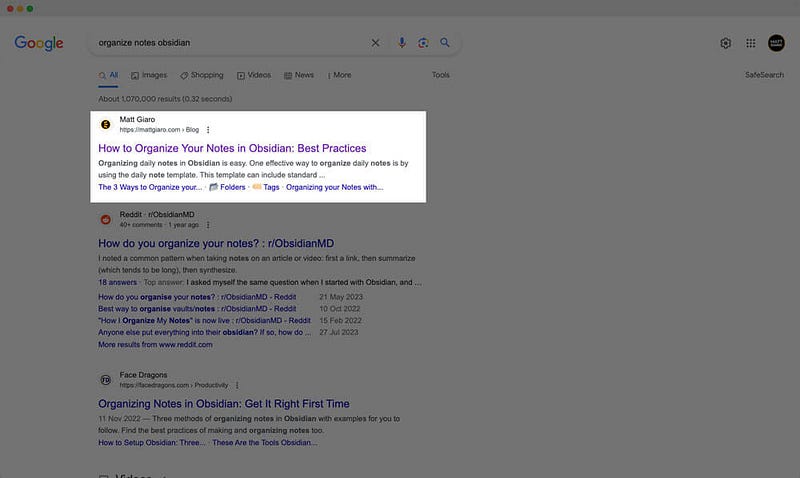
Look at my article on “How to Organize Nodes in Obsidian.” You probably won’t find another article that comes up with the same insights because I take a hybrid approach on how to organize notes.
I am not saying this to brag.
But it’s the reason why this article survived the helpful content update is because the content is… duh, helpful—even though it has been generated with ChatGPT.
I don’t say that my insights are the ultimate truth. But they’re my truth. And that matters.
Don’t be a lazy dumbass using ChatGPT to crank out generic garbage. Instead, feed it with your own insights, and then watch it help you come up with your first draft in a matter of seconds. And then take this first draft through a series of edits. And that’s it.
So instead of wasting 2, 3, 4, or more hours writing your next post, use ChatGPT to write your first draft and feed it with your own ideas.
See AI as a tool, your secretary who can type the stuff out for you. And then add your own personal touch to it by editing things out.
The goal of writing AI articles that stand out is that the article should not have been written by AI alone: it’s driven with your unique insights and takes.
Here are two free courses that I created that might help. (Feel free to pick one)
- How to rank your website on page one of Google in just 48 hours — Click here
- How to use ChatGPT to create blog posts 10X faster. (Click here)


