
How My CEO Saw a Digital Trend 8 Years Before Everyone Else and Made Millions From It
Surf the wave early, and don’t wipe out
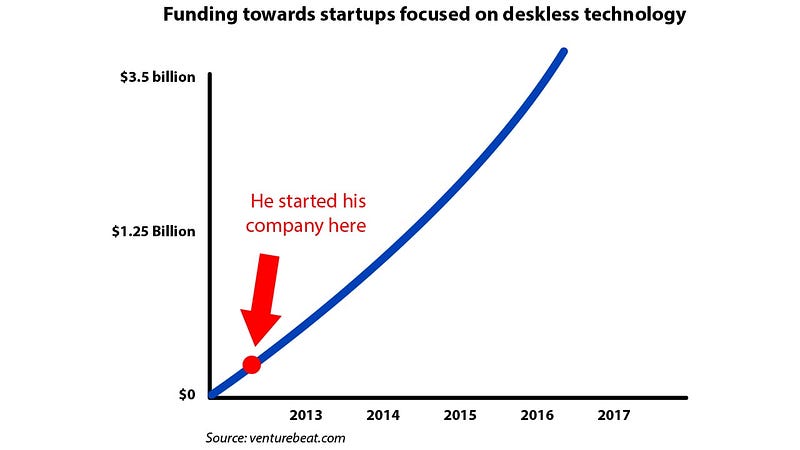
Back in 2020, my CEO sold his company for $30 million and “retired” shortly after that. He set up his own investment company and became an angel investor for projects he believes in. Why? Because he’s passionate about tech and excellent at spotting companies that have a high chance of success. He looks at trends in domains he knows rather than reading headlines announcing the next big thing one after the other.
He’s a visionary who built a company in a domain only very few people saw coming, literally 8 years before everyone else started catching up: mobile learning for remote and deskless workforce. When the pandemic hit and everyone was confined at home, our product saw a huge increase in popularity. Of course, my CEO didn’t anticipate that a pandemic would happen, but he anticipated that remote learning was getting bigger year by year, and he decided to start surfing the wave before everyone else.
In this article, I will go over 5 key points that made my CEO successful and define him as a visionary entrepreneur.
1. Create cross-industry solutions
World-changing trends are created in world-shaping industries, and the more you can create a product/solution which will appeal to the biggest industries in the world, the more money you’ll make. Here are the 10 biggest industries in the world, which employ over 110M people across the globe (2022 numbers):
- Consumer Electronics Manufacturing (17.4M employees)
- Commercial Real Estate (17.1M)
- Fast Food Restaurants (13.4M)
- HR & Recruitment Services (11.9M)
- Apparel Manufacturing (9.6M)
- Hotels & Resorts (9.5M)
- Coal Mining (8.9M)
- Tourism (8.6M)
- Commercial Banks (8M)
- Auto Parts & Accessories Manufacturing (8M)
The genius part about the solution provided by my CEO’s company is that it literally targets 80% of those industries. How? Mobile learning for deskless workforce is a need for companies that have workers in factories, in remote locations, in hotels and restaurants serving customers. The app we offer enables decision-makers to communicate with their workforce, have them take aptitude tests, surveys, create online social groups, and much more.
Before creating his company, my CEO had a 9–5 job in telecoms, and he got his big idea by noticing how bad the onboarding was for new employees. When you start a new job, it’s about more than knowing where the coffee machine is, or where to find the menu for today’s lunch at the canteen. If you can understand the industry you’re working in better, and see how the company you work for creates a key role in it, you’ll become a much more efficient and valuable employee.
My CEO saw all that, but he didn’t see any solution to the issue. So he decided to create his own thing.
2. Put your money where your mouth is
It’s good to have ideas, but if you don’t invest in them nothing will happen, and you’ll get passed by. If you don’t have money saved up, you can try and find investors to buy into your idea. That’s what my CEO did, but he also didn’t pay himself for years before the company started making some money.
Years later, when the company was burning through cash but struggling to break even in revenue (a common Silicon Valley strategy that is starting to show signs of exhaustion), investors started to become reluctant to pump in more cash. My CEO was forced to take out a big loan and use his house as collateral. If he truly believed in his idea, the only option to keep it alive was to put his skin in the game too.
There are a lot of excuses people come up with in life for not following their dreams or ideas, and money is often one of them. The thing is, you don’t need millions to start, you often don’t even need a lot of money. My CEO created his company 8 years ago, and the world was a different place back then. It’s crazy to think about but 8 years ago a lot of the free digital tools we now have at our disposal either weren’t that good or didn’t even exist yet.
Nowadays, you can create a proof of concept for almost anything in your bedroom, you can advertise and pitch your ideas to millions of people through social media or by creating your own website. “Put your money where your mouth is” is just a saying, what matters is to stop finding excuses and learn the skills you need to succeed.
3. Be a shaper
“A shaper is someone who comes up with unique and valuable visions and builds them out beautifully, typically over the doubts and opposition of others.” — Ray Dalio
“Shapers” is a term created by Ray Dalio, one of the most successful investors of all time. He created this term while conducting research on how to best handle his succession at his investment firm Bridgewater Associates, in 2012. His team found that the biggest component that needed to be brought on to fill the “Ray Gap” was something called “shaping”.
Dalio convinced shapers who he knew through his success and reputation (Bill Gates, Elon Musk, Jack Dorsey, Reed Hastings…) to take a 1-hour personality assessment. He then laid down the biggest traits that emerged from his studies:
Shapers are independent thinkers
Dalio was fired from one of his jobs for punching his boss in the face and founded his own firm shortly after that. My CEO was never violent, but he also quit his job, said “screw it”, and built his own thing.
Shapers are extremely resilient
Dalio spoke with Jack Dorsey, who was ranked one of the worst CEOs in America 2 years in a row. Yet for the past 10 years, he’s helped create 2 of Silicon Valley’s most successful companies (Twitter and Square). My CEO had to face investors’ critics more than once during his tenure, and although he always listened he never let those critics get in the way of his success. Many people would have folded.
Shapers have a wider range of vision than average
This goes back to identifying trends and patterns in top industries. Shapers are not only able to have a wider vision than average, but they also recognize that there are some things they can’t see. To fill in those gaps, they do 2 things:
- Hire people that are better than them at specific tasks My CEO had a great vision for an app that would help managers create onboarding programs for their deskless teams, but he didn’t have the knowledge to create the product. So he used investors’ money to hire a bunch of coders and a tech lead.
- Take in huge amounts of information to learn much faster than average Right before the pandemic, the company got very close to tipping over and sinking. We needed a new strategy, new teams, and we needed them fast. My CEO spent countless late nights learning about the OKR Strategy and implemented it at our company within months. It saved us, and I wrote about it here.
Shapers are passionate
The number one reason my CEO (or even Musk, Gates, or Dorsey) was able to keep running his company for almost a decade through countless storms and with huge financial stress is very simple: he’s always been passionate. You can’t just go through the type of crap you have to go through when running a startup without being passionate.
4. Read a lot
- Warren Buffet spends as much as 6 hours per day reading
- Bill Gates reads 50 books per year on average
- Elon Musk would read for 10 hours per day as a kid
- Most people read less than 12 books per year
My CEO’s office was always filled with tons of books, and here are some of his favorite ones:
- The One Thing, by Gary Keller
- Eat That Frog, by Brian Tracy
- Deep Work, by Cal Newport
- 7 Habits, by Stephen R. Covey
- Measure What Matters, by John Doerr
I remember one time our marketing department had to implement a new strategy none of us knew about or understood. We showed up at the office one Monday morning to find a box filled with 20 copies of the same book to pass around, on the exact strategy we needed. It was a gift from our CEO.
He also always encouraged us to use our company credit card to buy books, even if they were not related to our industry, even if it was fiction. Why? Because no matter what you read, you get inspired, creative, and more knowledgeable from books.
It’s not just about absolute knowledge either, this is also relative. When you take into consideration that most people read less than 12 books per year, it’s very easy to see how much you can get ahead by simply reading 2 books a month. Most people don’t put in the work and/or get interested in things, either because they’re fine with it or by lack of motivation.
If you want to get ahead, start with finding trends where nobody is looking
Nobody knows what the future holds, but only those who experiment and seek more information will get ahead. By investing time and effort into those 5 key points, you’ll maximize your chances of creating the next big thing:
- Think about cross-industry solutions. World-changing trends are created in world-shaping industries.
- Put your money where your mouth is. It’s good to have ideas, but if you don’t invest in them nothing will happen.
- Be a Shaper. Someone who comes up with unique and valuable visions and builds them out beautifully, typically over the doubts and opposition of others.
- Read a lot. Most people barely ever read, so by simply reading 2 books a month, you’ll accumulate way more knowledge than the next guy.
And as always, remember to enjoy the journey.
Did you know I make Youtube videos too? Here!