
SAVING ADVICE
How Much Should I Save Today To Reach $1 Million by 65?
Want to save a million dollars by retirement? Read how.

Do you dream of a comfortable retirement with a cool million dollars in the bank to fund your golden years?
The good news is, yes, it is achievable.
It’s an admirable goal, but one that requires careful planning and discipline.
Then comes the golden question that many people have: how much do I need to save daily, monthly, or annually today to reach that $1 million mark by age 65?
A million dollars may seem like a huge amount, and for many of us, it might seem tough to reach. However, with proper planning and discipline, reaching it isn’t as tough as it seems.
Let’s get into the numbers with a clear example to guide you along the way.
Meet Jack, a 35-year-old working professional who’s got big plans for his future.
Jack’s goal? $1 million at 65.
He wants to make sure he’s financially safe when he retires at 65. He has a plan to retire with $1 million as his safety cushion. But right now, he needs to work on a plan to ensure he gets there.
Here’s what Jack needs to consider:
Time Horizon
Jack still has 30 years before he turns 65. It might feel like a lot of time, but the sooner he begins saving, the simpler it becomes to reach his goal, all thanks to the magic of compound interest.
Expected Rate of Return
Jack wants to put his savings into a diversified portfolio, hoping to make around 8% profit each year. This seems like a doable goal, looking at how investments have done in the past, and with the help of an investment advisor, it should not be difficult to achieve.
Inflation
Jack also needs to think about inflation, which makes money worth less over time. If inflation goes up by around 2% every year, Jack has to make sure his savings grow faster than that so they don’t lose their buying power.
I know we all see a higher rate of inflation, but let’s consider an average number over the past few years.
With this understanding, Jack can now do the math to figure out how much he needs to save.
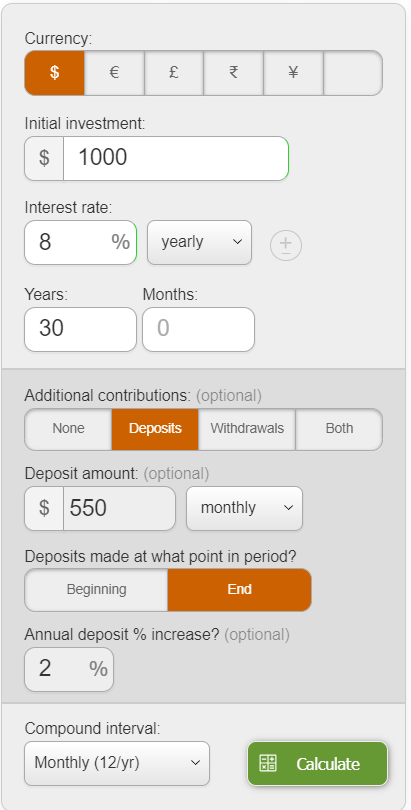
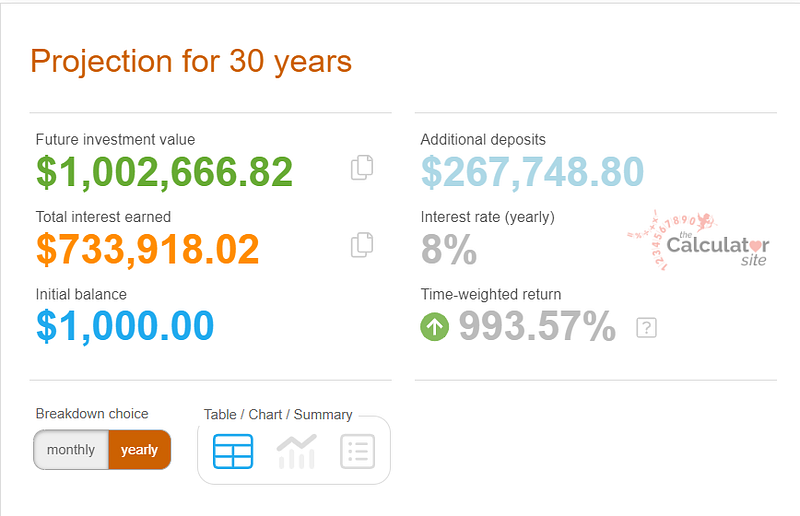
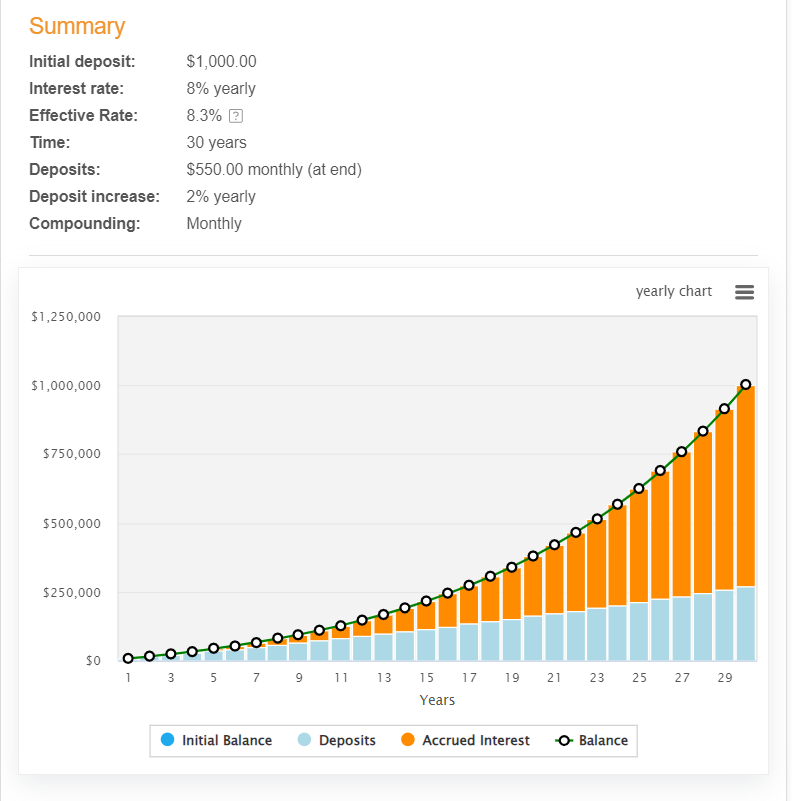
Jack tries out a compound interest calculator and finds out that he should save around $550 (indexed at 2% every year to beat inflation) every month to reach $1 million by the time he turns 65. This assumes his investments grow at an average rate of 8% each year, and his money deposit will need to increase by 2% every year.
I have used Compound Interest Calculator from www.thecalculatorsite.com for this demonstration. I have taken few screenshots from that tool to have some visual attraction to the numbers and how I calculated the target amount with few parameters.
But what if Jack decides he wants to retire a little earlier, like at 60?
Well, in that case, he’d have to raise his monthly savings to about $900 today with an increase of 2% annually to hit his $1 million goal in 25 years.
This example shows why it’s crucial to begin saving early and keep adding to your retirement fund regularly. With the magic of compounding, Jack can see his money grow steadily over time, even if he’s only putting in small amounts.
By just delaying his savings by 5 years his monthly savings need to increase by $350 to match the targeted amount.
Of course, Jack’s situation is just one example.
Your journey to $1 million will be unique and influenced by factors like your age, how much you earn, what you spend, how much risk you’re comfortable with, and the way you invest.
Try out the interest calculator today to figure out how much you should save now to reach your goals.
Keep in mind that getting to $1 million starts with one small step, and each dollar you save today is a step in the right direction toward a financially secure future.
Key message: If you aim to reach $1 million by the time you’re 65, it’s really important to begin saving and investing right away. Even putting away small amounts regularly can build up over the years and get you closer to your retirement goals.
I aimed to demonstrate that by saving in the early years. If you are interested in knowing more, please consult your financial advisors, who can help you match your specific financial goals.