
How Much Research Do You Do for Your Fiction?
Do you write what you know?
I’ve always thought verisimilitude was important in writing — those details that lend credibility and make it feel like real life. This is one reason for “writing what you know.” Even if the story itself is fiction, the details need to be true. I have abandoned novels I was reading because it was clear to me the writer didn’t do their homework.
Remember that book The Shack by William P. Young? It was very popular for a while. I tried to read it. In the beginning of the book, the protagonist is supposed to be very depressed, gripped by despair — yet he goes outside and marvels at the beauty of the ice hanging in the trees and the frosty landscape. Had he been truly depressed, he wouldn’t have noticed the beauty. (That’s not the only thing that made me abandon it. The narrative voice was too folksy, and it created a discord with the plot).
But what if you want to write what you don’t know? That’s where research comes in. Some details can be gleaned from Google. How many authors have search histories that include “when does rigor mortis set in?” or “what’s the difference between a sheriff and a chief of police?” or “does arsenic have a taste?”
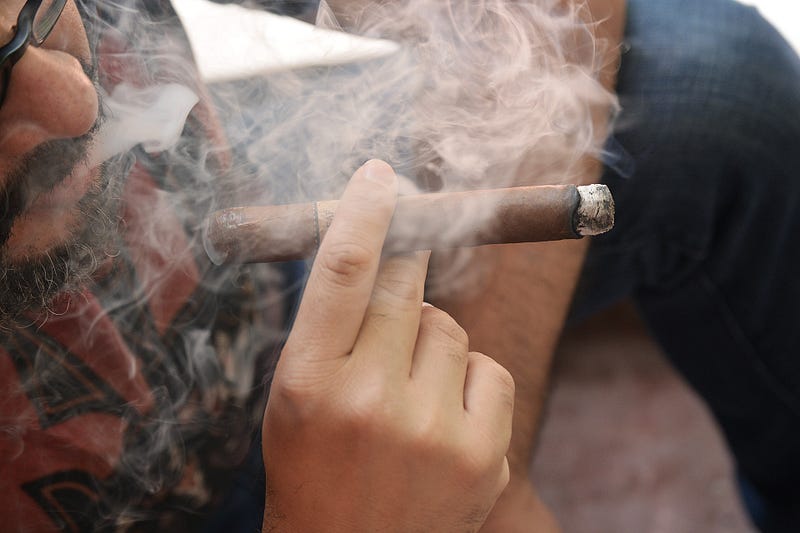
Sometimes, however, the research calls for a little first hand experience, which is how I ended up smoking a cigar.
My brother-in-law is a pipe smoker, but he has been known to smoke a cigar from time to time. He took me to buy a cigar and helped me pick one out. I couldn’t tell you the brand or anything about it other than it was a very traditional cigar.
In preparation, I watched a YouTube video about how to smoke a cigar. The host was very enthusiastic about the flavor. Now that I’ve experienced it, I’m pretty sure he must have been insane.
My brother-in-law helped me cut off the tip and told me to spin it as I lit it so it would light evenly rather than just on one side. And then I was on my own.
I went into the backyard and sat on the storm shelter, a pad of concrete that’s the perfect seat if you have short legs. At first, there wasn’t a lot of taste. It’s like it had to build in my mouth. When the flavor finally came, it was like rotting vegetation covered in pepper. The taste grew as I smoked. It was enduring and disgusting and filled my mouth. Not quite as bad as vomit, but there was a definite similarity. Occasionally, a flake of tobacco would come loose from the cigar and roll around my mouth until I spit it out onto the ground.
I didn’t smoke the whole thing, not even close. But I made myself smoke more than I wanted to — and I focused on the experience. One thing I will say for cigar smoking is that it is a very mindful activity.
I had to brush my teeth twice to get rid of the taste — and I had to wash my hair to get rid of the smell. I had flashbacks for the rest of the night. I can’t even imagine how someone could enjoy smoking cigars. I guess some people feel the same way about drinking coffee.
This morning I added the cigar-smoking details to chapter 10 of the novel I’m writing. Those details are worth every disgusting puff I took on that cigar. It was fewer than 100 words, but those words add texture to that chapter.
What about you? What kind of research have you done for your writing? And how important is research to your art? Because that’s what writing is — it’s an art — and those details that lend verisimilitude are what brings your art to life.
