avatarCarlos Nunes

Free AI web copilot to create summaries, insights and extended knowledge, download it at here

2094

Abstract

">This rule of thumb gives you an estimative of how much you can withdraw from your savings without being afraid to run out of money before you die.</p><p id="1332">Later in 1998, another three professors from Trinity University performed a study that was popularized as “Trinity study,” and using the same data and analysis from Bengen, they arrived at similar conclusions, curiously this study became more famous than the original research from Bengen.</p><h1 id="1976">What is this magic number?</h1><p id="8df6">The studies concluded that if you have your money invested in a properly diversified portfolio (stocks and bonds), you can withdraw around 4% of your savings every year, and your savings will not run out before you <i>kick the bucket</i>. The rule assumes a historical return of the financial market.</p><h1 id="6884">So how to calculate the value you need to stop now?</h1><figure id="9de5"><img src="https://cdn-images-1.readmedium.com/v2/resize:fit:800/1*Vpgk5I2Ghwict91LzS7ZKg.jpeg"><figcaption>Photo by <a href="https://unsplash.com/@kellysikkema?utm_source=unsplash&amp;utm_medium=referral&amp;utm_content=creditCopyText">Kelly Sikkema</a> on <a href="https://unsplash.com/s/photos/calculator?utm_source=unsplash&amp;utm_medium=referral&amp;utm_content=creditCopyText">Unsplash</a></figcaption></figure><p id="ee57">Using the rule of thumb from Bergen, you can easily estimate the savings you need to stop working and live from your savings returns.</p><p id="a1ff">Let’s do the calc’s together!</p><p id="b9c0">Firstly, you need to know how much money you need to cover your annual expenses.</p><p id="e6fe">The annual expenses should include all your costs, such as food, housing, utilities, taxes, travel, leisure, etc.</p><p id="0a98">For this example, let’s assume you need 48,000 to cover your yearly expenses.</p><p id="0cba">With this number in your hands, now the calculation is straightforward.</p><p id="da6c">You need to divide the annual expenses by 4%, so for this example we have:</p><p id="ab51"> 48,000 / 0.04 = $ 1,200,000</p><p id="f477">So, it means

Options

to retire and live only from the return of your savings you’ll need to save $1,200,000.</p><p id="7f3b">Bear in mind that this value considers that you are going to live only from the return of your savings, so basically, you can break bad and not worried about another source of income.</p><p id="69e2">If the person continues to receive money from other sources such as rental incomes or pensions, the total saving will reduce, or you can increase your safe withdrawal rate.</p><p id="7b09">The calculation also considers the inflation effect, so every year, you can correct the withdrawal rates by inflation if necessary.</p><p id="fb90">This calculation is just a rule of thumb; however, based on the market returns and cycles from the last 80 years, we can safely say the rule is pretty accurate.</p><h1 id="3fd6">Expenses are the key</h1><p id="578a">Besides the considerable impulse given to the FIRE movement (Financial Independence and Early Retirement), the most exciting part of this formula is the crucial message about the influence of your expenses.</p><p id="a93c">If you manage to reduce your yearly expenses and invest the savings, you can become financially independent faster, due to two effects: reduction of costs and the compounding effect of your savings earn.</p><p id="a26d">To make your life easier, I draw a table that shows you the influence of expenses on our savings goal.</p><figure id="ea0b"><img src="https://cdn-images-1.readmedium.com/v2/resize:fit:800/1*RjnrcVEHdLwavYR5GqnkiA.png"><figcaption>Target savings vs. expenses</figcaption></figure><p id="193c">To conclude;</p><blockquote id="8cba"><p>“If we command our wealth, we shall be rich and free. If our wealth commands us, we are poor indeed.” — Edmund Burke</p></blockquote><p id="3b28">All the best, and be safe!</p><p id="8472">This article is intended for informational purposes only, and it illustrates what I do with my money, it should not be considered financial advice. You should consult an unbiased financial professional before making any significant financial decisions.</p></article></body>

How much do you need, and how early can you retire?

In October 1994, the financial planning journal published a ten pages article that could be considered the pillar of the FIRE movement.

Photo by Harli Marten on Unsplash

In October 1994, the financial planning journal published a ten pages article from a financial planner called Willian Bengen.

In this article, Willian shared a rule to calculate how much was necessary for an individual to save to become financially independent.

An American born in 1947, Bengen received his B.S. from MIT in aeronautics and astronautics. A few years later, he earned his certification in Financial Planner practice and, finally, his master’s degree in financial planning.

This brilliant article is one of the main pillars of the FIRE movement (Financial Independence/ Early Retirement).

The rule of thumb not to run out of money

Photo by engin akyurt on Unsplash

In the article from Bengen, he performed a detailed analysis of the effect of asset allocation, inflation, historical market collapses, and he was able to define a rule of thumb for withdrawal rates from retirement savings.

This rule of thumb gives you an estimative of how much you can withdraw from your savings without being afraid to run out of money before you die.

Later in 1998, another three professors from Trinity University performed a study that was popularized as “Trinity study,” and using the same data and analysis from Bengen, they arrived at similar conclusions, curiously this study became more famous than the original research from Bengen.

What is this magic number?

The studies concluded that if you have your money invested in a properly diversified portfolio (stocks and bonds), you can withdraw around 4% of your savings every year, and your savings will not run out before you kick the bucket. The rule assumes a historical return of the financial market.

So how to calculate the value you need to stop now?

Photo by Kelly Sikkema on Unsplash

Using the rule of thumb from Bergen, you can easily estimate the savings you need to stop working and live from your savings returns.

Let’s do the calc’s together!

Firstly, you need to know how much money you need to cover your annual expenses.

The annual expenses should include all your costs, such as food, housing, utilities, taxes, travel, leisure, etc.

For this example, let’s assume you need $ 48,000 to cover your yearly expenses.

With this number in your hands, now the calculation is straightforward.

You need to divide the annual expenses by 4%, so for this example we have:

$ 48,000 / 0.04 = $ 1,200,000

So, it means to retire and live only from the return of your savings you’ll need to save $1,200,000.

Bear in mind that this value considers that you are going to live only from the return of your savings, so basically, you can break bad and not worried about another source of income.

If the person continues to receive money from other sources such as rental incomes or pensions, the total saving will reduce, or you can increase your safe withdrawal rate.

The calculation also considers the inflation effect, so every year, you can correct the withdrawal rates by inflation if necessary.

This calculation is just a rule of thumb; however, based on the market returns and cycles from the last 80 years, we can safely say the rule is pretty accurate.

Expenses are the key

Besides the considerable impulse given to the FIRE movement (Financial Independence and Early Retirement), the most exciting part of this formula is the crucial message about the influence of your expenses.

If you manage to reduce your yearly expenses and invest the savings, you can become financially independent faster, due to two effects: reduction of costs and the compounding effect of your savings earn.

To make your life easier, I draw a table that shows you the influence of expenses on our savings goal.
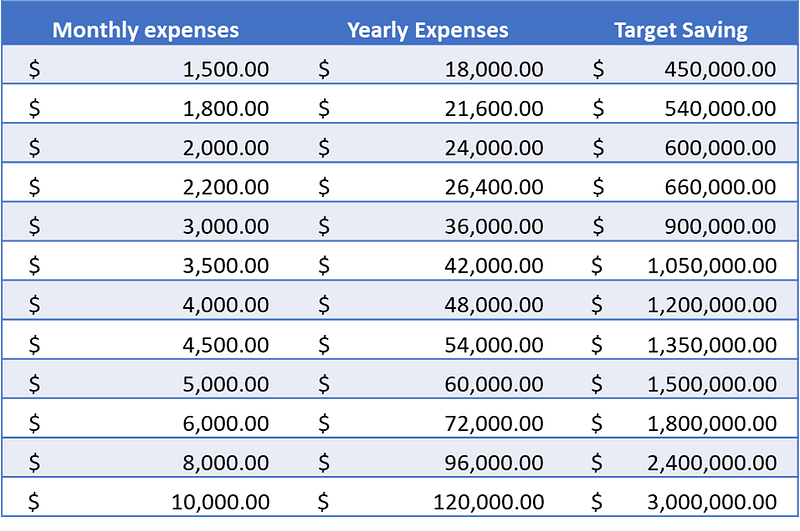
Target savings vs. expenses

To conclude;

“If we command our wealth, we shall be rich and free. If our wealth commands us, we are poor indeed.” — Edmund Burke

All the best, and be safe!

This article is intended for informational purposes only, and it illustrates what I do with my money, it should not be considered financial advice. You should consult an unbiased financial professional before making any significant financial decisions.

Retirement
Early Retirement
Financial Planning
Money
Investing
Recommended from ReadMedium