
How much do AI image tools perpetuate harmful stereotypes?
A new analysis will (hopefully) make you think twice about using latent diffusion models without questioning the outputs

We’re seeing major advances in artificial intelligence arrive thick and fast while new devices are being released on a monthly basis. Some AI insiders have expressed concern that it might cause human extinction, while others say that we shouldn’t be distracted by potential long-term effects because the imminent risk is much more significant. On the other hand, could artificial intelligence be the key to unlocking Africa’s potential? Or has Joe Biden just killed the buzz? The AI tides change every week…
Most of the AI news we see concerns Large Language Models (LLMs) such as ChatGPT and Bard. But latent diffusion models that create images, such as Midjourney and Dall-E, have improved significantly in technical quality over the last few months. Can the same be said for their capacity to produce a representative range when it comes to human faces and places?
Simple prompts, astonishing outputs
If there’s one area where machine learning has failed miserably, it’s reducing ethnic stereotyping. I already wrote about my own rough-and-ready test three months ago and now there’s a major analysis by Rest of World that proves just how reductionist AI image generators are. The authors performed experiments using simple prompts on Midjourney such as “A Nigerian person” or “A house in India”. The results are astonishing in their lack of variety. They are also uncomfortably and maybe even dangerously reductionist.
Ethno-cultural stereotyping isn’t the only bias revealed by the experiment. Bizarre ageism and sexism stereotypes are rampant. Apparently, an Indian person is in all cases an older Hindu man, while an American person is overwhelmingly white, young, and good-looking.
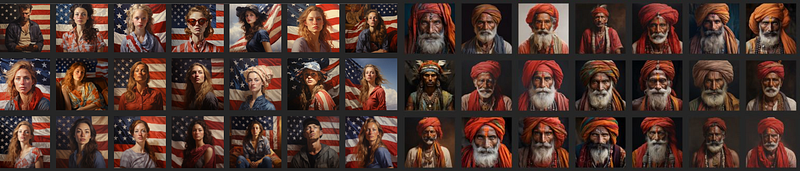
It appears that a narrowing of diversity and flattening of features are inherent in machine learning systems whose goal is to produce an average acceptable output. But that isn’t the only issue. One researcher in ethical and sustainable AI told the analysts that, “There tends to be an English-speaking bias when the data sets are created. So, for example, they’ll filter out any websites that are predominantly not in English.” This means that home-grown content which should contain an authentic range of representation will be excluded from data sets if the website is in a local language.
Feedback loops, focused biases
Even more insidiously, AI platforms “learn” using data sets that are typically sourced from the internet. Websites and social media will soon be awash in enormous quantities of stereotyped AI images that will, in turn, be scraped and re-input to the existing latent diffusion models, creating a vicious circle of hyper-focused bias.
Given the daily flood of online hate and blinkered perspectives we are now witnessing, the last thing we need is quick-and-dirty access to blatant stereotypes. But none of the companies that sell access to their AI tools seem willing to clean up their models or prevent the situation from deteriorating.
Or maybe they simply don’t know how to stop it.
What’s your opinion on the subject? Will you tread carefully when using AI to create images of people and places? Do you think the companies that own the platforms should make greater efforts to fix the issues reported in the analysis referenced here?
I also cover brands, culture and tech in my Discomfort Zone newsletter on Substack.

This story is published on Generative AI. Connect with us on LinkedIn to get the latest AI stories and insights right in your feed. Let’s shape the future of AI together!
