avatarElvira Yuzbay

Free AI web copilot to create summaries, insights and extended knowledge, download it at here

2140

Abstract

ring a range of similar concepts.</p><p id="aeab">So, to express more complex thoughts, words can be combined, which <b>encourages speakers to use them in creative and imaginative ways</b> rather than relying on strict literal meaning.</p><p id="4ca4" type="7">Coffee might be “telo pimaje wawa” (powerful dark liquid) to some and “telo ike mute” (very bad liquid) to others. — The Guardian</p><p id="8df2">The language also has a simplified way of expressing colors, with only five words: black, white, red, yellow, and blue/green.</p><p id="a3c2">However, speakers can combine these words to make more specific descriptions of certain colors. For instance, “purple” can be represented by combining the terms for “blue/green” and “red.”</p><h2 id="74be">Aesthetic scripts</h2><p id="36af">Interestingly enough, Toki Pona <b>has more than one writing system</b>.</p><p id="ca42">Initially, only the Latin alphabet with 14 letters was used. But with time, other alternatives were created to represent the language in a unique light.</p><p id="f056">The two most successful and widely used writing systems are:</p><ul><li><a href="https://omniglot.com/conscripts/sitelenpona.htm"><b><i>sitelen pona</i></b></a><i> (“simple writing” or “good writing”)— </i>a hieroglyphic-like script that represents each word with its own symbol and is known for its childlike shapes,</li><li><a href="https://omniglot.com/conscripts/sitelen.htm"><b><i>sitelen sitelen</i></b></a><b><i> </i></b><i>(<b></b>drawn writing”) — </i>a more elaborate non-linear system that uses logograms and an alphasyllabary to represent words and syllables.</li></ul><figure id="c880"><img src="https://cdn-images-1.readmedium.com/v2/resize:fit:800/1*1-Gp4-f_VRP_tWedOSOcXQ.png"><figcaption></figcaption></figure><figure id="b497"><img src="https://cdn-images-1.readmedium.com/v2/resize:fit:800/1*OfhPatyedSz0qbMTkwg0Mw.png"><figcaption><a href="https://upload.wikimedia.org/wikipedia/commons/a/ab/Toki_pona_sitelen_pona.png"><b>Sitelen pona</b></a><b> (on the left) and <a href="https://upload.wikimedia.org/wikipedia/commons/9/9a/Sitelen_nimi_ale.png">sitelen sitelen</a> (o

Options

n the right)</b>. Excerpts from Toki Pona: The Language of Good. (Wikimedia Commons)</figcaption></figure><p id="5e75">The artful designs of the glyphs in <i>sitelen sitelen</i> are inspired by various other writing systems, as well as US west-coast comix and east-coast graffiti artists.</p><p id="488a">Besides being aesthetically pleasing, the scripts also encourage users to slow down and think about language and communication.</p><h2 id="27cb">How long does it take to learn Toki Pona?</h2><p id="2c2f">Since it has simple grammar and a limited vocabulary, Toki Pona is relatively easy to learn.</p><p id="5d4d">It is estimated that<b> it takes roughly 30 hours to master the language</b>.</p><p id="3875">And not only is the vocabulary small, but the origins of many words are easy to identify. For example, <i>toki </i>means “speech” and is very similar to Tok Pisin’s “tok” and English’s “talk.”</p><p id="e02e">Besides <b>English </b>(30%) and <b>Tok Pisin</b> (15%), words are also borrowed from other languages such as <b>Finnish </b>(14%), <b>Georgian </b>(8%), <b>Dutch </b>(9%), <b>Acadian French </b>(10%), <b>Esperanto </b>(14%), <b>Croatian </b>(12%), <b>Mandarin </b>(5%), <b>Cantonese </b>(3%), etc.</p><p id="2997"><b><i>But how easy is it actually for us to radically simplify our thoughts, emotions, and abstract concepts when we are so used to doing the exact opposite?</i></b></p><p id="24d2">It might seem impossible to express such complex ideas with a limited vocabulary, but that’s where the beauty of Toki Pona lies.</p><p id="900e">The idea behind it is that when we reduce our thoughts to their most basic elements, we are able to communicate more profoundly.</p><p id="7167">So, to be able to fully grasp the concept of it, we would have to unlearn a lot of things we think we know about language and communication.</p><p id="ffe8">And while the language doesn’t seem very practical considering today’s circumstances and our lifestyles, I think it is a great way to get the creative juices flowing and maybe gain a fresh perspective.</p><p id="eeae"><i>Let me know what you think. </i>🌻</p></article></body>

How Much Can You Say With 137 Words?

Understanding the minimalistic nature of the Toki Pona language
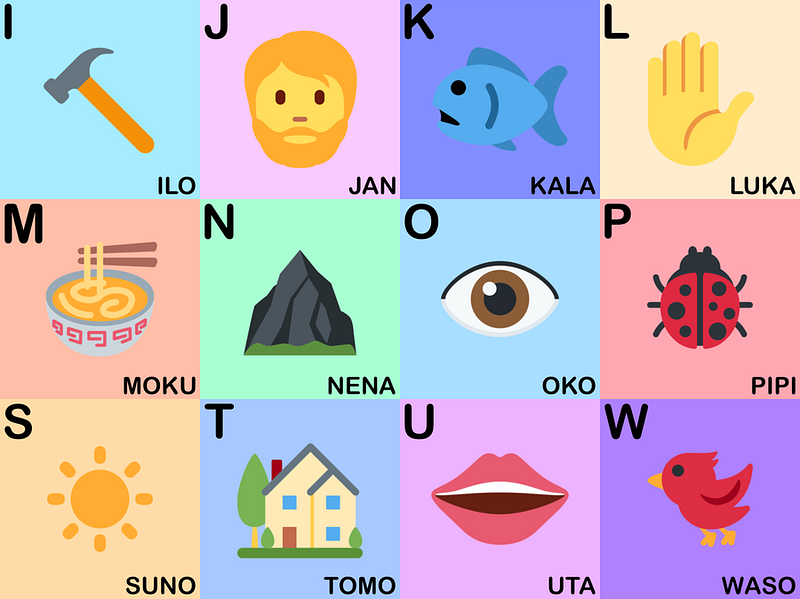
Latin Alphabet Chart for Toki Pona (Wikimedia Commons)

Language is something that comes intuitively to us humans.

As Noam Chomsky’s theory suggests, we are born ready to learn and understand languages.

And while languages usually emerge naturally through people’s interactions in a particular community, some of them are created for specific purposes.

The most famous examples include Esperanto, created in 1887 by L. L. Zamenhof as a universal second language; Interlingua, developed in the 1950s as an international auxiliary language; and Klingon, invented for use in the Star Trek franchise.

In 2001, a unique and interesting addition to the world of constructed languages was created: Toki Pona, also known as “the Language of Good.”

Encouraging creativity through simplicity

Developed by Canadian linguist and translator Sonja Lang, Toki Pona is known for its very small vocabulary, simplicity, and ease of acquisition.

Lang’s goal in creating the language was to simplify thoughts and communication as well as promote positive thinking through its minimalism and focus on simple, near-universal concepts.

Since the language is designed to be easy to learn and accessible to speakers of all backgrounds, it has simple grammar and a small vocabulary consisting of around 120–137 words, with each word being polysemous and covering a range of similar concepts.

So, to express more complex thoughts, words can be combined, which encourages speakers to use them in creative and imaginative ways rather than relying on strict literal meaning.

Coffee might be “telo pimaje wawa” (powerful dark liquid) to some and “telo ike mute” (very bad liquid) to others. — The Guardian

The language also has a simplified way of expressing colors, with only five words: black, white, red, yellow, and blue/green.

However, speakers can combine these words to make more specific descriptions of certain colors. For instance, “purple” can be represented by combining the terms for “blue/green” and “red.”

Aesthetic scripts

Interestingly enough, Toki Pona has more than one writing system.

Initially, only the Latin alphabet with 14 letters was used. But with time, other alternatives were created to represent the language in a unique light.

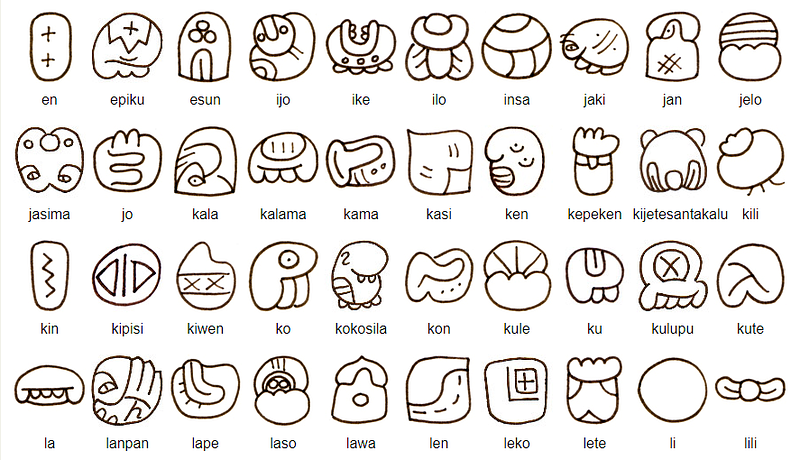
The two most successful and widely used writing systems are:

  • sitelen pona (“simple writing” or “good writing”)— a hieroglyphic-like script that represents each word with its own symbol and is known for its childlike shapes,
  • sitelen sitelen (drawn writing”) — a more elaborate non-linear system that uses logograms and an alphasyllabary to represent words and syllables.
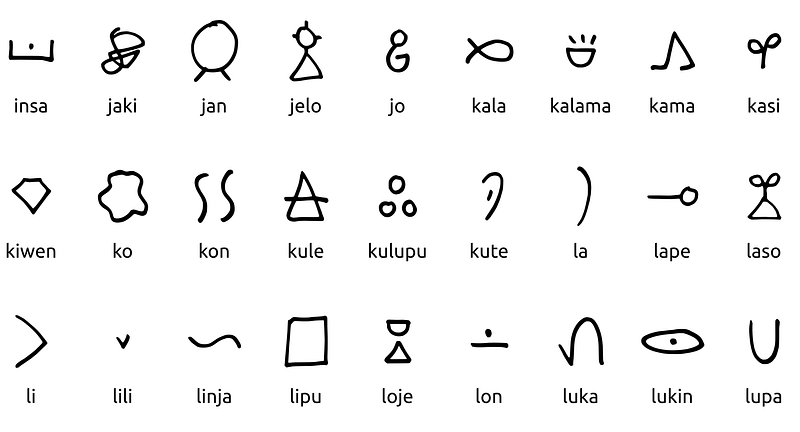
Sitelen pona (on the left) and sitelen sitelen (on the right). Excerpts from Toki Pona: The Language of Good. (Wikimedia Commons)

The artful designs of the glyphs in sitelen sitelen are inspired by various other writing systems, as well as US west-coast comix and east-coast graffiti artists.

Besides being aesthetically pleasing, the scripts also encourage users to slow down and think about language and communication.

How long does it take to learn Toki Pona?

Since it has simple grammar and a limited vocabulary, Toki Pona is relatively easy to learn.

It is estimated that it takes roughly 30 hours to master the language.

And not only is the vocabulary small, but the origins of many words are easy to identify. For example, toki means “speech” and is very similar to Tok Pisin’s “tok” and English’s “talk.”

Besides English (30%) and Tok Pisin (15%), words are also borrowed from other languages such as Finnish (14%), Georgian (8%), Dutch (9%), Acadian French (10%), Esperanto (14%), Croatian (12%), Mandarin (5%), Cantonese (3%), etc.

But how easy is it actually for us to radically simplify our thoughts, emotions, and abstract concepts when we are so used to doing the exact opposite?

It might seem impossible to express such complex ideas with a limited vocabulary, but that’s where the beauty of Toki Pona lies.

The idea behind it is that when we reduce our thoughts to their most basic elements, we are able to communicate more profoundly.

So, to be able to fully grasp the concept of it, we would have to unlearn a lot of things we think we know about language and communication.

And while the language doesn’t seem very practical considering today’s circumstances and our lifestyles, I think it is a great way to get the creative juices flowing and maybe gain a fresh perspective.

Let me know what you think. 🌻

Language
Toki Pona
Constructed Language
Language Learning
Fun Facts
Recommended from ReadMedium