
How Much Are Migrant Workers Lives Worth?
It is time Singaporeans take a hard look at ourselves and beliefs on the value of peoples’ lives.
On 21 April 2021, Singapore reported a second migrant worker death after a lorry carrying migrant workers crashed into a tipper truck (The Straits Times). Mr Sugunan Sudheeshmon, aged 28, leaves behind his wife and 18-month-old son who are staying in Kerala, India. His heartbroken mother shared that she worried daily about whether he would fall ill with Covid-19 and “never expected to take him back as a dead body” due to an accident.
On 26 April 2021, yet another accident involving a lorry carrying 10 migrant workers was reported (Channel News Asia, 2021). Pictures of the accident showed the lorry overturned on its side, and the fitted canopy had been flung off.
This unsafe practice of transporting migrant workers in lorries is not new. In 2010, 3 workers were killed when the lorry carrying them crashed, and they were “flung off the vehicle” (Today, 2021). Members of Parliament and the public called for greater protection of migrant workers. The Land Transport Authority and Ministry of Manpower then instituted a new rule where lorries had to be fitted with canopies and higher side rails. However, this is clearly not sufficient.
A Closer Look At The Lorries
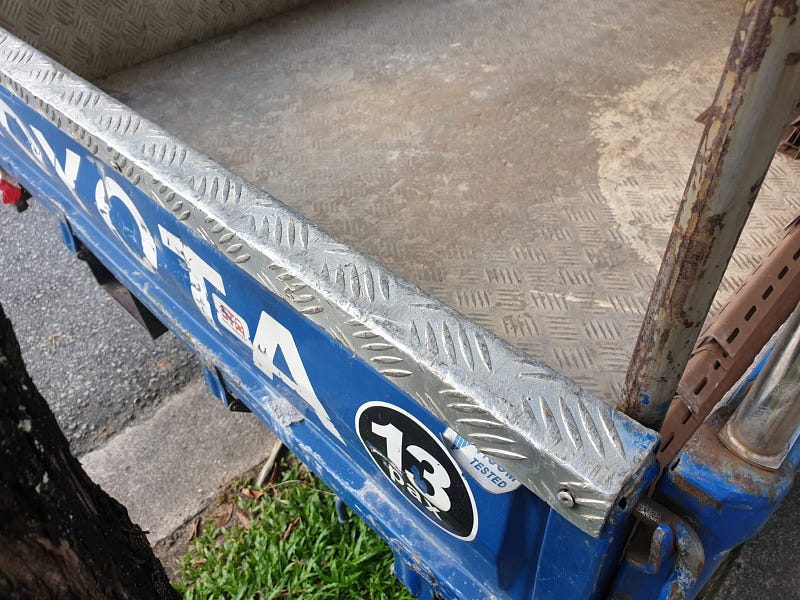
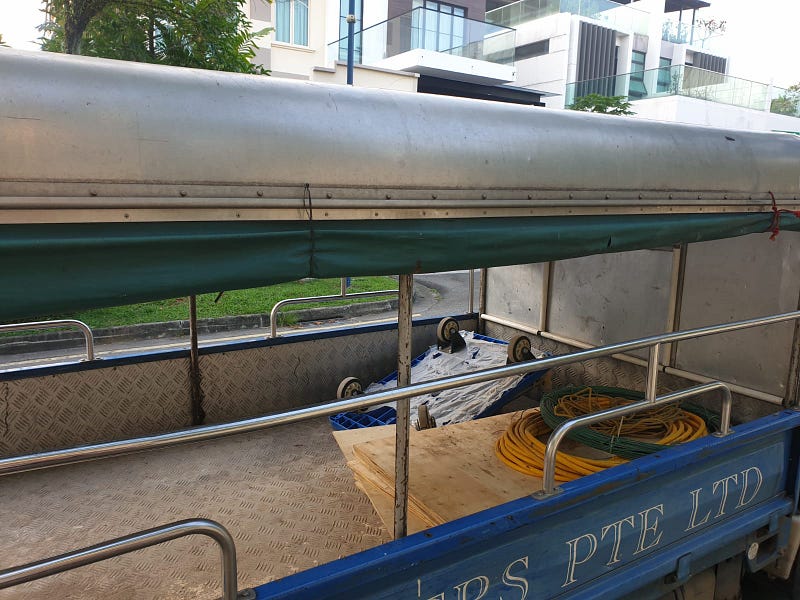
If you look closely at the images, despite the canopies and side rails, it still looks highly unsafe (and terribly uncomfortable). These lorries carry both people and the equipment used for their work. Each lorry comes tagged with the number of people it is legally allowed to carry. This means that the company can decide to pack in 13 migrant workers and the equipment needed. I have seen with my own eyes how some workers are packed like sardines and if they are unlucky, they have to sit right in the middle with no railing to hold!
In Stranger to My World, MD Sharif, a Bangladeshi worker in Singapore, writes about the terrible anxiety he faces when being transported in such lorries:
When I see migrant workers going to work in lorries, my chest becomes twisted. I want to stand in front of the lorry deliberately and tell the driver to run over me. If the government of this country is tired of mourning the dead, workers must stop riding in lorries! When I see migrant workers dressed in colourful, dirty clothes sitting in lorries, my heart weeps. I am ashamed. I become speechless and, for awhile, dull like the sun that is clouded over. Why is this the fate of those who sweat and sacrifice to modernise and boost the economy by building this city?
I wonder if our eyes have dulled. So often we see migrant workers transported in this manner that we hardly blink an eye. Sometimes, we look away, because some aunty had told us to be careful of prying eyes.
Would we act the same way if we saw our children in uniform sitting in the same setting? Would we not blink an eye if we transported the elderly in this manner? Would we look away in fear of prying eyes, if we saw tired blue-collared workers in suits, coming home from their day jobs?
Arguments made against proposals to transport in minibuses
In 2010, there were several proposals made to transport migrant workers in minibuses with seatbelts instead. According to Ng Jun Sen, writer for Today, the following arguments were made against these proposals:
- “The effectiveness of these improved measures should be studied “before concluding that (lorries fitted with canopies and side rails) are insufficient and going for a ban”. (Raymond Lim, 2010)
- Difficulty of organizing transportation in minibuses due to:
a. Many different dormitories that workers stay at off-site (Johnny Lim, 2021)
b. “Not optimal” to organize transport in this manner as there are thousands of workers and worksites (Johnny Lim, 2021)
3. Minibuses cannot be used at the worksite to transport materials, whereas lorries can. (Johnny Lim, 2021)
What Drives These Arguments?
As I read the arguments listed above, I couldn’t help but notice the patterns in the language used. “Effectiveness”, “Difficulty”, “Not Optimal” — these words reveal the intense focus on productivity. Decisions made on migrant workers’ lives are measured against the larger goal of productivity and efficiency.
This method of decision-making is known as Utilitarianism. Utilitarianism, simply put, asserts that a decision is morally right if it maximizes the “overall good” (Stanford Encyclopedia of Philosophy). This ethical approach was championed by philosophers like Jeremy Bentham and John Stuart Mill.
In this particular case we are examining, those who are making arguments against the use of minibuses for migrant workers do so because the “overall good” (i.e. less costly = more business for contractors; less organizational hassle = easier management) is achieved.
However, is this approach to decision-making still relevant today, especially in present day Singapore?
The Cost of Holding On To Utilitarianism
Holding on to such a framework for decision-making is innately harmful to society. It normalizes and presents to society as a fact that:
- Migrant workers’ lives are worth less than citizens or expats.
- The overall good of society should always be measured by the economic benefit of the decision.
- The majority’s needs and desires should always trump that of the minority’s.
These beliefs fuel a toxic culture of comparison between different segments of society, and further widen the inequality gap. The danger of measuring everything against the economic benefit also fuels the belief that work and the economy is more important than lives. Is this really a society that we want to build?
While utilitarianism may still have a place in our society, it should never be used as a framework for making decisions when it comes to life or death situations.
So How Much Are Migrant Workers’ Lives Worth?
The answer to this is, and should always be, priceless. All lives are priceless. It does not matter whether they are migrants, citizens, minorities, disabled, elderly etc. All lives matter. This must be our belief going forward. If it means greater inconvenience on upper management and greater costs on customers’ wallets, so be it. We cannot let another life be taken in such a senseless manner.
So please, honour the lives of those who work such hard jobs to build our city. Are safe minibuses too much to ask?