
Mature Flâneur Down Under
How Mount Taranaki became a legal “person” in New Zealand
It happened September 1, 2023
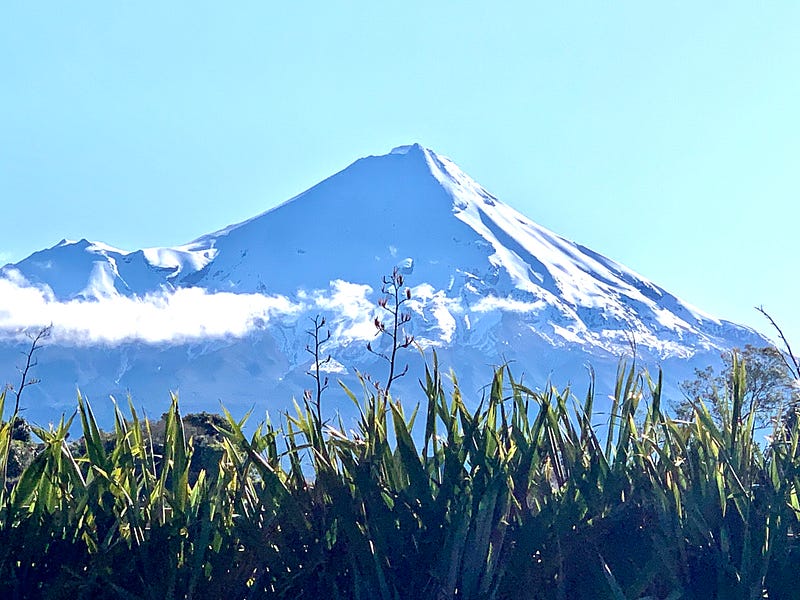
Mount Taranaki dominates the southwest coast of New Zealand’s North Island like Mount Fuji dominates Tokyo Bay. Its near-perfect snow cone is stunningly beautiful. It was wreathed in cloud when we first saw it from afar on our drive into the Taranaki district on Sept 1, 2023. Teresa (my beloved spouse) booked us into a B&B as close to the mountain as possible, with a full view of the peak from our backyard.
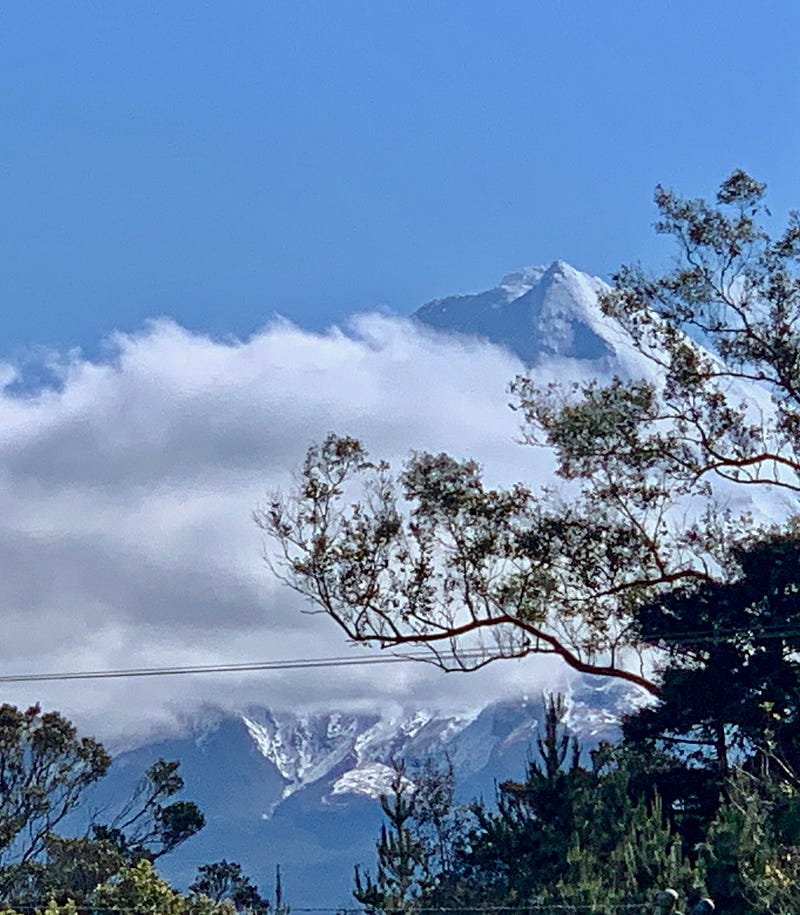
Throughout the afternoon we watched Taranaki play with that cloud: one minute revealing a hint of a cone, a few minutes later completely concealing itself. Then, just before sunset, the mountain whisked its white garment away altogether, as if to say to all mortals in the land below, “Ta da! Here I am, glorious Taranaki!”
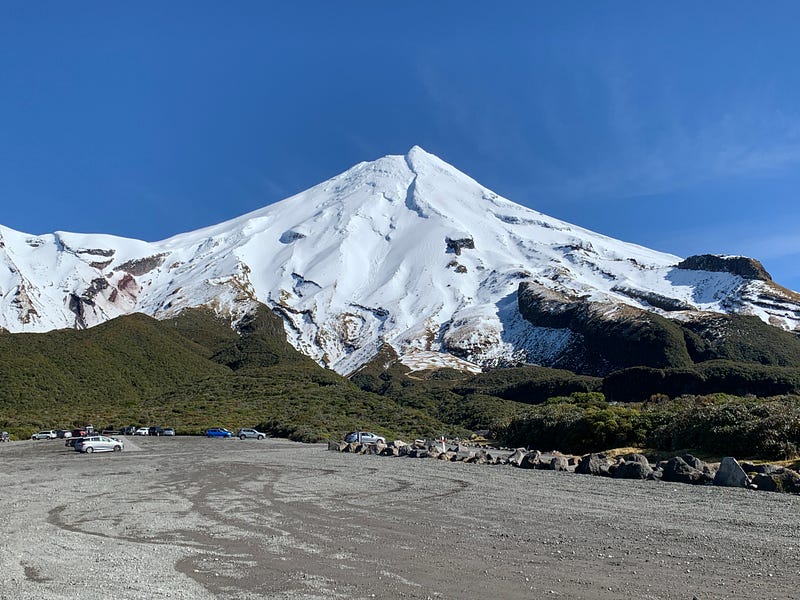
Little did we realize how propitious that magnificent self-unveiling actually was. On that day, Sept 1, 2023, at the conclusion of extensive negotiations with the Māori tribes of Taranaki, the Government of New Zealand officially recognized Mount Taranaki and the surrounding parkland as a legal person. Henceforward, the mountain effectively “owns” itself — or should I say, himself?
To the Māori, there is not the same division as in our world between human and non-human; their world is fully alive in a way ours is not. Major features of the land, such as mountains, are therefore anthropomorphized in myths into beings with their own stories, their own all-too-human emotions. In the case of Mount Taranaki, his tale is one of jealousy, humiliation, and love:
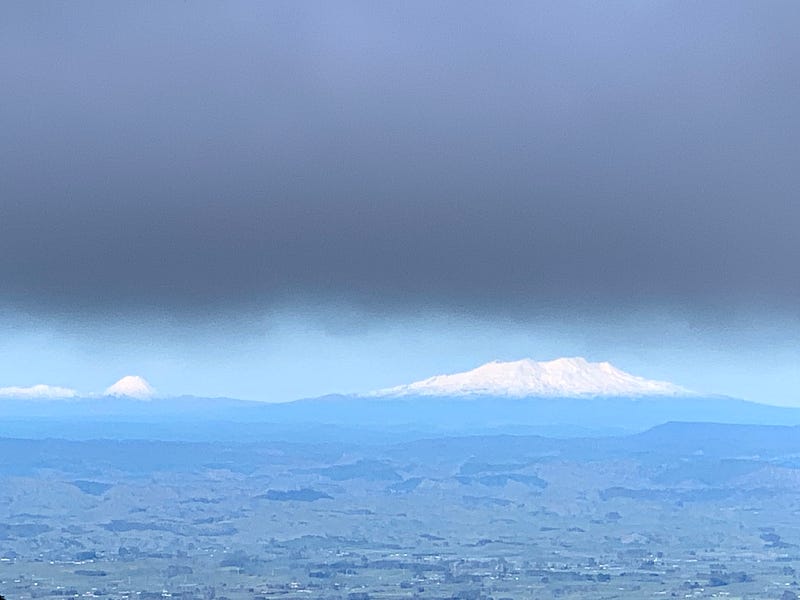
Taranaki once lived next to four other volcanic mountains in the center of the North Island: Tūrangi, Ruapehu, Tongariro, and Pihanga. Taranaki was in love with Pihanga, but so was Tongariro, who was stronger. They fought over Pihanga and Taranaki lost. Scarred and humiliated, he was exiled to the west coast. As he withdrew, his pathway carved out the long Whanganui River valley that runs from the interior to the ocean. When he arrived at the shoreline, he glimpsed the small but beautiful Mount Pouākai. He was drawn towards her, and loved her. Pouākai and Taranaki’s children became the trees, plants, birds, rocks and rivers that flow from their conjoined slopes.
To colonial New Zealanders, however, the mountain was named “Mount Egmont” in 1770 by Captain John Cook as he sailed along the coast, in honor of the first admiral of the British Navy, Lord Egmont. Egmont was an old man, and likely died before he learned someone had named a mountain after him. Just five years previously, in 2018, the name was officially changed to “Taranaki” on maps and government documents as part of the ongoing treaty negotiations with the Māori tribes of Taranaki, though until September 1 the national park was still named “Egmont.”
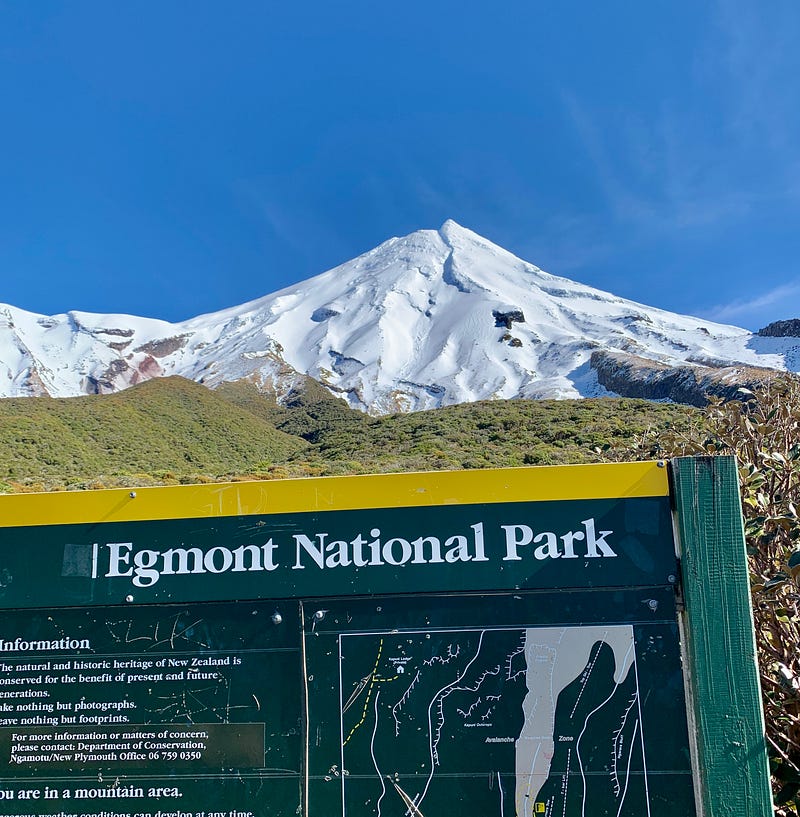
The name-change is just one part of a major victory of the tribes who have patiently negotiated with the government for years over the confiscation of their lands during the 1860s and 70s “Taranaki Wars”— a time when violence erupted between Māori and settlers, as land was taken from them without being properly sold.
Here’s how Radio New Zealand reported the story:
The deed recognised the Crown had breached [the terms] of the Treaty of Waitangi in relation to Taranaki Maunga [Mountian] including by confiscating almost half a million hectares (1.2 million acres) of Taranaki lands.
The national park that contains Taranaki Maunga and surrounding peaks, which is currently called Egmont National Park, will be renamed Te Papa-Kura-o-Taranaki, which means ‘the highly regarded and treasured lands of Taranaki’.
The park and its contents will be vested as a legal person, named ‘Te Kāhui Tupua’ — so the park will effectively own itself. But its interests will be represented by Te Tōpuni Kōkōrangi, a collection of both iwi (tribe) and Crown appointees.
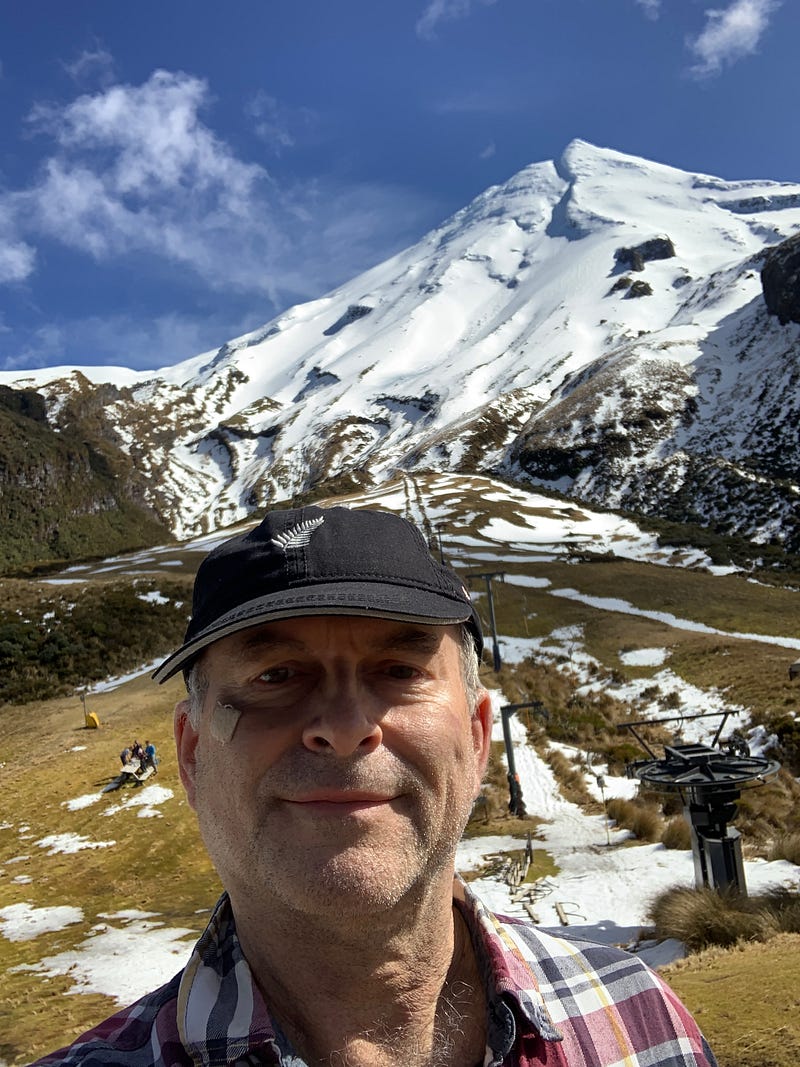
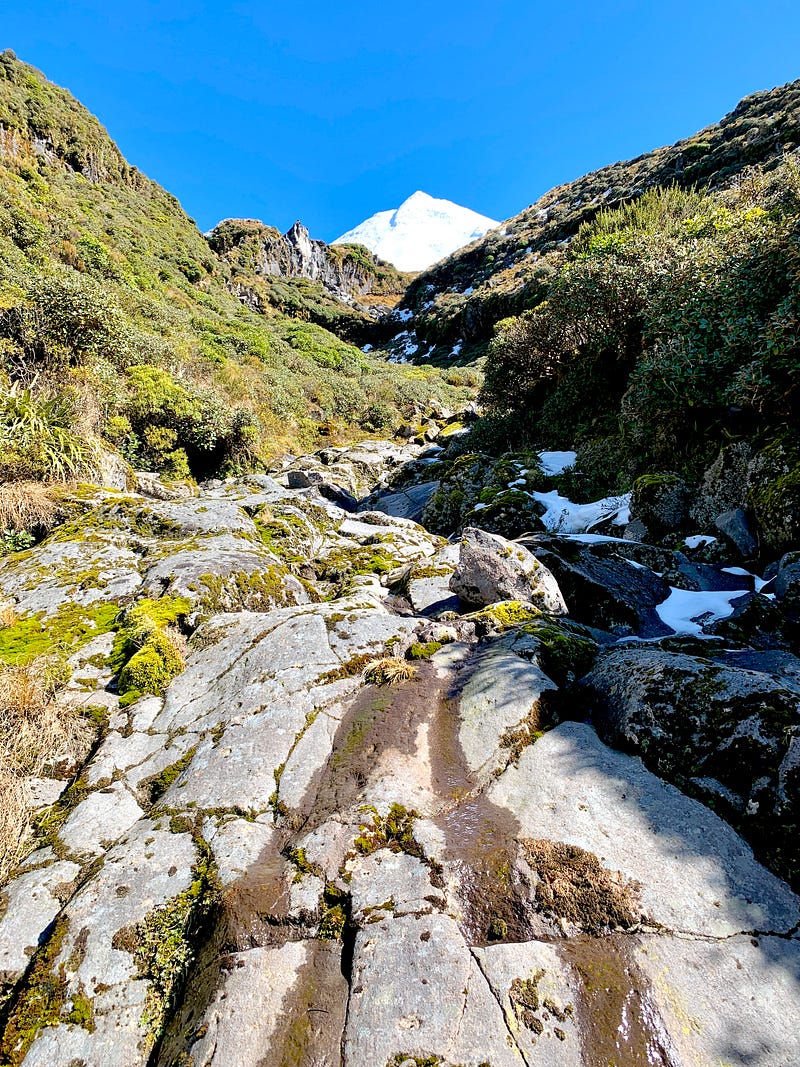
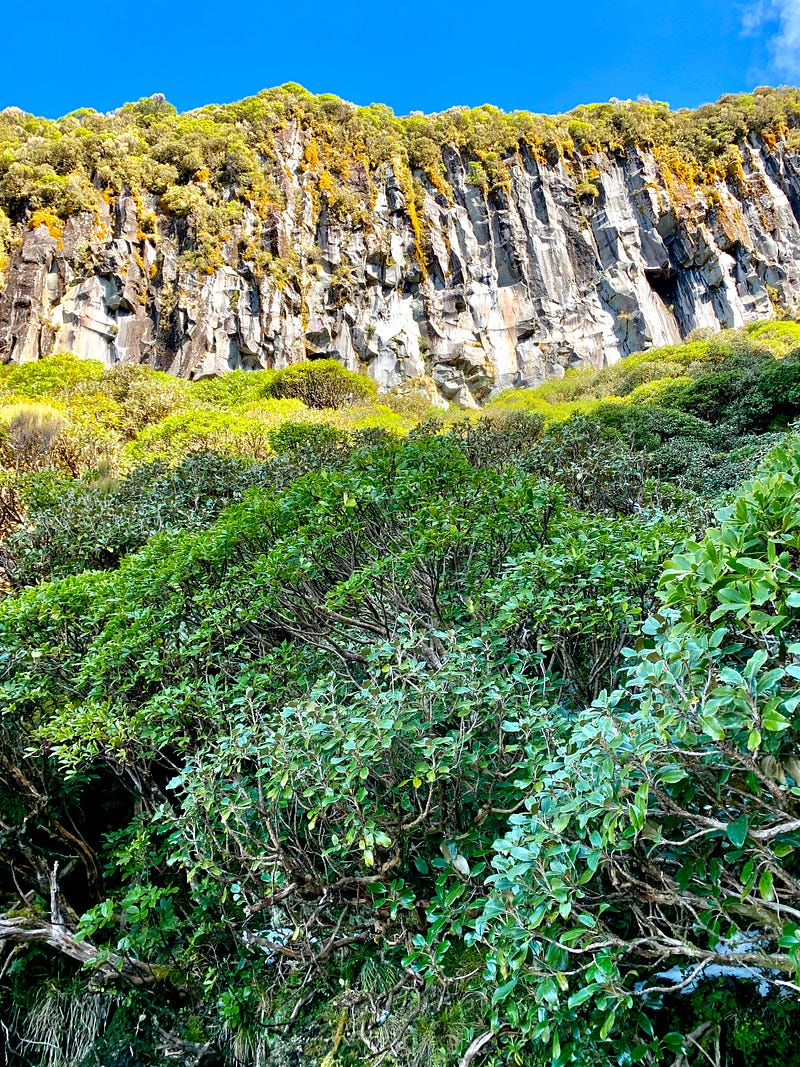
I went for a hike up to the snowline of Mount Taranaki the following day. The mountain’s vegetation at high elevation is composed of dense, low trees and bushes. The air was filled with birdsong. At one point, I paused to listen to what seemed like dozens of tūi birds, each one riffing its own unique, improvised-jazz-like melody, as if played on a set of bells. Stoat traps were laid out here and there along the pathways, with signs warning not to disturb the traps, as stoats killed kiwis. Kiwis on Mount Taranaki? Yes! In fact, they even live in the farm zones as far down as where we were staying. Teresa and I could hear them from our B&B in the evening, screaming their love calls from the wooded banks of a nearby stream.
At the snowline I found a ski lift operating. Dozens of people were skiing and sledding in the warm, spring-like weather. I asked four of hikers I met on the trail who were locals if they knew about the name change and the new ruling, and they all did. So did the hosts of our B&B. My sense was that though they all seemed positive about it, the change was not all that relevant to their lives.
But I think it is a big deal. I wonder, is this the first instance of this kind of legal ‘vesting’ of a mountain with personhood? How cool if it were to become a precedent in other countries as well — a new way of legally defining our relationship with our mountains, rivers, wetlands, forests?
The whole Taranaki community is on a fascinating journey. Their district website lays out a detailed roadmap for a “Just transition to a low-emissions future” by 2050. It’s an an ongoing process of collaboration and vision creation that specifically acknowledges the role of the mountain as Maunga.
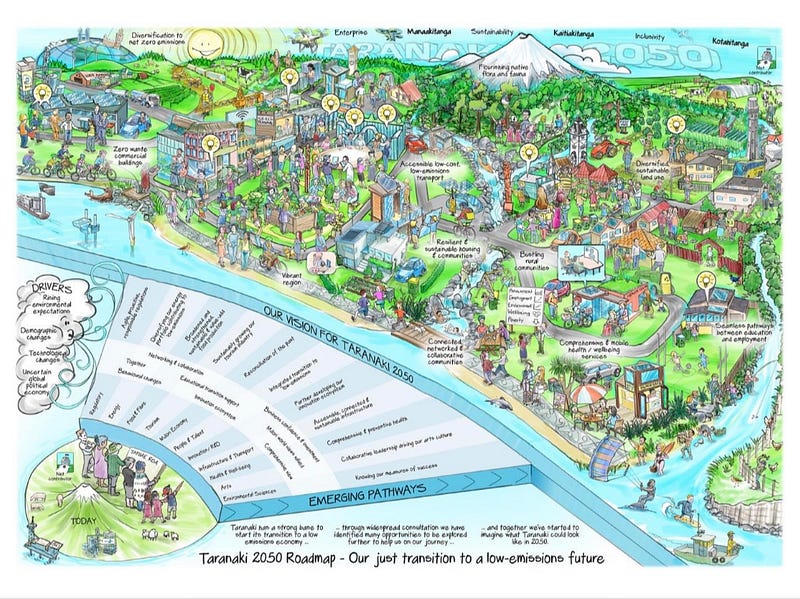
From their website:
Today we’re leading the drive towards a prosperous and sustainable future with fresh thinking and an innovative spirit. Vibrant and stunningly beautiful, our ancestral Maunga guides and protects us, stretching to the Tasman sea and an endless horizon. A horizon we’re looking beyond.
While any attempt to chart a course to a desired future is bound to be fraught in an era of climate change, the very mountain that provides the region its blessings also poses its greatest threat. Because Taranaki is not a dormant volcano.
Taranaki is the volcano “most at risk” of large eruption in next 50 years in New Zealand, according to volcano researchers. The mountain first erupted a mere 130,000 years ago, and has erupted and collapsed many times since. Scientists have determined that on average it has a major eruption every 300 years, and it has been about 250 since the most recent one. So, geologically, this mountain’s story is not one of jealousy and romance, but of destruction and rebirth.
Somehow, I do not think the Māori have a problem reconciling this volatile geology with their romantic mythology. For several hundred years, since arriving on these Islands from Polynesia, they have endured and recovered from eruptions, earthquakes, floods and other natural disasters — not to mention the conflicts with British settlers and the loss of their land. But, they are a patient and resilient people. They survive. They rebuild.
The scientific articles I scanned on Taranaki’s volcanic history included plans for Taranaki district to prepare and recover from eruptions — which though it doesn’t appear on the brightly colored 2050 vision-roadmap, will doubtless be part of the planning that goes into realizing Taranaki’s future, and the continuing story of the first mountain to gain legal recognition as a person.
***
Please take a look at my new book: Mature Flâneur: Slow Travel through Portugal, France, Italy and Norway.


