
How Moral Are You?
Everybody has a price, the important thing is to find out what it is

Have you ever been to the church?
In a typical church service, the preacher will tell you a good deal about how we are all created in God’s image and likeness. As a person created in God’s likeness, you have to aspire to be as God wants you to be holy, righteous, upright, with a god-like sense of morality. This same scene repeats itself in mosques, synagogues, and other temples, only with a different set of religious rituals accompanying it.
An unbelievably large percentage of the world is religious, which means that an unbelievably large number of people actually listen to these sermons and believe in them enough to take them to heart. And so, a lot of people go around their daily lives with a higher sense of calling, a calling to morality. Even in non-religious settings, there is a great deal of talk about ‘doing the right thing’. Morality is the unspoken ideal everybody tries to live up to, and every day is judged by the amount of good one is able to do, or at least how one tries to mitigate the harms one can’t control. Morality is the ideal that is lurking in the background of every action we undertake.
Due to how serious the topic is, it would be morally right (pun intended) to inform you at this point that I’m not about to take a deep dive, thorough look into morality from some philosophical standpoint that equals the philosophical prowess of Aristotle or other more refined contemporary philosophers. Far from that. Instead, I’m about to do some good old ruminating and opinionating. Now that we’ve got that out of the way, let’s get into it.
What makes a person more moral than another? What qualities does a person have to possess to be judged as having a higher sense of morality, or being on a higher moral standing than another? Well, this could be a topic for a long and drawn-out argument in a philosophy class, but since we aren’t doing all that, I’ll give you the answer in a nutshell. Usually, the person usually has a higher sense of moral responsibility. This sense manifests itself in one of 2 ways;
1. The individual tries to do the best good for the highest number of people as much as they can. This can manifest itself at work, where the individual displays a sense of duty, executing their work excellently, and being an exemplary, diligent employee.
2. The person maintains a strong principle of right and wrong based on their conscience or religious views that preclude them from compromising their work or selling out for financial gain. They will refuse to do anything that stands against their moral principles, even if it brings them material or immaterial gain.
If you are in the second category, congratulations to you; not a lot of people make it to this category. You are the kind of person that many people would refer to as a hero. You would be idealized in movies, played by a self-righteous actor; a person who doesn’t care about possessions or status in the world. A person who won’t be compromised by money fame or power. This ideal is held up as the ultimate human, someone we should all look up to, and an ideal we should all aspire to. A person who has conquered greed and is beyond reproach; the ultimate human.
But does this person really exist? As an idealized human definition of morality, money, power or personal gain isn’t the price. But does that mean that this individual can’t actually be bought? Sir Robert Walpole didn’t seem to agree in 1734 when he looked at the corrupt members of parliament and declared “…all men have their price…”. Whatever the intents and meaning of Sir Robert Walpole — may his soul rest in peace — he was up to something.
Let’s look at Maslow’s hierarchy of needs for some little guidance here. On the first level of his pyramid of needs are physiological needs like air, water, food, shelter, clothing, and reproduction. This is the entry-level step. There are people who can be compromised by these levels of needs. For these people, their rudimentary needs in life such as food, shelter, and clothing have not been fully satisfied, and so offering them these rudimentary things can exert great leverage over them. For these people, their price is on the entry-level step; physiological needs.
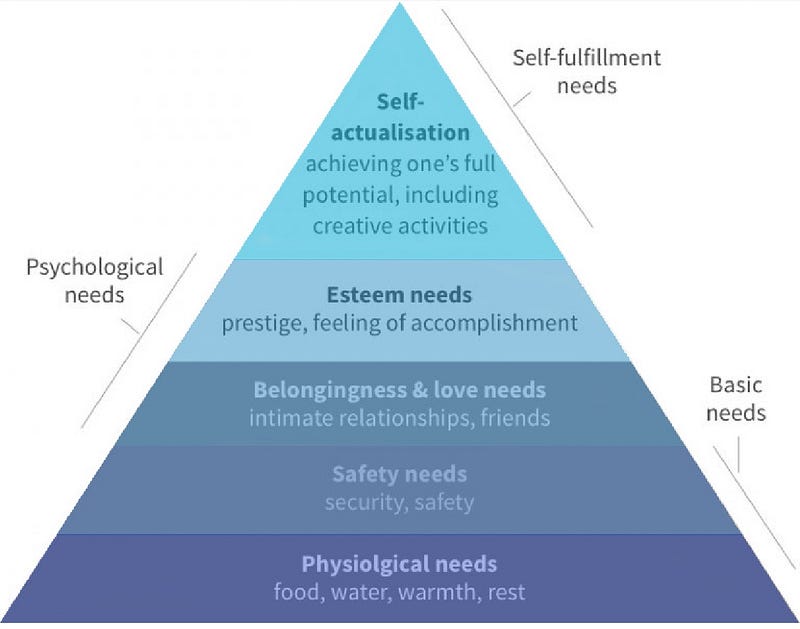
As you ascend Maslow’s pyramid, the nature of the needs progressively changes. From the entry-level needs which are anchored on physiological satisfactions, the pyramid progresses upwards towards less tangible needs. The list becomes less material and more abstract. It goes from physiological needs to safety needs (personal security, employment, property, health, resources), to love and belonging (friendship, intimacy, family, sense of connection), to esteem (respect, self-esteem, status, recognition, strength, freedom) and finally to self-actualization (desire to become the most that one can be). Without bothering you with the details, the point is that as our faces are different, so are our needs. Every individual’s needs lie somewhere on Maslow’s pyramid; some individuals are higher on the pyramid, whereas others are lower. The key to finding out what it takes to comprise an individual or buy them off therefore depends on finding out their level on Maslow’s hierarchy and what their peculiar combination of needs are. For a person who has transcended the level of psychological needs, needless to say, it would be foolishness, or at best an effort in futility if you tried to buy this individual’s conscience with money that is only enough to cover these needs. Take for instance a person who needs status, recognition, or freedom (items on the last but one rung of the pyramid), if you must offer this individual money in a bid to make them bend their sense of morality, then the money better be large enough to afford them the recognition, status, or freedom that they crave. On the other hand, you would be better off offering this kind of individual a position on a board, a lifetime award, or other things that confer on them the level of esteem that they think is befitting for them.
At the end of the day, we are humans and humans are imperfect beings. Yes, we aspire to a higher calling, we aspire to attain the noblest state of existence, where we can truly be said to have attained the highest state of morality. Despite our noble aspirations, we fail. Although most individuals would like to be seen as moral, they are only moral to the extent that they cannot be bought cheaply, or with material things. But there is always a price, everybody has a price. If you offer someone a bribe in the right way and it gets turned down, you’ve done one or more of the following;
A. You didn’t get the timing or place right i.e. you’ve tried to compromise a person in a place or at a time that is inappropriate.
B. You’ve underestimated the price
C. You are completely wrong about the nature of the individual’s need(s) and consequently, the content of the price.
In the infamous words of Pablo Escobar,
“Everyone has a price; the important thing is to find out what it is”


