
How Mental Illnesses Emerge: Defenses Against Love and Happiness

Every mental illness can be understood as a function, not a dysfunction. Instead of failing to function in work or love — Freud’s metric for the efficacy of psychoanalysis — we can see mental illnesses as succeeding in creating a desired world, or avoiding a feared one. Mental illnesses, like sanity, can be understood as navigations of a troubling world.
Mood disorders (depression, anxiety) are defenses against happiness. They come between the person and the happiness they would live were it not for their inner plague. Personality disorders (borderline, narcissistic) are defenses against love. They create a rigid set of beliefs or behaviors that all but prevent unconditional love.
This is why depressed people can lead meaningful lives despite their suffering whereas narcissists, even when successful in work and society, lack meaning. For what is your meaning if you cannot love?
To state that we can see the function in a pathology is not to imply the patient wants this defense or consciously chooses it — only that it works. The abused child who grows up to have a personality disorder doesn’t feel safe in love, and so, avoids it through the sabotage of their pathologized personality. Their personality itself is a defense mechanism that prevents vulnerability in self or other, ensuring a different narrative: the one in which love fails: fails to happen, fails to hurt them. The unhappy child who was not loved or nurtured doesn’t align with happiness, and so grows to live a life that feels like their childhood: the futility of seeking happiness in a world that obeys their childhood. Our childhood is the belief, our adulthood, the behavior.
Here is an embrassingly brief description of how various mental illnesses can accordingly be seen. I say embarassingly because I have sacrificed depth for breadth. This is to depict, not explore, these pathologies.
Personality Disorders
- Narcissists can see their own soul, but not others’. Hence they conclude that the (only) soul exists for self-importance, not connection. There are, after all, no other souls with which to connect. The only act left is to please oneself. The only reason others exist is to supply pleasure. There is no shame at hurting others since they have no souls. Their victims call narcissists ‘soulless’, when, ironically, this is how the Narcissist sees them. If only they could find someone who wouldn’t mind…
- Dependent Personality Disorder involves an inability to function independently or say no. To quote Atmosphere, they are ‘aggressively passive.’ They pair well with Narcissists because they outsource their confidence and autonomy to a parasite who is only too ready to weaponize them.
- Borderlines believe love is real — until it is touched. They avoid touching love for fear of its disappearing, and then touch it for fear of being unloved. They need what they fear, and fear what they need. If only they could find someone whose superpower was to never leave…
- Avoidant Personality Disorder makes an obsession of shame. They deserve nothing, and so they pair well with Borderlines due to their lack of boundaries and excessive tolerance of others’ impositions.
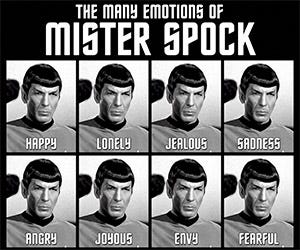
- Schizoid Personality Disorder was in fact the inspiration for the seemingly apathetic Spock. They rarely demonstrate human emotion outside banalities or formalities. They can care, but will almost never look like it due to their sliver of emotional range.
Mood Disorders
- Anxiety is an awareness of the lack of control one has over one’s life, which is reflected by the lack of control over one’s feelings. This usually takes the form of obsessing over a potential future pain or decision so as not to be present.
- Depression is a living of life without life-force, as if one has mixed feelings about existing. Depression can yield an insidious shame: of the fact that the depressive is living. The depressive and his happiness stare at each other through the thick glass of unlived life.
- OCD involves controlling one’s outer world to compensate for one’s lack of control over their inner world. The disease imbues the material world with a religion of order that knows no limit, all the while disguising a psyche that is rampant chaos. Salvation is replaced by hyper-ritualized control that is as futile as it is repetitive. A religion of obsessiveness that threatens hell without delivering heaven.
Neuroses
- Parentified children (usually, children of alcoholics) grow to fall for ostensible grown-ups who suffer from Peter Pan Syndrome. They once again find themselves caring for an emotionally incompetent adult. They need and resent control the way Borderlines need and resent vulnerability.
- Peter Pan Syndrome often results from a parent who left, leaving a void of adulthood that childhood fails to fill. Or, the coddled child grows to find an adult who will enable them the way their spoiling parent did. They often believe they are special, and it is the harsh adult world that is not appreciating them that causes the problem.
- Chasing love in the emotionally/physically unavailable person. This is a defense mechanism wherein if their crush were to magically become available, the attraction would immediately disappear. To them, love is a theory, not a practice. By wanting what they cannot have, they are prevented from having the vulnerability they cannot handle. Vulnerability for the wounded can feel like a disease, and so sabotaging a relationship through futility is its own cure.
- Celibacy/Promiscuity. There are healthy versions of both, though this can also be an outgrowth of molestation. Either often means a person avoiding vulnerability by avoiding intimacy or, alternately, spreading it thin asymptotically. (I have always wanted to use that word to describe sexual neurosis. Done.)
- Falling for Damaged People. This form of codependency involves the need to be needed. Those who rely on us due to their dependence will not leave us. The certainty of not being abandoned becomes the main criterion sought in relationship, at the cost of all others. This is why I tell people who date addicts: ‘He was addicted to his drug. You were addicted to him.’
- Self-sabotage. The ultimate self-fulfilling prophecy of the pessimist. It’s as if you believe life will ruin you, but you fool life by beating it to the punch.
- Addictions. This almost always involves a trauma that puts a hole in the heart where love should have been. The addiction is stuffed into that hole, but, since it is fleeting, dissolves, and the hole is exposed once again. This is why addiction never cures itself, but love does.
You can request an article in the comments. You never know.
To follow me: https://medium.com/@myartman
To subscribe: https://medium.com/@myartman/membership


