
A Book Review
How “Mastery” Helped through my First Job
Four Life Lessons From Robert Greene
Finding a proper job in Greece is considered a tough challenge for a post-graduate, especially when he or she lacks the working experience. The odds of finding a job in your field are the same as the chance of me keeping my writing schedule. As a result, many young Greeks experience great disappointment since they have a deep desire to work, but can’t find a suitable job for their educational and economic level.
After eight months of stagnation, with the help of a recruiting website and a lot of luck, I’ve been hired to a job that matches my studies and expectations. In that time-span, between disappointing interviews followed by a great deal stubbornness and night palpitations probably caused by anxiety, I wrote and read every day.
I didn’t read a lot of books, instead I narrowed my focus in a handful of them in order to absorb every ounce I could.
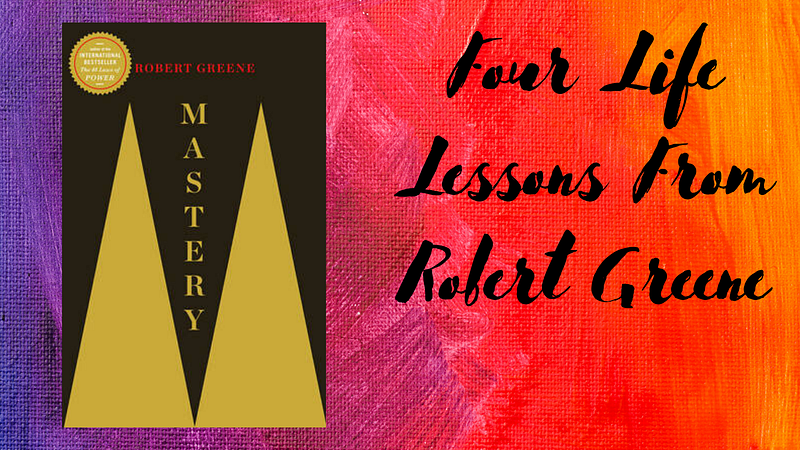
My main companion was “Mastery” by Robert Greene.
I’ve bought the small version of the book to carry it with me.

Going deeper into practicality: The beginning of Mastery
Being fortunate enough to study in a department that includes many laboratories instead of classes, “practical thinking” was encouraged. Of course, there were few exams that you have to absorb information regardless of whether you comprehend the subject or not; still, many professors gave the chance to understand the subject deeply.
After taking my diploma, I could have enrolled for a master degree here in Greece for two more years, pass the classes ending with an intriguing thesis.
I genuinely enjoyed studying, but I wanted to experience a reality that is ruled by practicality for the most part of it and not passive absorption.
As we get older, greater emphasis is placed on book learning-absorbing as much information as possible about various subjects. Such knowledge of history, science or literature is abstract, and the process of learning largely involves passive absorption. Passage from Mastery
The first mistake a new employee is prone to make
When I started in my new job, my main focus was to absorb the new world I’ve encountered. The way of doing things was as fresh as engaging. My luck continued since I met my supervisor, a genuine man willing to share with me a ton of practical advice. Apart from learning how things work in this new environment, I sometimes find my self in an emotional need of wanting to prove myself.
Many times I’ve attempted to change things that were beyond my understanding at the time. When I got into the job, I focused on proposing different (let alone untested) solutions for several problems. I was happy about my ideas and proud to share them with my coworkers.
I was acting foolish.
I misjudged that new ideas are hardwired with creativity.
In reality, the distance between new, untested ideas and creativity is vast, especially when you are a new employee.
Taking into consideration our time at school and university, we place value on making a good impression when we enter a new environment. Unfortunately, we carry this habit into our working environment as well. We crave an approving comment about our work, neglecting important social dynamics or lessons from our mentor. This need for approval can take considerable emotional space, leaving out crucial information about work itself.
Any positive attention you receive is deceptive; it is not based on your skills or anything real, and it will turn against you. Passage from Mastery.
As Mastery suggests, good impressions must be accumulated by the thirst of knowledge, not the desire to rise on higher ranks unprepared.
Mentors: The exploiters of your weakness and the ticket to Mastery
Let’s be honest, the information we receive from books are not tailored to our personalities. Especially with non-fiction books, the best we can do is mix the information we receive with the way the world responds to us and vice versa. Fortunately, certain people appear to our lives who can help us take a closer look into habits and thought patterns that we avoid for years. Exploit uncomfortable facts about ourselves that we neglect while we read books that validate our beliefs and boost our ego.
Those people are called Mentors.
In my first months in the company, each time I worked on a project, my mentor/supervisor would take a glimpse to examine the way I worked. When he didn’t like the way I approached the matter, he would stop me and say: “You got to learn to work properly” and he would show me a more productive way.
Mastery takes a good look at the apprentice-mentor dynamic by sharing strategies to take advantage of this relationship fully. I’ve enjoyed the story of Michael Faraday and his relation with his mentor.
Robert Greene does a fantastic job of explaining the mentor-apprentice relationship before it even began. He explains the way Faraday was able to gain entrance to the elite science club even though he came from a lower social class, the way he learned by his mentor and the reason their relationship had to come to an end.
The Naive Perspective: The Road Block to Mastery
Chapters like “The Naive Perceptive” is the reason I still read “Mastery” five years of its purchase. I have fallen victim repeatedly to this perceptive; therefore, I try to come back to this chapter as a reminder.
The naive perspective goes back to when we were little and the way we idolize our parents. There was one point at our childhood that we say that mom and dad aren’t so gracious as we imagined resulting in great anxiety within us. We refuse to comfort reality and accept that people don’t possess one-dimensional traits we cloud our view projecting our desired values to them.
This perspective is transferred through our working environment, making us victims always reacting to other’s people misbehaviors. We are blinded by their true motives hence still being on the defensive.
Social Intelligence is nothing more than the process of discarding the Naive Perspective and approaching something more realistic. Passage from Mastery.
A book companion: A strongly recommend the book “What Every BODY is Saying- An Ex-FBI Agent’s Guide to Speed-Reading People”, while you read Mastery’s chapter regarding social intelligence.
Closure — Mastery is a tool
I would suggest that Mastery isn’t a book in the way you read it once and dispose of it. I’ve found to be a useful tool that accompanies me through my life. Mind that I’ve scratched the surface of it’s first part “The Apprentice Phase”.

Stay in touch. Sign up to my Newsletter!
Thanks to Raf Bakoulis


