
How Marketing Creates Memories
And why “memories make sales”
Imagine you’ve snagged a face serum after it’s gone viral on TikTok.
The serum promised fantastic results, but only if you used it every night.
You were really excited to see your skin transform, so you used the serum every night… for a few days.
Then your old skincare habits took over. You stashed the fancy serum in the back of your bathroom cabinet and forgot all about it.
Turns out, the number one reason new products fail in the long run is that people just forget to use them.
So how can we, as marketers and experience designers, create memories that help our brands grow?
Here’s what behavioral science, psychology, and neuromarketing suggest:
How to Create Memories for Customers: The C.R.E.A.T.E.S. Model
If you want to be unforgettable, follow these seven principles:
C: Consistency
R: Repetition
E: Emotion
A: Attention
T: Time & Frequency
E: Experience
S: Storytelling
1. Consistency
If you want someone to remember your brand, don’t change the logo, the packaging, the brand colors, or even the spokesperson for a while.
And by “a while,” I mean years.
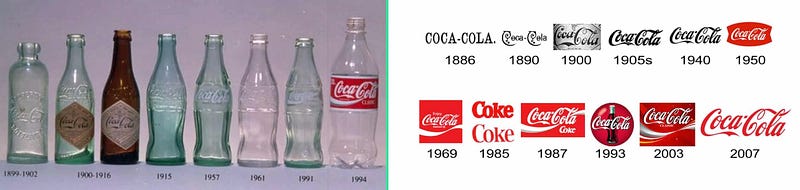
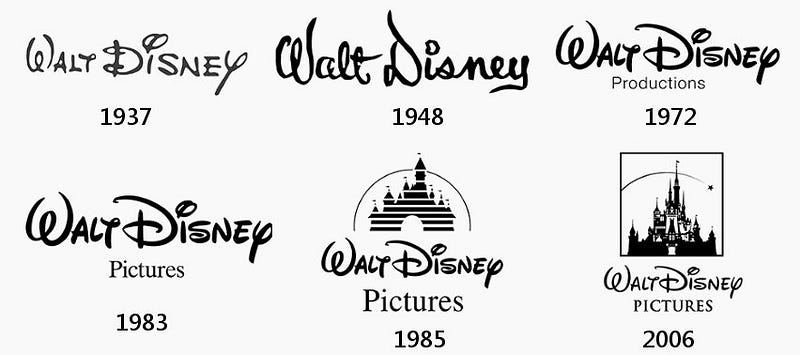
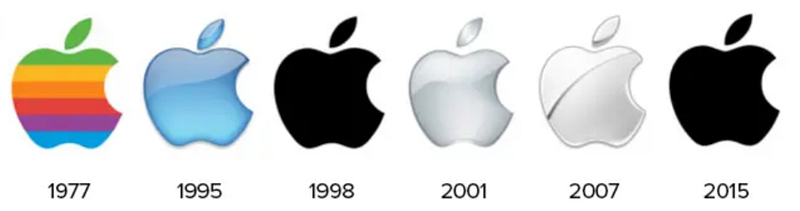
Sound extreme? The world’s most recognizable brands are surprisingly consistent:
Coca-Cola: 100+ years of basically the same logo
Disney: Small deviations on their logo in the past 85+ years
Apple: A strikingly consistent logo for the past 45+ years.
2. Repetition
If you want people to remember your brand and what it sells, you can’t just tell them once.
You can’t tell them twice.
You have to tell them thousands of times.
Consistency and repetition go hand-in-hand.
When you show someone the same logo thousands of times over the span of 20 years, it’s easy to remember. But if you show a customer 10 different logos in 20 years, it’s nearly impossible to create memories, because to the customer, the brand is always changing.
It’s why brands like Coca-Cola spend more than $4B a year on advertising that puts those brand assets on display (without talking about price or product features).
The more you want someone to remember something, the more you have to repeat it.
3. Emotion
Want people to remember your brand and its products? Make them emotional.
Studies tell us that emotion is like superglue — it makes information stickier and more likely to be remembered.
Deloitte Digital even found that these positive emotional experiences drive business results:
- 92% of customers are more likely to stay loyal to a brand with which they have a positive emotional connection.
- 88% of customers are more likely to spend more with brands about which they feel positively.
- 91% of customers are willing to advocate for businesses with which they associate positive emotions.
Nike evokes the emotion of sports:
British retailers John Lewis are world-famous for evoking the emotions of Christmas:
Even this Ford ad that celebrates human innovation evokes feelings of pride in its viewers:
4. Attention
Marketing can’t create memories if everyone ignores your marketing, right? So grabbing attention is a key part of creating memories. And while emotions and storytelling can capture peoples’ attention, making sure our messages are salient and simple is critical as well.
Salience Bias describes our attraction to things that are “easy” for our eyes to notice. So what elements can make something salient?
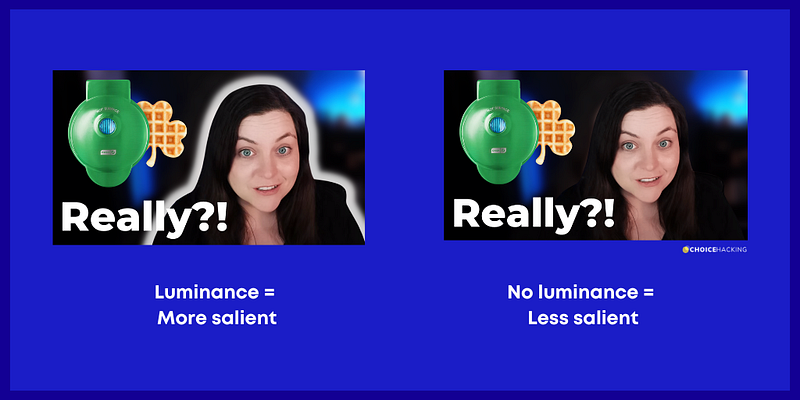
1. Luminance: The intensity of light emitted from an object.
For example, a glowing effect around an element will make it stand out from the background.
2. Texture: Patterns that add more visual information.
For example, fried chicken is more salient than grilled chicken because its crunchy texture draws attention. Any type of angular or interesting texture attracts attention.

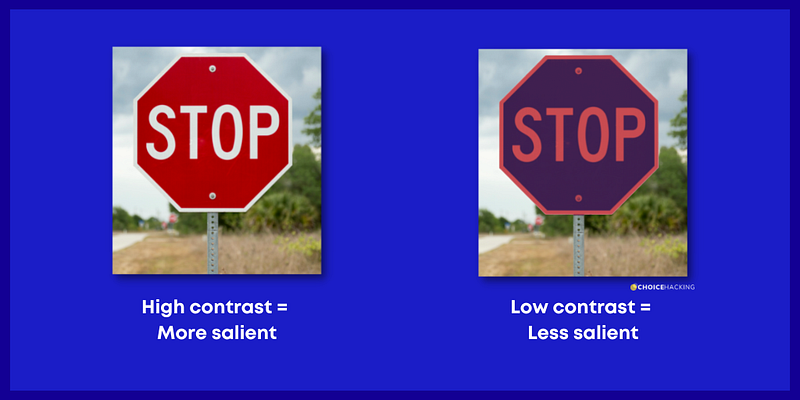
3. Contrast: How different two colors are from one another.
For example, black text on a yellow background is a combination often used for road signs. Yellow contrasts with the surrounding environment, and black contrasts with the yellow background.
This results in a clear message, that’s also easy for drivers to notice.
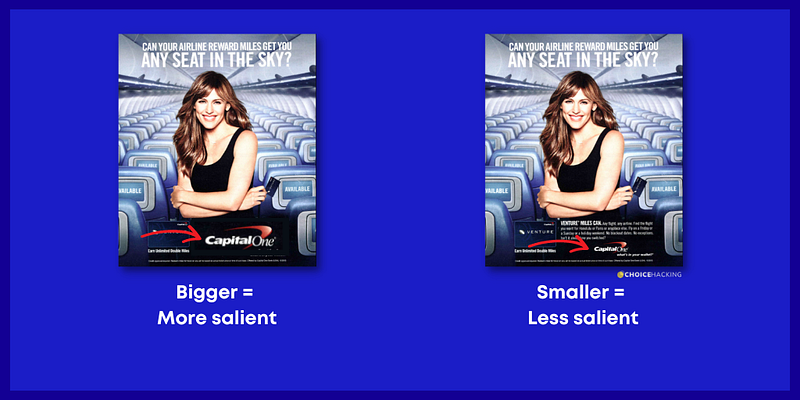
4. Size and Scale: The size of one element in comparison to another.
In some cases, a client’s request to “make the logo bigger” is correct (at least when it comes to salience).
5. Time & Frequency
Even if you’re repeating a consistent message, you still need to give these messages time to sink in. Does that mean you should invest all your money in playing the same TV commercial on repeat?
No. In fact, it’s much more effective to leave some time for customers to digest what they’ve seen (before seeing it again).
The Spacing Effect says a brand is more memorable when it’s seen multiple times, but those views are spread out over time — not one right after the other.
A steady drip approach is more effective than a constant barrage of ads or short bursts of activity.
6. Experience
If want to teach someone a new concept, “learning by doing” — also called Experiential Learning — is the most effective method. If you want your child to learn addition, for example, having them add physical blocks together instead of abstract numbers can help them better understand the concept.
When we physically experience something, it increases the chances that we’ll absorb and remember the concept.
Experiences are sticky — they become memories much more easily than random information. So it makes sense that customer experiences and experiential marketing are so important to brands.
7. Storytelling
Narrative Bias says that people make sense of the world through stories. Our brains have to process a lot of information, so we pay more attention to (and better remember) narratives instead of random information.
That’s why it’s easier to remember the plot of Hamilton than it is to memorize the Constitutional Amendments — our brains remember the story of the musical, but have a harder time stringing together non-narrative information.
The Bottom Line
As marketers, it can be tempting to think that advertising is driving sales. That the right ad at the right moment, with the right message is all people need to buy. But in reality, that happens very rarely.
More often customers have been exposed to your brand in multiple places before they click buy. They remember your logo, your name, or what you do.
Things like Consistency and Salience might feel unsexy, but it’s the most critical work of marketing. It helps work a groove into consumers' brains so that when it’s time to buy, they choose your brand. As the saying goes:
Memories make sales.
Getting traffic but not enough sales, leads, or clients? 👇
What if you could quickly understand a customer’s impressions of your digital experience, get rapid expert feedback, and immediately understand how to improve your experience with marketing psychology and behavioral science?
My popular Choice Hacking CX Audit can help you.
✅ 43-point CX Audit
✅ Drive sales and retention
✅ Build your brand for the long-term
// What is a Customer Experience Audit?
Part expert review, part user research, and part behavioral diagnostic, I record a video teardown of your website or marketing experience and share my initial recommendations in an actionable 43-point CRO report.
Each audit will help you:
✅ Instantly understand flaws in your messaging, visuals, design & information architecture
✅ Quickly identify areas where behavioral science and persuasive design can help your business accomplish its goals
✅ Predictive AI Salience analysis to understand what users are noticing and what they’re missing.
To see an example audit or schedule yours, visit: https://www.choicehacking.com/customer-experience-audit
This article was originally published on my site Choice Hacking.