How many rational values can cos(x) take for x rational multiple of pi?
Niven’s theorem
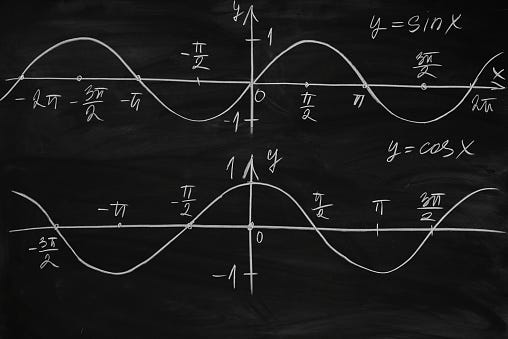
We want to find the possible rational values of cos(qπ) where q is a rational number. Of course we have the well known values of -1, -1/2, 0, 1/2 and 1 but are there any others?
It turns out there are not. Try to see why. For the proof, read ahead!
We start by defining some important definitions for this
Algebraic number
A number α ∈ ℂ is said to be algebraic if it is the root of a polynomial with rational coefficients. For instance, π is not algebraic as it is well known that it is transcendental but all radicals are algebraic.
Algebraic integer
If this number also turns out to be the root of a monic (first coefficient is 1) polynomial with integer coefficients, α is an algebraic integer. The set of algebraic integers is closed under addition. (This can be proven using symmetric polynomials but will not be included here). Additionally, the only rational algebraic integers are the integers as can be proven by the rational root theorem. The fact that the integers are algebraic integers follows from the polynomial P(x) = x-n.
Roots of unity
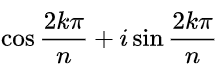
These are the complex roots of the polynomial P(x) = xⁿ — 1. There are n of these and they are always of the form
For k ranging between 0 and n.
Proof of Niven’s theorem
We start by noticing that

always represents some root of unity as we can choose q to be 2k/n for some k and n as if we substitute n = 2N we get k/N which is the definition of rational number.
Thus, z is a root of P(x) = Xⁿ-1 and as this is a monic polynomial with integer coefficients, it follows that z is an algebraic integer.

This is the complex conjugate (also actually a Galois conjugate of the previous) so it is also an algebraic integer by the complex conjugate pair theorem. Therefore, both are algebraic integers. That means that
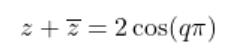
is an algebraic integer. As 2cos(qπ) is rational and between -2 and 2 inclusive, it follows that it must be an integer between -2 and 2. Thus, it must be one of -2, -1, 0, 1, 2 and dividing by 2 we get that cos(qπ) ∈ {-1,-0.5, 0, 0.5,1}.
Finally, we provide a construction for all of these. This could be for instance
cos(0) = 1
cos(π/3) = 0.5
cos(π/2) = 0
cos(2π/3) = -0.5
cos(π) = -1
Q.E.D.
Which concludes the proof of Niven’s theorem.
Applications
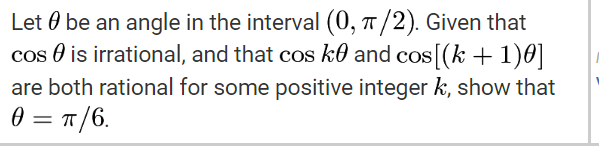
This was one of the problems proposed for the International Math Olympiad Team Selection Test in the USA.
It is also a cool result in its own as well as having quite a few enlightening proofs including the one stated above, and another which attempts to bound the denominator of cos(2ⁿθ) using the double-angle formulas.
If you liked the post, don’t fret to say so in the comments, clap or subscribe!