
How Long it Takes to Disappear
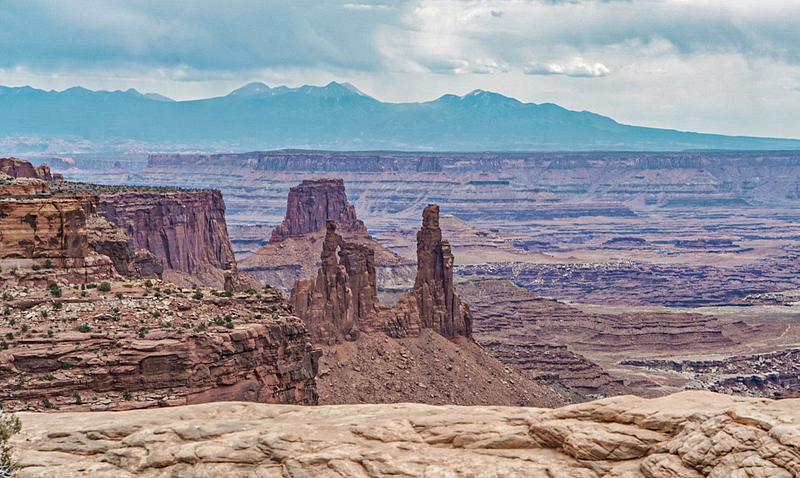
When I go to Canyonlands National Park for the first time, I worry about the crowds. I’m not traveling alone, but fewer people will make it easier to do what I came here to do.
The main reason I enter the wilderness is to lose myself, or rather, lose that which haunts me. I walk until it disappears, or until I find a new way to endure it — whichever comes first. This ritual requires a degree of detachment, both from the people I love and from humanity itself.
We arrive at the campsite in Moab as the sun dips downward, igniting the landscape around us, and I see that my concern was unfounded.
Here, where hundreds of sandstone needles and spires slice the air like knives, and the horizon stretches flat for thousands of miles between swaths of land and sky, solitude is inevitable.
I choose to escape on a hike in which everyone is distracted. My sister kneels to pick up glittering rocks, examining each one with care, and her boyfriend searches for scenes to capture on the Lecia dangling from his neck.
My thirst to be alone is always temporary; a cool pool in which to be refreshed before returning to what I know.
I take the path over a mound clotted with sagebrush.
I look back. The hill has obstructed my view of my companions, but I believe they are there.
I lean into the panoramic view of the canyon — the curl of the Green river, the cake-like layers of rock, the towering ochre monoliths.
A forever of wild, unencumbered.
My urge to be alone is easier to neglect if I’m in the city, living in a neat square of existence, but now that I’m standing on the edge of a cliff with no trace of humanity in sight, I feel it: an invitation to slip unseen into the distant purple.
It isn’t suicidal — I don’t want to leave my whole self behind. Rather, it’s closer to what the French call L’appel du Vide, the call of the void. It’s when the urge to know what lies beyond feels bigger than the consequence of that knowing.
I take a seat on the orange rock and wait.
Five minutes go by.
Then ten.
Then twenty.
They should’ve arrived by now.
I stand up, call out my sister’s name. Alyssa?
There is no trace of her, nor a single stranger.
Flies buzz in circles around me. A hawk shrieks in the canyon.
Our parks should be teeming; a rainbow of license plates winding bumper-to-bumper, a million sweaty noses and camera-clad dads peering from rolled-down windows. But since this pandemic began, the same fear that has swallowed most people’s inclination for wonder had driven me out into the empty world, longing to be free.
Solitude is what I wanted — but now I consider what, out here, that really means.
In a swirl of visions about heat stroke and starvation and death, I change my mind, decide I don’t want to be gone.
Already, it’s too late.
I am no stranger to getting lost.
In fact, I’ve honed my expertise in this art over the last decade.
By the year I turn eighteen, my father cannot stop drinking, and the last time I live in a house with him he hurls a pair of steel toe boots at my sister and me, closing his bedroom door before seeing where they land.
My mom, separated from him, moves into the cottage she grew up in — the one overlooking the salty river where palms lean haphazardly like crooked teeth.
There’s no home I can go to where I feel safe.
It’s easy to ignore that I don’t have a house the first year it becomes real because I’m in college and I live on campus. But then comes Christmas and instead of going home to a house where my family lives, like all my classmates do, I go elsewhere.
I see my sister in Rhode Island and we drink entire bottles of wine and set tables for two, then stumble to the bar on the corner that feels more like a living room, packed with people who, like us, have nowhere else to be.
These are the nights when Alyssa and I realize how much we need each other, how we are all we have anymore.
I usher whiskey down my throat until two men appear beside us. We talk about the seven fishes feast, a tradition we are not celebrating with our Sicilian cousins this year because we are instead practicing the art of ignoring, each laugh like a brushstroke, every sip like an eraser, undoing our family portrait.
It becomes our tradition. Years later in a different city we’re sloshed again, boots slipping through snow on the sidewalk that leads home from the tavern, and what I understand about the strangers I meet at bars is that when their fingertips yearn for the shell of my body they are seeking an escape of their own, but it is one I cannot grant them because I must be the one who leaves.
This is a test, an act of resistance, that I will soon learn to use in a bigger way. I will learn to leave friendships, relationships, jobs, and places I live; places I love. What I don’t know when I am twenty is that I want to be gone because it means no one can let me down.
I believe that being left by someone I want, or who I think wants me, is so much worse than being alone by choice.
There is power in being the one who goes, even when you want to stay. It also means you never stick around long enough to let anybody love you.
Some people say I’m running. I think it’s the only way I can be saved.
The late May drive from Denver to Moab had felt more parched than usual because we’d spent most of spring in quarantine.
When we pulled off 1–70 to switch drivers and stretch our legs in the sudden, fry-an-egg-on-it hot, my sister, the artist, pulled a jasper bracelet from her backpack and handed it to me.
To borrow.
Now, the gold and violet stones cool my wrist, soothing the panic that’s settled in my chest. Will it still be on my arm by the time they find my body? Or will they find it on a rock or under a tree, the rest of me gone for good?
Maybe, I think, this was the right path all along and they’re the ones who took the wrong turn. This is a small way I distract myself. Regardless of which path is the right path, I cannot deny that it was me who made the mistake by leaving.
At least I’m not the real kind of lost. I don’t have to shelter in the shade and conserve my water and hope for search and rescue to find me before nightfall.
I still have options, but only two.
I can stay in the same place and wait for them, which has already proven fruitless, but feels safe.
Or, I can take a chance and walk back the way I came. Maybe there’s a fork in the path, a well-defined route they’re already on. I can look for someone, anyone, ask if they’ve seen them.
But this is the desert—not a place to wander. What if I take the wrong fork? What if I don’t see anyone?
I ready myself, mentally, for the latter choice.
The one which bears the risk of getting the real kind of lost.
People lose themselves in national parks all the time. The number of people who go missing for good is unclear because the park service doesn’t keep a running count, and it would still seem tiny compared to the amount of people missing in the country as a whole.
Many of the permanent disappearances are unexplained. Bodies appear without shoes or clothes miles from where they were last seen; other times in obvious places that were repeatedly searched.
They also can tumble from ledges, fall into geysers, freeze in the snow. Their shoes can turn up without a body, or appear with a foot still inside.
Then, there are the murdered ones — people who disappeared from cities and towns but whose bodies were stashed in desert canyons or alpine lakes.
Sometimes, long after the search gets called off, the only trace of a person rests in the memory of those who loved them. This leaves the families of those lost to the ether with one answer: that there is no answer.
Still, I believe a person walks into the wilderness for a reason. I’m not so concerned with how many people vanished or what ultimately became of them.
Instead, I want to know why they went at all.
Perhaps they wanted to find a home within themselves.
Perhaps they knew that this is something you do alone.
The first summer I have nowhere to live, I stay on my best friend’s farm, which is a mile from the house I grew up in. It’s the same house my mom and I lived in my senior year of high school, the one with little furniture or heat, the one with the foreclosure sign tacked into the frozen ground outside.
The shame of it clings to me like cellophane. The tree in the front yard, the one I used to read under on perfect summer days, has been chopped down. A car I don’t recognize is parked in the driveway.
Each time I pass I can’t decide if it hurts more to look, or look away. I don’t know anyone who knows what this is like.
There was a time when humans existed only in the realm of the wild, when we slept in caves and dined in meadows and worked in the forest. I want to go back to the time when we belonged inside the whole world, but this is not how people think, not anymore.
For months, I share a bed with my friend and my clothes are in a suitcase, but I don’t consider this a problem until I meet up with an ex boyfriend I’m sort of seeing again. I wear the most beautiful thrift store dress I own, a red button-down with white polka dots.
We’re sitting on the grassy hill that slopes down from the old brick middle school and he says to me, “but you don’t even have a house.”
It’s something everyone already knows without the words needing to be spoken.
I want to say: The reason I don’t have a house is because I’ve lost mine; or rather, it was lost to me.
I want to say: It isn’t my fault.
Instead, I leave and never return.
Being without a home teaches me that worthiness is not a trait you earn.
Worthiness is a thing you learn how to hold inside yourself.
The summer after my sophomore year of college, I see for the first time that not having a home means I’m not expected to be anywhere.
It’s a lure I gulp impatiently.
Since I can go anywhere, I decide on far away.
Far away turns out to be the high sierras of California.
The first night at camp we sleep outside under the stars. We are a clump of counselors swaddled in sleeping bags and giggling past curfew. I’m afraid a bear is going to ramble through the woods and place my head in its maw, but then dawn comes and the birds flitter through the trees and we all wake up without a roof over our heads.
For the first time in a long time, I feel equal.
Living in the wild for a summer quickly strips away the things I thought mattered (wifi, electric lights, beds) and gives me room to grow. I take up singing while walking through the woods to warn bears I’m near.
I learn to love sleeping outside so much that I never sleep in a tent, except when it rains. Even then I unzip the tent to watch the jagged bolts of light flash through the sky.
For a week I take a camper’s clammy hand in mine on walks through the pines because her dark eyes go calm when I do. I squash a spider that I want to keep alive and act in a play and cinch a million life jackets on little bodies. I do it because it’s my job, but also because it gives me purpose.
On the last night before the counselors leave, after all the girls have gone home, we walk to the far end of the big lake and leap in naked. The water, black and slippery around me, feels like a hug from someone who used to love me.
In the moonlight that reflects on the steady ripples I decide that I am always at home in the wild.
As long as I show up, it will take me into its arms.
The day before I got lost in the desert, I got dizzy.
We’d walked down a short path to peer up at the petroglyphs, centuries-old messages whose meaning turned to mystery within the bend of time.
After a full morning out in the desert, the bake of it had started to wear on me. I felt the nausea first in my head, the way a migraine makes my mind feel like a boat in a storm, the throb in my skull like a hull hitting a dock.
I moored myself in the cave, on the cool sand beneath the red handprints, where a tiny crevasse opened up like a black mouth and let out a cold wind, gently, in cycles, like breath.
I let it guide my own.
I liked the thought that people had lived here, gathered here, dined here. This shady respite from the melting yolk of a sun. This ancient resting place, a gift from the same earth that rendered my being. I drank it all in, healing from the inside our.
On the new trail in Canyonlands, I find someone who’s seen my sister. Then another.
I am on the popular route now, the real route. The hikers point me down, down, down the path until I see them scattered across the long thumb of an outcropping. Mutual relief registers as I lock eyes with my sister.
She is sitting, exhausted from my absence. I climb up to the rock where she’s perched.
“We thought you fell off a cliff.”
From there I see the place I was waiting, though it’s so far away I would’ve been just a speck to them.
“I was just over there,” I say, pointing to the nub of rock where I’d laid and looked at the sky.
I wasn’t gone for long, but it was enough. Enough to understand how easy it is to become gone for good. Out there, a second is as long as an entire day.
That’s how long it takes to disappear.
I spend most of the ride home wondering how many missing people are indeed trying to leave the world they know, but only for a moment, when an encounter with bad weather, or animals, or confusion halts their journey home.
Maybe, like me, wandering is necessary to escape ruin; getting lost a means for survival. Losing myself in the desert revealed this truth to me: I stray not because I want to be gone, but so that I can give myself the act of return.
When you’re the only thing you recognize, you must believe that you are worthy of saving.
That is how you walk back into the world renewed — but only if you’re lucky enough to find your way home.
Discovery is expected, but never guaranteed.


