
How Lao Tzu and Buddha Teaches us The Underlying Harmony of Life
One taught us to be still and the other taught us the reality of suffering.
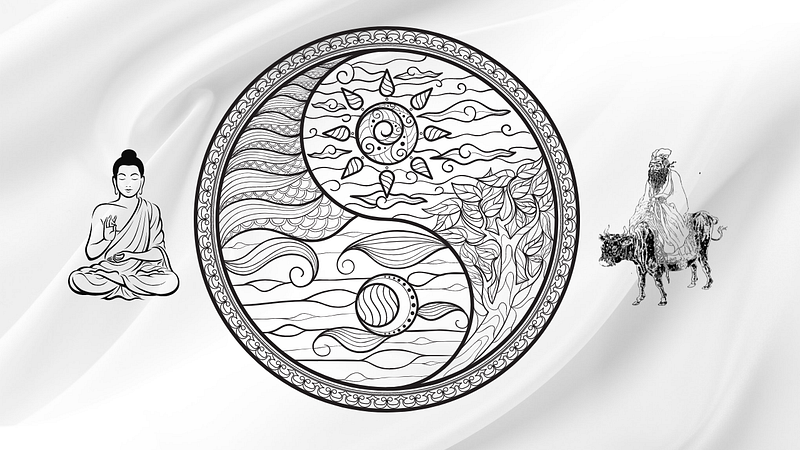
As a child, I was always very fascinated by the concept of Meditation to achieve a higher awakening. But never bothered to pursue it.
Later, while growing up, reading a lot of non-fiction self-help books and listening to podcasts I have noticed that almost every piece of advice leads to Meditation.
While reading about Meditation and its benefits there were several instances where I have encountered the concepts of Taoism and Buddhism.
Being an Asian living in India a culturally and spiritually rich country, I was very much aware of the Lord Buddha’s path of awakening but never knew about the teachings of Lao Tzu.
That is why after reading a lot about them, I have tried to compile some of the underlying teachings of them in a clear and concise manner that will work as a stepping stone towards the path of your own’s awareness and awakening.
“Do not dwell in the past, do not dream of the future, concentrate the mind on the present moment.” — Lord Buddha
Change your inside, the outside will follow
Buddha found his awakening (nirvana) under a tree of “Bodhi” near a small village named Bodh Gaya in Bihar, India.
After confronting the harsh truths of life, he was determined to find enlightenment and to understand the meaning of life by confronting suffering.
He taught us the middle way of living a life with a unique perspective. He further added that “One should not bathe in luxury, nor abstain from food and comfort altogether but find a balance between them, the middle way”.
In the current world, we often crave materialistic happiness. The brand we are using often represents the type of human we are and as we are heading towards the meta-world it's the number of followers and views that will determine the kind of person we are not the actual we.
I personally every day question myself in the morning that What is enough for me? — The word enough determines everything. When you know enough, it is highly probable that you will achieve contentment with life in every possible manner.
Buddha told us that life is difficult and brief and bound up with suffering. So it is wise to accept the reality, the present instead of living in the past and future.
It is not that our low paychecks and fewer views that make us unhappy, it is the mindset with greed, vain and constant gratification.
Understanding is only a part of becoming a better student in life. Accepting reality as it is will make a better person.
“To the mind that is still, the whole world surrenders “— Lao Tzu
The Art of Being Still
Lao Tzu is also known as The Old Master invented the concept of Taoism/Daoism to the world through his teachings written in the book “Tao Te Ching”.
It is somewhat a collection of writing representing how to lead a good life with virtue, happiness the Dao way. Daoism also introduced us to the art of effortless action also widely known as Wu Wei.
But rather than saying much about these things I wanted to tell a story about Lao, Buddha, and Confucius. All three of them are great spiritually awakened and have their own philosophy towards life.
So one day, vinegar was supposed to be tasted by everyone. Confucius thought it was sour, similar to how he thought the world was full of degenerate people, while Buddha thought it was bitter, similar to how he thought the world was full of misery. However, Lao Tzu considered the flavor to be delicious.
This kind of philosophy is very much discussed in Tao Te Ching by Dao. His focus on living life along with nature is very well known and often said by many popular celebrities.
The famous saying by Bruce Lee Be Like Water is derived from Taoism. Tao Te Ching consists of many verses in which Tzu depicts nature and life in sync.
Nothing is weaker than water, But when it attacks something hard Or resistant, then nothing withstands it, And nothing will alter its way.
The Tao Te Ching passages quoted above demonstrate the nature of water: Water is so fine that a handful is impossible to hold; strike it, and it is unharmed; pierce it, and it is unharmed; sever it, and it is undivided. It has no shape of its own and instead conforms to the container in which it is contained.
His concepts are not always useful in the current world but there are certain philosophies that can help us not to live a life but to enjoy it in its fullest sense.
Lao’s remarks serve as a reminder of the value of quiet, openness, and reconciliation with natural forces that are unavoidable.
Taoism is not a religion, nor a philosophy. It is a “Way” of life and life if best lived when it is balanced.
Both the philosophies of Buddha and Lao make us aware of our own self and how it is important to live life at the moment. Because for myself there was a moment, it was very hard not to think of the future and past but now with practice, I found myself mindful and at the moment always.
Hence, it is better to turn these teaching into action and make a habit out of them. A better way to implement this in life is to follow the 2 Minute Method mentioned by James Clear in his book Atomic Habits.
Key Takeaways
Let’s dive into a quick recap of what we have learned so far and also a perfect section for readers who don’t want to read this long article. Lol!
- Lord Buddha taught us that we must do everything we can to free ourselves from our own tyrannous impulses and see suffering as our common bond and compassion with others.
- Understanding is only a part of becoming a better person.
- Lao Tzu reminds us that nature does not hurry yet everything is accomplished.
- It is as much important to be in the present as it is to be in sync with nature. Nature teaches us patience and stillness (tree and water)
- Meditate and inhibit the practice of going inwards just 2 minutes in a day in order to become awake.
Thank you for reading this till the end.
If you want to show some love to this post buy the medium monthly membership by purchasing it from my referral link here.


