
How Labeling Ourselves and Others Can Impede Our Mastery
I used to think all descriptions longer than one line were annoying. In the books I read, I wanted to skip them, while at the same time making myself read them and victimizing myself that I had to do this. In writing, I tried to skip them too. And more than that, an idea formed in my mind, I am not able to write descriptions.
Then two things happened. The first one had to do with reading descriptions.
Reading descriptions
Here is what I wrote in July 2014 in a blog post called “A Discovery about Descriptions.”
One of the things I used to dislike in books were long descriptions. Even descriptions by such masters as Leo Tolstoy and Jane Austen made me sometimes quite impatient, and my brain was thinking, When will the story continue?
I was sure this was a result of my impatience, not the lack of virtue of the pieces I read. But still, these experiences made me afraid to create my own descriptions when I started writing fiction myself.
And then several months before writing this blog post, I read The Signature of All Things by Elizabeth Gilbert and became completely dumbfounded. The book was amazing and…full of descriptions! Many of them pages and pages long. How could that be?
I found the answer in an article in Writer’s Digest from January 2014 by Elizabeth Sims, which I read not long afterwards. The title of the article was “Miscalculations and Missteps.” And there, in Section 6 — “The Great Undescribed,” I found the following:
Take a risk and go long. The value of a relatively long description is that it draws your readers deeper into the scene. The worry is that you’ll bore them. But if you do a good job you’ll engross them. Really getting into a description is one of the most fun things you can do as an author. Here’s the trick: Get going on a description with the attitude of discovering, not informing. In this zone, you’re not writing to tell readers stuff you already know — rather, you are writing to discover and experience the scene right alongside them. — Elizabeth Sims
This passage revealed to me the secret of the SOAT (as Elizabeth Gilbert calls The Signature of All Things), which was unclear for me before that. The SOAT is full of descriptions, but each description is full of discoveries: of love, of one’s own body, of lust, of science, of mother nature, of the secrets of the universe and its origins, and much more. The whole book is a continuous discovery. You can hear this wonder in the voice of the narrator, who mirrors the wonder of the main character, Alma Whittaker, as she experiences it throughout her journey.
The book also covers a time period of more than 50 years! That again goes against the advice I learned, “The shorter the timeframe, the better. Backstory can go further back, but the plot itself should unfold in a short period. Otherwise, you will bore the reader.”
But the SOAT proves this advice completely wrong. It starts with Alma’s birth and finishes with her death. This story covering a whole life of its protagonist and beyond fascinated millions of readers and became an international bestseller.
Even at her death, Alma is still discovering. One reader’s review of the SOAT describes Alma as “insatiably curious.“ And I became more and more curious with every sentence I read of Alma’s story.
I am very grateful to both Elizabeths (Gilbert and Sims) for lifting my fear of descriptions, for showing me that I can love reading long descriptions and wish for more, and for giving me a great clue for how to recognize an excellent one.
All this led me to a thought which applies to everything:
One of the clues to having fun, along with being in the moment, is to be in a constant mode of discovery, walking through life “with an open mouth” and being in awe of everything inside and around ourselves.
Writing descriptions
Fast forward one year later, when I first wrote this chapter that you are reading now. By this time, I was sure there were brilliant descriptions that could captivate me. So I started approaching each book I read and wrote with curiosity about both dialogue and descriptions. But there was still a problem. I didn’t believe I was capable of writing good descriptions, not to mention captivating ones.
Then one evening I went to a meeting of the writers’ club I attend here in Aalborg, Denmark. I hadn’t managed to write something completely new for that particular evening, so I took with me the first chapter of a story I had recently posted online.
This story, which eventually became a novelette, is called Nothing Is As It Seems. And it came to life after I watched a “one-minute writing class” video created by my writing teacher and friend Menna van Praag. As an exercise to develop a story, she had suggested we start with the first paragraph of her best-selling book The House at the End of Hope Street, and then continue writing and creating our own story from there.
So, at the writers’ club meeting, I sat in a comfortable armchair in the cozy living room atmosphere of two of our writing club members and read out loud to them this first chapter of my new story. As I read it, I realized, The chapter is full of descriptions. And they are good!
When I finished reading, I looked up with the still-unprocessed shock of this discovery on my face. I can write good descriptions?!
The feedback from my fellow writers added to the shock. They liked the chapter too. The only correction they offered was about the way I pronounced the word “wrapped.” My thoughts went wild. Really? Only this? And the rest is all good?
After that, they pointed out the especially good parts of the piece. I had to agree. They were good, and I liked reading them aloud.
Of course, there were still bits to be tweaked here and there, and I did so before sending the whole story to my editor. And the story did become much better after the edits. But on that evening, I understood that this piece was something I wouldn’t be ashamed to read out loud again.
Thus, my advice here to you, dear writer,
Whether you have problems with descriptions or not, watch out for those labels you give yourself, your writing, your reading abilities, and anything you do. Observe them, lift their edges, and peek underneath. You might discover that those labels are long outdated, and might not have been true all along.
At this point, I would like to tell you one of my favorite jokes:
A man was asked whether he could play the violin. His answer was, “I don’t know. I never tried!”
So, let’s approach everything with this attitude. Let’s not say, “I can’t do something,” until we try, and try again. We might discover that we can, are very good at it, and that we even enjoy doing what we want or have to do.
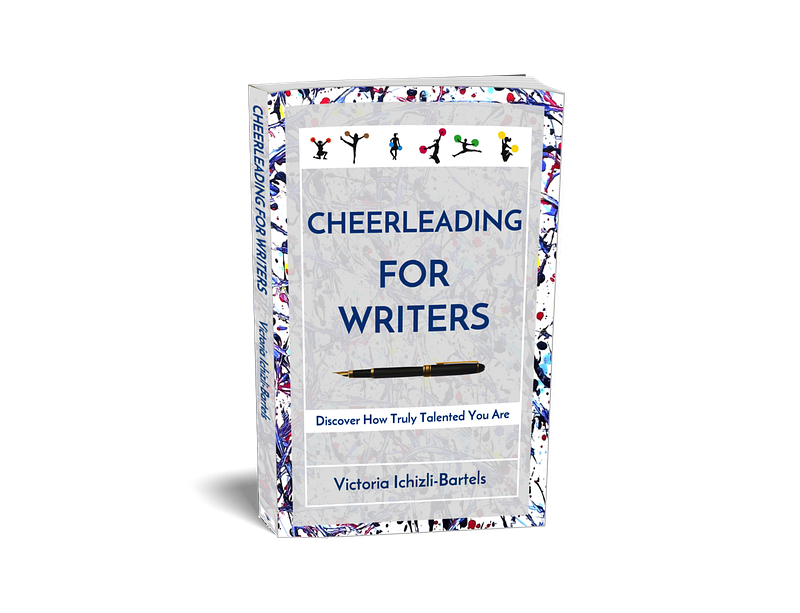
From Cheerleading for Writers: Discover How Truly Talented You Are.
P.S. To keep in touch, subscribe to my newsletter, Optimist Writer.
If you enjoyed the story above, you might also like this one:
About the author:
Victoria is a writer, instructor, and consultant with a background in semiconductor physics, electronic engineering (with a Ph.D.), information technology, and business development. While being a non-gamer, Victoria came up with the term Self-Gamification, a gameful and playful self-help approach bringing anthropology, kaizen, and gamification-based methods together to increase the quality of life. She approaches all areas of her life this way. Due to the fun she has, while turning everything in her life into games, she intends never to stop designing and playing them.