avatarAlexander Yung

Free AI web copilot to create summaries, insights and extended knowledge, download it at here

2925

Abstract

ce:<a href="https://www.nydailynews.com/news/politics/ny-juul-tobacco-menthol-flavors-20191017-qg4h72qeirbsjctbbrormk3gqm-story.html"> NY Daily News</a></figcaption></figure><p id="b962">For years, tobacco companies have been using cigarette flavors that would appeal to young people. Take, for example, the iconic “Marlboro County” ad campaign in 1955, which promoted flavored cigarettes.</p><p id="69ef">Marketing-wise, this makes sense. Youth e-cigarette users have cited flavors as the main reason they began using e-cigarettes. And 43% of young people tried e-cigarettes because of their appealing flavors.</p><p id="9bfc">To appeal to teenagers’ tastes, JUUL offered eight flavors in the US: Virginia tobacco, classic tobacco, mint, menthol, cucumber, mango, creme, and fruit. But in the UK, the company offered Mango Nectar, Royal Creme, Golden Tobacco, Glacier Mint, and Apple Orchard.</p><p id="369f">JUUL has used its diverse flavors to play a central role in its marketing campaign, placing special emphasis on sweet and fruity flavors such as mango to appeal to teenagers.</p><p id="0d26">The company used its early slogan in 2016, “Save room for JUUL” as a play on the common phrase “Save room for dessert.” Many other slogans would appear such as “Get into the tropical mood of summer with mango JUUL pods” and “Love, love, love the mango pods.”</p><h1 id="0f09">3. Social Media Influencers</h1><figure id="49d2"><img src="https://cdn-images-1.readmedium.com/v2/resize:fit:800/0*w1e9N1mPlIGybIGN.png"><figcaption>Social Media Influencer Christina Zayas Promoting JUUL. Source:<a href="https://www.cnn.com/2018/12/17/health/juul-social-media-influencers/index.html"> CNN.com</a></figcaption></figure><p id="3fa4">JUUL has constantly used social media influencers — people on social media with large followings — to promote their brand and inspire sales.</p><p id="a456">On internship.com, JUUL has looked for influencer marketing interns to research, create blogs, and manage celebrity influencer engagements. On the interns’ applications, JUUL wanted people who have a strong following on their social media, blogs, and vlogs.</p><p id="8784">JUUL has been known to use YouTubers to promote their products. For example, YouTuber DonnySmokes created a JUUL “unboxing” video which brought in 52,000 views.</p><p id="d9a9">The company has also paid full-time social media influencer Christina Zayas to promote its products, paying her $1,000 for one blog post and one Instagram post. Before Christina deleted her Instagram post, it had reached more than 4,500 people and had 1,500 likes.</p><h1 id="f6e6">4. Hashtag Marketing</h1><figure id="0c35"><img src="https://cdn-images-1.readmedium.com/v2/resize:fit:800/0*gGSfW1xcsE-fTnSe.png"><figcaption>JUUL Twitter Post. Source: <a href="https://www.vox.com/2019/1/25/18194953/vape-juul-e-cigarette-marketing">Vox.com</a></figcaption></figure><p id="d1e4">Hashtag mark

Options

eting has greatly expanded the company’s social media reach. The company used these hashtags in their Instagram posts: #juul, #juulvapor, #switchtojuul, and #vaporized.</p><p id="1fa0">In turn, JUUL’s customers or vendors use their own hashtags to promote JUUL’s products: #juulnation, #juullife, etc.</p><p id="1029">In 2018, JUUL posted an average of 877 posts per day. JUUL’s posts used youthful, humorous, and meme themes to appeal to teenagers.</p><p id="90e6">Even though JUUL closed its social media accounts and deleted its advertisements in late 2018, teenagers would still use the company-created hashtags. The teenagers’ posts would do the work for the company: increasing engagement and the likelihood the posts would be retweeted and shared. This further promoted JUULs’ products to a greater audience.</p><p id="27c0"><b>As a result, JUUL has created a wildfire, having its own customers promote its products through viral social media posts without having to pay them.</b></p><h1 id="c8fe">5. Using Famous Cigarette Advertisements</h1><figure id="2ff1"><img src="https://cdn-images-1.readmedium.com/v2/resize:fit:800/0*yVQlNtfbylo69YJP.png"><figcaption>JUUL and Old-fashioned Cigarette Ad. Source: <a href="http://tobacco.stanford.edu/tobacco_main/publications/JUUL_Marketing_Stanford.pdf">Stanford University School of Medicine</a></figcaption></figure><p id="23e6">JUUL’s advertisements have constantly featured bright images with strong emotional themes. But to many anti-smoking advocates and tobacco researchers, the advertisements looked eerily similar to ones tobacco companies used in the 1970s.</p><p id="ee9f">On many side to side images, the JUUL and old-fashioned tobacco advertisements were near identical.</p><p id="0d6a">JUUL’s advertisements, like its tobacco predecessors, attempted to market its products using positive themes. The company portrays its products as romantic, healthy, relaxing. etc.</p><p id="ecf7">At the same time, the product’s advertisements used people in positive social interactions: groups of happy friends, attractive women, and couples to show JUUL can enhance relationships between people.</p><h1 id="5b2f">In Conclusion</h1><p id="1279">According to the World Health Organization, the number of vape users has increased rapidly from 7 million in 2011 to 41 million in 2018.</p><p id="dac5">At the same time, the e-cigarette market is booming, expected to be worth $29.39 billion in 2022.</p><p id="4f6c">But vaping has caused thousands of lung disease cases in the United States, causing the e-cigarette industry to face intense criticism. JUUL is now facing multiple state and federal investigations and lawsuits for their marketing techniques and products.</p><p id="4bd9"><b>Even though JUUL’s marketing campaigns have stopped, JUUL still remains extremely popular among teenagers — showing how successful their marketing campaigns were.</b></p></article></body>

How JUUL Took Over Vaping

5 Strategic Marketing Strategies Towards Teens

Photo by FORMM agency on Unsplash

Originally intended for adults, vaping has become extremely popular among teens in recent years.

According to the Center for Disease Control and Prevention, some 4.9 million high school and middle school students used an e-cigarette-related product in 2018.

A major reason for vaping’s popularity was due to JUUL’s early marketing campaigns, dating back to June 2015.

Founded by two Stanford design graduates, JUUL, officially known as JUUL Labs, is one of the most popular U.S. e-cigarette companies, known for its products’ sleek design.

Not only is JUUL stylish, but it also contains as much nicotine as one to two packs of cigarettes, allowing JUUL to create long-time users.

In 2015, JUUL launched its controversial Vaporized marketing campaign, which promoted the product using models and bright color schemes. The company spent more than $1 million to market its product through social media channels.

JUUL has denied its early marketing campaign was directed to young teens. But after some analysis, it becomes clear JUUL was marketing towards that specific demographic, using these various techniques…

1. Sampling Events

JUUL Launch Party. Source: Douglas and London

In JUUL ’s early marketing campaign, the company promoted free samples through social media sites and email invitations in major metro cities. The events used attractive women wearing colorful JUUL t-shirts to attract customers.

Using youth-themed events — music, cinema, etc. — the company wanted to introduce JUUL, having teenagers become familiar with the product and create brand loyalty. To this end, JUUL gave away free products and allowed teenagers try various JUUL flavors.

The events were always free and featured popular bands and actors. At the Sundance Film Festival in 2018, JUUL had celebrities Nicholas Cage, Elijah Wood, and members of Imagine Dragons photographed at their JUUL lounge.

2. Diverse Flavors
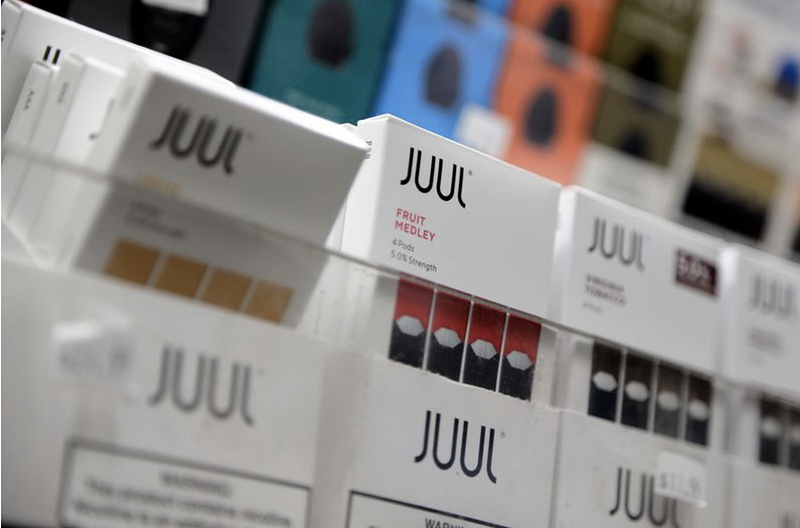
JUUL’s Diverse Flavors. Source: NY Daily News

For years, tobacco companies have been using cigarette flavors that would appeal to young people. Take, for example, the iconic “Marlboro County” ad campaign in 1955, which promoted flavored cigarettes.

Marketing-wise, this makes sense. Youth e-cigarette users have cited flavors as the main reason they began using e-cigarettes. And 43% of young people tried e-cigarettes because of their appealing flavors.

To appeal to teenagers’ tastes, JUUL offered eight flavors in the US: Virginia tobacco, classic tobacco, mint, menthol, cucumber, mango, creme, and fruit. But in the UK, the company offered Mango Nectar, Royal Creme, Golden Tobacco, Glacier Mint, and Apple Orchard.

JUUL has used its diverse flavors to play a central role in its marketing campaign, placing special emphasis on sweet and fruity flavors such as mango to appeal to teenagers.

The company used its early slogan in 2016, “Save room for JUUL” as a play on the common phrase “Save room for dessert.” Many other slogans would appear such as “Get into the tropical mood of summer with mango JUUL pods” and “Love, love, love the mango pods.”

3. Social Media Influencers
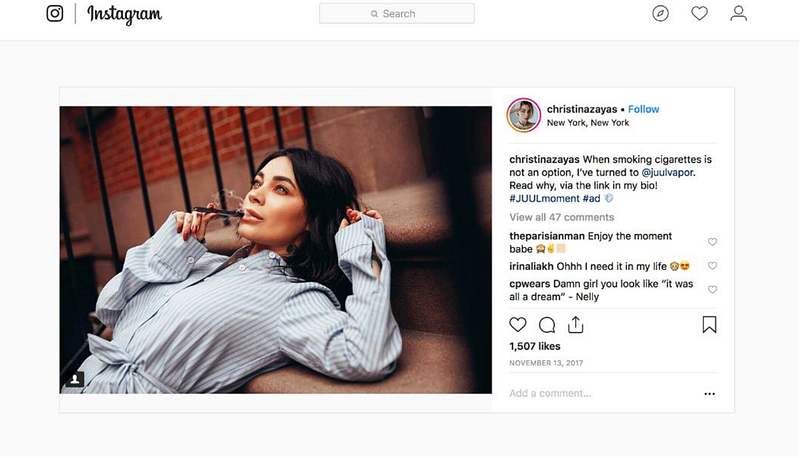
Social Media Influencer Christina Zayas Promoting JUUL. Source: CNN.com

JUUL has constantly used social media influencers — people on social media with large followings — to promote their brand and inspire sales.

On internship.com, JUUL has looked for influencer marketing interns to research, create blogs, and manage celebrity influencer engagements. On the interns’ applications, JUUL wanted people who have a strong following on their social media, blogs, and vlogs.

JUUL has been known to use YouTubers to promote their products. For example, YouTuber DonnySmokes created a JUUL “unboxing” video which brought in 52,000 views.

The company has also paid full-time social media influencer Christina Zayas to promote its products, paying her $1,000 for one blog post and one Instagram post. Before Christina deleted her Instagram post, it had reached more than 4,500 people and had 1,500 likes.

4. Hashtag Marketing

JUUL Twitter Post. Source: Vox.com

Hashtag marketing has greatly expanded the company’s social media reach. The company used these hashtags in their Instagram posts: #juul, #juulvapor, #switchtojuul, and #vaporized.

In turn, JUUL’s customers or vendors use their own hashtags to promote JUUL’s products: #juulnation, #juullife, etc.

In 2018, JUUL posted an average of 877 posts per day. JUUL’s posts used youthful, humorous, and meme themes to appeal to teenagers.

Even though JUUL closed its social media accounts and deleted its advertisements in late 2018, teenagers would still use the company-created hashtags. The teenagers’ posts would do the work for the company: increasing engagement and the likelihood the posts would be retweeted and shared. This further promoted JUULs’ products to a greater audience.

As a result, JUUL has created a wildfire, having its own customers promote its products through viral social media posts without having to pay them.

5. Using Famous Cigarette Advertisements
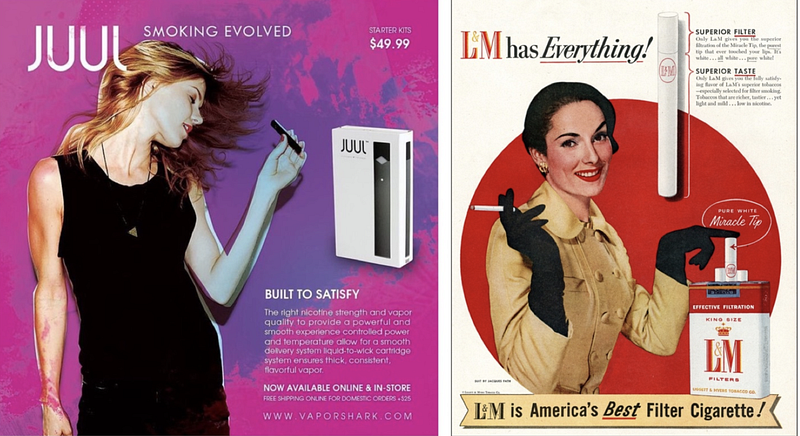
JUUL and Old-fashioned Cigarette Ad. Source: Stanford University School of Medicine

JUUL’s advertisements have constantly featured bright images with strong emotional themes. But to many anti-smoking advocates and tobacco researchers, the advertisements looked eerily similar to ones tobacco companies used in the 1970s.

On many side to side images, the JUUL and old-fashioned tobacco advertisements were near identical.

JUUL’s advertisements, like its tobacco predecessors, attempted to market its products using positive themes. The company portrays its products as romantic, healthy, relaxing. etc.

At the same time, the product’s advertisements used people in positive social interactions: groups of happy friends, attractive women, and couples to show JUUL can enhance relationships between people.

In Conclusion

According to the World Health Organization, the number of vape users has increased rapidly from 7 million in 2011 to 41 million in 2018.

At the same time, the e-cigarette market is booming, expected to be worth $29.39 billion in 2022.

But vaping has caused thousands of lung disease cases in the United States, causing the e-cigarette industry to face intense criticism. JUUL is now facing multiple state and federal investigations and lawsuits for their marketing techniques and products.

Even though JUUL’s marketing campaigns have stopped, JUUL still remains extremely popular among teenagers — showing how successful their marketing campaigns were.

Psychology
Marketing
Startup
Social Media
Social Media Marketing
Recommended from ReadMedium