
How I’ve Learned to Live with a Nonexistent Working Memory and You Can Too
Bullet journaling, personal journaling, and other tools have helped me remember how to live.
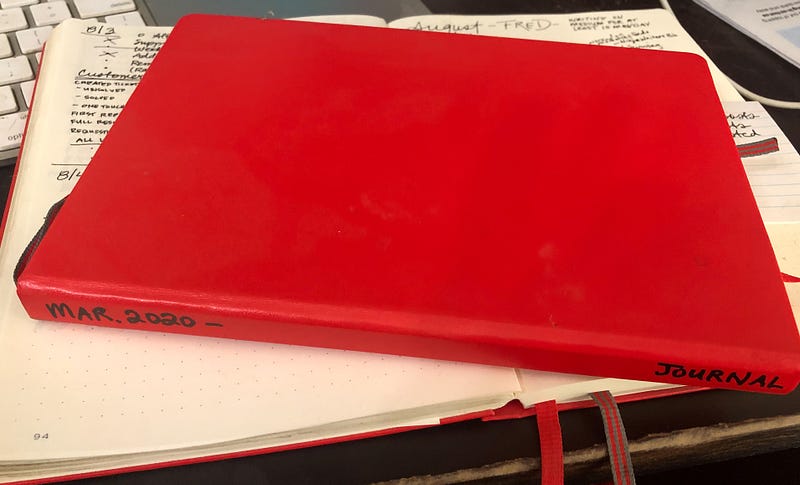
My memory is a sieve — in that, I don’t remember half of my life.
No exaggeration; I know things happened and I remember emotions and feelings but rarely specifics, like what a person said or other details that make the event more memorable.
My therapist and I have had some intriguing conversations about why my brain mocks me like this. Early trauma. My lizard (read: ADD) brain. Fibromyalgia memory fog. All the above.
Unfortunately, having a reason doesn’t matter when I still have to live with the consequences.
What Consequences?
I don’t remember many of the important things that have happened to me. I know they happened and sometimes even have the pictures to prove it, but I don’t always remember anything about them.
- My wedding day.
- The days my boys were born (aside from a few specific moments; and honestly, part of this could be because of being on the ‘good drugs’).
- My graduation.
I’m still surprised when I see photos about get-togethers I don’t remember, sometimes including people I never remembered meeting.
If I didn’t write about it, even fleetingly, I rarely recall it. But if I write it down, I’ve found it will sometimes come back to me even years later. Not always, but sometimes.
Details are filler.
I forget or just never retain details, especially about people, even about people I love. I get mixed up on birthdates, anniversaries, years, and everything in between.
My grandmother used to tease me because for years I remembered her birthday on November 11 — except it was on November 10. I was ridiculously proud several years ago when I scheduled her birthday in my calendar, along with a reminder a few days before, and I called her — on the right day!
When I realized the full extent of my memory issues, my grandmother was the first person I told.
What’s interesting is that my day-to-day memory is largely intact. I can do my work with ADD annoyances, but not with the long-term memory issues that plague the rest of my life.
My writing hasn’t escaped unscathed.
I have private writings about events I don’t remember, and I question my memories about everything.
On the other side of the problem, there are things I remember vaguely, and that illicit a strong emotion, but I can’t remember more than vague snapshots in my mind.
I qualify all my own memories. And I pass that through to my writing.
My Memory Issues Are Part of Me
I’m the poster child for adult ADD, but my memory issues go beyond the memory issues described by others with ADD (and ADHD).
My husband is my memory-keeper.
He’s been my best friend and partner in crime for over 27 years, so he’s been a part of many of the memories I wish I had. He reminds me, sometimes with spontaneous stories about the boys when they were younger, about the first movie we ever saw on our first date (Hot Shots, Part Deux), and I remember why I fell in love with him over and over again.
I vaguely remember my mother saying I had CRSS as a kid, so my memory issues have been around for most of my life (CRSS = Can’t Remember Sh*t Syndrome). I imagine I wrote about it in a huff in one of my early diaries; I think of that with a grin now.
So trust me when I say I have found every trick there is to remember things. Things in the past and things coming up like appointments and milestones, things that hurt, and things that make me smile.
Things.
Both unimportant things and amazingly important things.
I’ve tried all manner of tips and tricks, but the ones I use regularly are usually the simplest (I am, sadly, a shiny object habitual offender).
If you struggle with memory issues, either like my own or because of other issues or neurodiverse conditions, I hope some of my tips and tricks can help you.
My Bullet Journal
I’ve been using a bullet journal (BuJo for short) for almost four years. My routine has evolved from using simple notebooks sporadically to using multiple special notebooks now religiously (I love and use Leuchtturm 1917 almost exclusively now).
An article by Shaunta Grimes helped me realize what a big role my BuJo has played in working through some of my memory issues.
I wish it was easy for me to take notes during conversations as she describes, but I’m usually all into note-taking or all into the conversation; not both at the same time. I have stopped someone to jot down things here and there, or asked them to email or text me something they mention, but not to the point of whipping out my notebook and taking notes during our conversations.
But in the same way she uses her everyday notebook, I use my BuJo. Except I don’t whip it out when I talk to people. Usually.
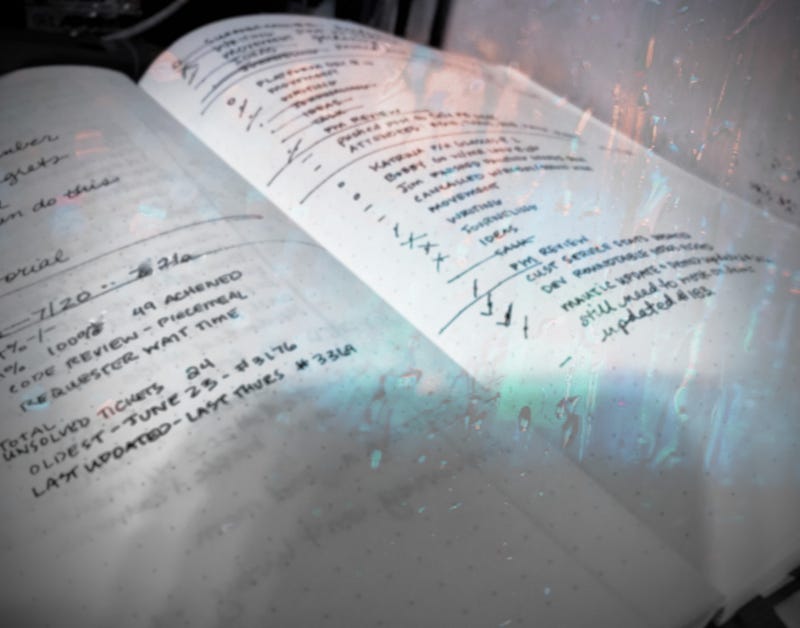
I do try to take notes soon after talking with people if I want to remember the conversation. Sometimes my notes are the only thing I remember about events or conversations, so they are especially important to me.
I keep my daily log, migrating anything I didn’t get done the day before. I keep checklists and notes, mixed in with goal lists and breakdowns. When I get phone calls or I need to make a phone call, I write it in my daily log. I keep them all in the same book. My BuJo goes with me almost everywhere and has become a source of truth for me.
It’s my day-to-day book, and it helps me with my working memory issues. Sometimes I keep notes separately and I still try to fold the pages into my actual journal. I don’t do fancy symbols and designs, though I have a background in art, because it’s important for my BuJo to be functional. If I spend too long trying to make it look pretty, then it’s not as functional for me.
My BuJo has made the most difference in my ability to work with my memory issues. Without it, I doubt I would do most of the rest of this list.
Morning Pages, or Dear Diary
I have another, separate notebook I use to journal in throughout the day, specifically every morning. I use this journal to do my morning pages (as described in the book The Artist’s Way, though I haven’t finished it). Where my BuJo is for my working memory, my journal is for my long- and short-term memory.
Making my journaling a part of my morning habit single-handedly helped with my depression. My therapist helped.
In this journal, I try to write at least a sentence or paragraph about each day, and in particular, any event I’ve been to or special experience I want to remember. I will sometimes pull it out in the middle of the day to write things down as they come to me. Because I’ve lost the memories of so much of my early life, anytime I remember something now I try to capture it, because I don’t know when or if I’ll ever think of it again.
While many people never read back through their regular daily journal, I do it often to remind me about my life.
Therapy has been life-changing for me; after my sessions, I try to write about our discussions and dig further into anything I’ve discovered or remembered.
I sometimes write out song lyrics or poems that mean something special to me, or that I can’t get out of my head.
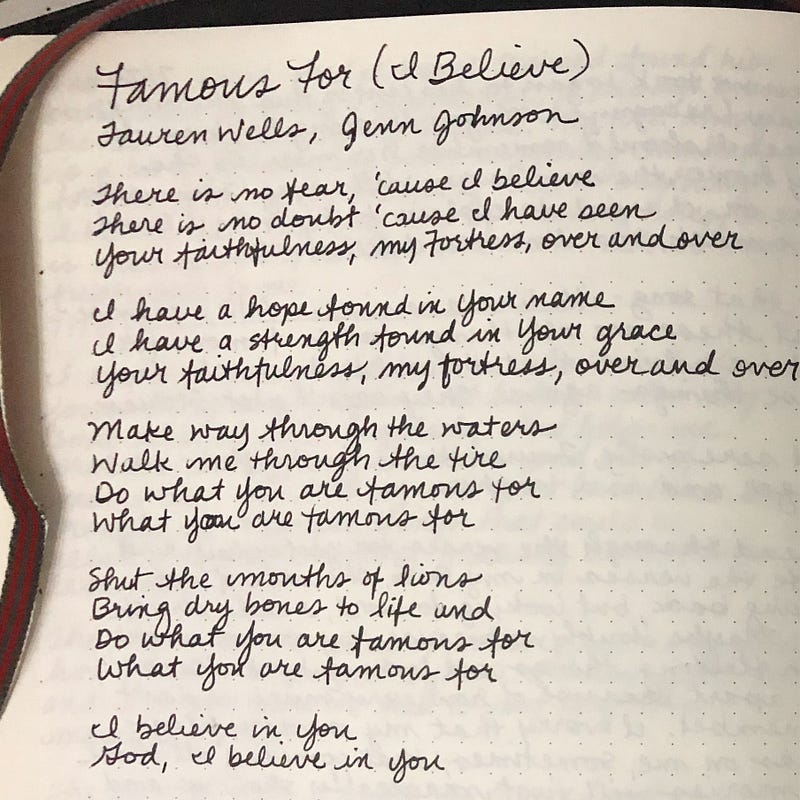
Music is very healing to me (and my family) and songs that get stuck in my head are an opportunity to dig into those melodies and the feelings they evoke.
Other Notebooks
I have a semi-regular notebook I use besides these, adopted specifically to help counter my memory issues. It started after I took a course from Marie Forleo related to her Everything is Figureoutable book. She mentioned writing things out in a notebook repeatedly, as a way to tell your brain it was important and so you would believe it.
Everything is figureoutable, even memory issues from hell
I loved the idea so much that I adapted it, and now I write out scriptures and quotes I want to remember several mornings a week. I pick at least one or two verses, sometimes more. And I write them out five times, sometimes ten. I still can’t always memorize them, but at least this keeps it top of mind for me and I can bring up the general idea of the scripture when I need it.
I use a plain old school notebook for this. I’ll sometimes go several days or weeks in between picking this back up again, but I love doing it in the morning as a private way to meditate and be close to God.
Flow State and Morning Routines
I never realized that my lack of a morning routine was a huge reason why I rarely experienced a flow state. Of course, I didn’t know what a flow state was either.
My research started by reading the Miracle Morning book by Hal Elrod. That book sent me down a rabbit hole. I loved his idea of having a miraculous morning by rising early and sticking with a morning routine. So I tried it. And I loved it.
Except for the lack of sleep.
So I started looking for other options on morning routines. I stumbled on an article written by Benjamin Hardy that helped me understand that a lot of these ‘morning routine’ people use a lot of the same ideas. They just call them different things. The secret is to use the bits that work for you and lose the rest. Hardy included a lot of information not only on why a morning routine was important, but what a flow state was, and why we should try to enter it. I love data, and Hardy included a lot of data in his piece.
I realized that the flow state was a way to help my unfocused brain, to help focus the chaos of lost memories and inattention. It wasn’t just something I could use for working, or while I was journaling (though it helped!), but something I could use while writing too.
“The best moments in our lives are not the passive, receptive, relaxing times… The best moments usually occur if a person’s body or mind is stretched to its limits in a voluntary effort to accomplish something difficult and worthwhile.”
– Mihaly Csikszentmihalyi, Flow State
I am still experimenting with my own morning routine.
I currently try to wake a little before everyone else and journal for 30 minutes to an hour, usually finishing up with freewriting. I read my devotional. Have some coffee. Do some deep breathing. And then my day begins.
It is a routine and it’s ingrained in my head. I do it without thinking, and I enter a flow state much easier. The whole point of a morning routine is to help you start your day ready to enter flow state. It’s also to ground my day and get a lot of the chaos out of my head.
‘Focus Music’ is My Secret Weapon
When I did my research on ways to help me enter the flow state easier, I discovered the wonder of what I call ‘focus music’; others call it brain music. You can find music using binaural beats for free on YouTube and other music sites, and I used them for a long time.
Now I use an app called Brain.fm. I love it so much I bought a membership. It allows me to focus within 15 minutes of listening, usually much less. I use it multiple times throughout the day to help me focus while completing work, writing, or researching.
I’m so well-trained now that the act of putting my headphones on is sometimes enough to help me focus easier.
This ability to focus more easily makes retrieving knowledge easier.
Simple Meditating Changed my Life
I’m not the poster child for meditation. I know I can’t sit still for long, drawn-out meditation sessions, and I know I couldn’t tell you any of the different types of meditation.
What I do know is that I started practicing daily meditating to slow down my thoughts in the morning, and I realized it slowed down my anxious thoughts too. As I practiced deep breathing and emptying my mind, I also found I’d started doing it in the middle of the day when I needed to reset myself. I’d do it in the car. After one of the kids had a meltdown (or during). After (or before!) emotional conversations.
It’s not a magic pill, and it didn’t help me remember much of anything. But meditating calmed my mind and made it easier for me to focus.
It’s almost like a superpower that I can pull out anytime my thoughts or emotions try to spin out of control.
I tried several apps and honestly; I found them too regimented and expensive for the simple way of meditating that works for me. So I sometimes use what I call ‘focus music’ and sometimes the quiet of a new day is enough to close my eyes, breathe deeply, and clear my mind. I sometimes only do it for a minute or even thirty seconds, but I’ve meditated for fifteen minutes or more.
Spaced Repetition and ReadWise.io
I started doing a lot of research into spaced repetition when I realized how little I remembered of the books and articles I read. I have always been a reader, but remembering the important bits of what I’ve read has been a challenge.
Spaced repetition is a way of constantly reminding yourself of important facts you might have learned from books, magazines, articles, any kind of source. You space out how frequently you’re reminded of these facts, and eventually you bring them up just often enough to recall them when you need to.
People much smarter than me have written books and articles on the subject, but none of their systems work quite as well as I hoped.
The article that intrigued me the most and started this reading frenzy came from Ryan Holiday’s brilliant article on the way he organizes his commonplace book (of sorts) using index cards.
A way to remember everything I read? Count me in!
I’ve tried to use notecards like Ryan Holiday has, with limited success. I forget to get them out and write the notes on them. The practice led me to search for an electronic way to capture all the ideas, notes, and highlights that make up my version of a commonplace book (people used commonplace books for centuries, from Michelangelo, da Vinci, Ben Franklin, and so many more).
And that led me to Readwise.io. It’s a paid app that you can also use on the web, and it imports from Kindle, Medium highlights, and other sources. You can also enter your own notes — add a quote, an idea, even while you’re reading physical books. Readwise understands spaced repetition, too.
If you use the system Ryan Holiday’s described, when you go back to review notes and highlights from books you’ve read, you could enter those highlights, marginalia, and other notes into Readwise.io as you’re reviewing them.
I also like to use the browser extension when I’m reading anything online, but you can copy and paste into it instead.
Readwise reminds me of 15 passages I’ve highlighted and/or notes I’ve taken every day (in-app or by email). Some days I review many more, but I try to always review at least 15.
I sometimes think of notes to add, and sometimes I’ll discard irrelevant ones altogether. The best part is when I see connections between different articles and books. Those deep connections lead to new ideas and ways of looking at the world. Having a system to capture it all so I don’t forget it is priceless to me.
Repeating and reiterating what you’ve learned helps make connections and improve memory. Organizing it into a system means it will be so much easier to retrieve when you need it. There’s a reason that smart people often carry around a notebook.
-Ryan Holiday, Article: What Matters: Information vs. Knowledge vs. Experience
Shiny Tools and Me — Other Tech Help
I use tech constantly, so it’s only natural that some of my best tricks are tech, like Readwise or Brain.fm.
Before I started digging into alternative ways to poke at my memory issues, I used apps that came on my phone. Long before I ever used an iPhone, I used those default apps on my phone and computer to help me remember important dates.
They were initially an inconsistent help because syncing wasn’t always easy back then. Now, however, you can sync lots of phone apps with your computer and vice versa.
There are lots of smartphone apps now that promise to help form this habit or that habit, to help remember this thing or that thing. I’ve used a lot of them. Unless you’re trying to set up a routine, a process through which you use these tools, they will remain on your phone, inconsistently used or even unused at all.
I’m not saying ‘don’t use them’, but I am saying to consider what purpose a given app will serve. I ascribe to Cal Newport’s Digital Minimalism theory (and highly recommend the book!).
“Digital minimalism definitively does not reject the innovations of the internet age, but instead rejects the way so many people currently engage with these tools.”
― Cal Newport, Digital Minimalism: Choosing a Focused Life in a Noisy World
Calendars, Google, and iCal
I have two-way sync set up between the calendar I use for work and the one I use for my family. I set up syncing between my two main calendars on my iPhone and computer. And I synced my family calendar to my husband’s calendar. If it isn’t in my calendar or written in my daily log in my BuJo, then it’s very unlikely I’ll remember it. I use a default reminder system with all my appointments and events — I’m reminded the day before and 30 minutes before of every event.
I’ve previously used apps like Cozi, but since I am in charge of most of the scheduling, it was more than we needed. If multiple people in your family have their own calendars, it might be worth checking out for you.
Technology is both exciting (because I don’t have to remember everything!) and overwhelming (look at all the shiny tools!). Carrying around a phone helped me since I could add appointments to the calendar on my phone. Once I solved the syncing issues, that is.
Reminders Are Life
I use a Mac and iPhone and use the reminders built into them to help me remember important things.
I mentioned above that I used a reminder a few days before special birthdays so I would remember to call people important to me. I found if I only reminded myself the day of their birthday or special event, I’d sometimes ignore the warning on my phone and still forget to get a call or message out.
I’m one of those people who puts multiple reminders together for appointments (usually at least three). I even have a reminder set up to head to bed, although I ignore it too much so I need to edit that.
This works especially well for helping trigger new habits.
Nothing is a Magic Memory-keeper (Except Maybe My Husband)
Living with a memory loss is hard and frustrating, for me and the people I love. I barely scratched the surface about all the ways it has affected my life. And I am positive I haven’t remembered all the ways I’ve learned to counter it.
I keep poking at the systems I use to make them better. And over time, I’ve made genuine progress.
Anyone with memory problems can do the same. No, you won’t be able to trick yourself into remembering everything, but you can learn how to work around your own nonexistent memory, just like I did.


