
How italki Helped Me Finally Speak Vietnamese
It turns out that talking to a ruthlessly honest stranger was what I needed
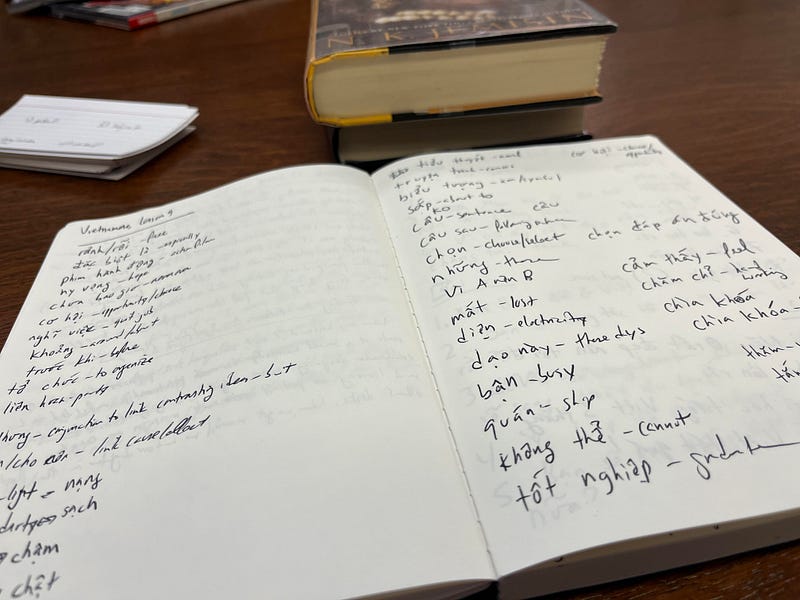
I’ve been learning Vietnamese for most of the past decade, and, honestly, it’s been slow going. My husband is Vietnamese-American, and I began to study the language when we were dating. I remember cooking with him in and watching his lips as he slowly annunciated words beginning in ng- like ngoc (sweet) and ngong (delicious), and finding it incredibly sexy yet also difficult to imitate. I listened to Pimsleur Vietnamese. I watched a lot of Youtube videos. I checked out a very dry textbook from the 1970s from the library and worked my way through it. I found phrasebooks with ironic titles like Instant Vietnamese and Vietnamese in a Flash.
Above all, though, I spent a lot of time with my boyfriend’s mom. At first I called her Cô, meaning aunt, and then when my husband and I got married she became Mẹ (Mom) to me. I learned the language in relation to parent-child relationship in which my syntax, tone, and word choices are shaped by warm yet always respectful relationship of parent to child. To me, my mother-in-law has been the whole Vietnamese language for many years. The sounds of her voice — the inflections of her phone conversations, the rhythms of her prayers in the mornings, her playful tone when joking with her grandkids— have become my main windows into the language.
Over time, I learned to navigate the home environment in Vietnamese. I learned to understand what Mẹ was saying when she asked me to put something in the fridge, close the window, or turn off the lights. I also learned the basic scripts for making conversation — how are you doing, what did you do today, and most, importantly, what did you eat today? After a few years, I got to the point where I understood a lot of what was being said in Vietnamese, but often answered in English. As years went by, my efforts with the language waxed and waned depending on my circumstances. When I had babies and toddlers, I didn’t try too hard, although I nonetheless absorbed a lot of new vocabulary as my children cried for sữa (milk) or begged us to Ôm (hold them) or their grandma taught them to make a nasty face as a joke (làm mặt xấu đi!).
The biggest challenge with Vietnamese for me was pronunciation. Vietnamese is a tonal language, and a small mistake in tone completely changes the meaning of the word. In a language where đi means “go” and đĩ means “slut,” these mistakes can be really problematic. Often, when I try to speak to my mother-in-law, she looks back at me with a puzzled expression, trying to figure out what in the world I am saying, asking quizzically, “con muốn nói gì?” One afternoon a few months ago, I tried to explain that the kids had been learning their colors. I tried to say, “con học màu” (the kids are learning colors) but what came out was “con hút máu” (the kids are sucking blood)! After years of experience hearing the language, I had a lot of jumbled pieces of the language in my mind, but often with some crucial component of tone or sound missing.
Over the Christmas holidays, my polyglot brother recommended italki to me, enthusing about his experiences finding Spanish conversation partners. I initially went onto the site looking for someone to teach my kids. I found a young man named Văn who I thought he would be perfect for my four-year-old. He is young, loves music, and in his intro video he comes across as spirited and fun. I scheduled a trial lesson. When we talked, however, Văn told me that he does not teach children. Then, he began speaking to me in Vietnamese. There was something magical about being addressed in this intimate family language by someone new, in a safe space designed for linguistic trial and error. Over the course of our first lesson, he coaxed my Vietnamese knowledge out of hiding, even though when I tried to tell him that my mother in law is a manicurist who does nails (móng tay), what actually came out of my mouth was the word for pregnant (mang thai). Despite this, Văn seemed to see potential in me.
I booked another lesson, deciding I’d try to improve the kids’ Vietnamese indirectly by focusing on my own. Because he is in Vietnam, I’m able to schedule my classes with him early in the morning before the kids wake up. Since the class takes place before I’m officially on duty as a mother, I don’t feel like I am taking anything away from the family. These morning lessons are a small slice of the week that is all mine.
So now, every Friday morning I wake up at 5 AM, make myself a cup of green tea, and get ready to meet Văn. When the lesson starts, it’s dark, and by the end, the sun has illumined the windows and I hear my kids starting to wake up. On the other side of the world, Văn is ending his day. It’s 9 PM and I am his last student. He’s a 22-year-old college student living in Saigon who learned English from Youtube and American pop and rap. We have almost nothing in common, yet he has gotten me to speak more Vietnamese than anyone ever has before.
First of all, Văn, a musician with a sharp ear, is brutally honest with me about my pronunciation. He surprised me by pointing out pronunciation errors in words I’ve used for years and I thought I was pronouncing clearly. I always thought the Vietnamese th- was just an aspirated English [t] sound, but Van explained to me that it is actually a bit different, softer and more subtle. After that, he relentlessly corrected my pronunciation of th- for weeks until I finally started to hear it and get it right at least some of the time.
As part of my homework, Van has me record myself reading a dialogue out loud each week and send him the recording. Each week, usually the night before my lesson, I stay up late practicing each word. I use Google Translate’s dictation function to see if I’m pronouncing the words clearly enough for the voice recognition software to understand me. It turns out this is really difficult, and I need to repeat each sentence many times to get my pronunciation clear and understandable.
Văn is ruthless in his feedback. This is what I am unlikely to receive or accept easily from my family members, but it is what I need to improve. A few weeks ago, he told me “I hope you don’t take this the wrong way, but when you speak Vietnamese you sound like an old woman.” I asked him what he meant and he explained that my Vietnamese is tentative and breathy, like I am scared to use my real voice. He encouraged me to be brave and try to find my voice in Vietnamese even though I make mistakes. I needed to hear this. I needed guidance in finding my own voice as a Vietnamese speaker and to do that I needed honest feedback on what I really sound like.
Văn was the first person I’ve spoken to in Vietnamese who is younger than me. Here in the US, most first-generation Vietnamese people are my parents’ age. I realized that I didn’t know how to speak to someone younger and had to learn a new identity as the older speaker in the conversation. Văn addresses me as chị (big sister), and I address him as em (younger sibling). He told me to stop speaking so formally and avoid using the respectful way of expressing agreement or assent (dạ) that has become a reflex for me with my mother-in-law over the years. Placing myself in a new linguistic role gave me a sense of possibility in using the language beyond the home, in discovering it for myself and on my own terms.
For a few weeks after I started lessons, I became painfully aware of my many pronunciation problems, and for a while I spoke less Vietnamese with my family than ever. After about my fifth lesson, however, something shifted and I started to speak again. This time, my mother-in-law understood me most of the time. I found myself leaving voicemails for her in Vietnamese, making comments, asking questions, and requesting that she teach me vocabulary I was missing. Working with Văn gave me a safe space away from my family to tend to my Vietnamese and get to the point where I have courage to use it more confidently.
Marrying into a family is a complicated, intimate, and emotional journey. For me, language has been bound up in this process. The close tie between language and family has at once given me a personal knowledge of the language and at the same time has made it hard to step back and really master Vietnamese. My main conversation partner is my mother-in-law, and while she has taught me everything I know about the language, and so much of what I know about life, she is also my mother-in-law, someone I love deeply but also someone with whom I have a layered and complex relationship. Speaking with Văn on italki has given me a space away from the roles, rituals, and vulnerabilities of family life to focus on the language itself. This space has, in turn, empowered me to return to the family with a stronger sense of my own voice and the confidence to discover the language in the world beyond the home as well.


