
‘How It Is’ Fumbling Through Shadow and Light with Imperfect Strangers
‘How shall I move forward? you might ask yourself, as you stand at the threshold, confronted by the darkness ahead’
When I visited the Tate Modern museum in London, this large steel structure loomed in the center of Turbine Hall. Here, I began learning how to brave the unknown from this art exhibit “How It Is” by Miroslaw Balka. This experience will never leave me, and I hope it will instill for you a similar comfort.
“‘How shall I move forward?’ you might ask yourself, as you stand at the threshold, confronted by the darkness ahead. Many of us learn from an early age to fear the unfamiliar or unknown. If the unknown is also without light, it can become unjustifiably terrifying. How you approach the unknown is unique, as your first encounter with anything can only ever be as an individual. Staring ahead into the black void of ‘How It Is’ may make you wonder whether to move ahead at all. ‘How It Is’ simultaneously embodies the unknown and the familiar; the darkness is contained in a structure mimicking both the architecture of the Turbine Hall and a contemporary shipping container, luring you inwards through its recognizable form. ‘It’s fine,’ you reassure yourself, ‘What can actually be inside?’” -Miroslaw Balka
At the core of the gallery looms a steel cavern. Rising from the ashes, it towers over paintings, poetry, and people — pictures by masters might as well be doodles on the wall, their wild red brush strokes fade from focus.
Outside, beige buildings and trench-coats line the streets; glass facades showcase artisanal pastries; a hop and a skip away, Big Ben watches over us. To escape the hustle, I slip up a curved concrete staircase and up to Turbine Hall. Despite all the historic and modern architecture to see in London, the Tate Modern museum offers an unfinished industrial building as its main event today. A tall black box we would find to be more beautiful than any wonder of the world.
The box opens. Hordes of people flow in and out of what seems like an endless void. Pitter patter echoes; pensive moans seep through the metal frame.
I turn to my only companion, Elspeth. I take her hand — two young women who can barely make it through the entrance of an art exhibit.
We approach the chamber, closer, closer still … step onto the ramp in matching rain boots, and creeeeeek. Is the vessel over capacity?
A ray of track fixtures catches my eye; I cup my free hand, a temporary sun-visor to shade the glare, and nearly fall backward only to be squeezed by Elspeth.
“Sienna,” she persists. “Do you want to go in or not?”
Yes, this cool cocoon beckons. Surrounded by countless corridors, all I want is something to focus on.
We stand before this darkness, awaiting whatever is to come. Despite the signs that I should do otherwise, I venture inside. I don’t know where we’re going exactly, or why. I just go because everyone else is going. I follow the crowd.
Backward on her legs, Elspeth seemingly flies into the void. Her face radiates like the moon as her tousled ebony hair fades, leaving me, like a wide-eyed deer searching for her eyes, the headlights that constantly guide me through the overcast paths of the United Kingdom.
I inch onward. Ribbons of light and paint behind, the darkness consumes first, my hair strand by strand; once auburn, is now nothing. I cling to a ceramic heart in my pocket, petting it with my thumb one, two, three … nine times. Then I unclasp my hands, and with no one to hold them, reach forward. Fingernails disappear, then freckles one by one succumb to the absence of light. Up, right, left, I look, and down to where my feet are planted, nothing remains. Perfectly lit Tate Modern, filled with art to touch and see, is but a candle blown out in the background.
Here, all is dark, gone, hollow.
Letting my limbs loose, I reach for something, anything.
“Disculpa, sorry,” says who I believe to be an elderly gentleman I’m bumping elbows with.
“Okay, okay, it’s okay,” I reply; my mouth hangs open, and I inhale the breaths of people all around, exhale what I have left.
The taste of tin graces my tongue, the floor and ceiling begin to swallow me whole.
I drift through the void, voices murmur. If the walls could talk, they would know all the translations, but for me it is a mouthful of London — Brits, expats, tourists, friends, and family of them all, and who I hope is Elspeth not too far away.
The French drone, “Where are we gooù-ing?”
“I caaaaan’t seeee,” below, the British hum under water.
“No puedo ver,” echoes a boy in Spanish.
“…Cazzzzzza…”
Startled, I’m convinced bees are buzzing above my head.
“Vog-lio. Casa.”
My muscles, taut, vibrate like strings being plucked on a setar. I raise my hands to keep the bees at bay and receive a high five from someone coming the other way. Clap! Their hands are cold, fresh with morning dew … how can they see me?
“Hey! Eyyyyyyy!” she squeals freely, while my throat tightens. I pet my heart again.
Another body skips past, offering a breeze and “jaaaaaaa!”
Swimming through the sea of voices, I signal my existence to the crowd the only way I know — fingers stretched, shaking, as far as my eyes cannot see.
Clink. I reach the end of the box and touch the surface before me.
It’s time to turn around.
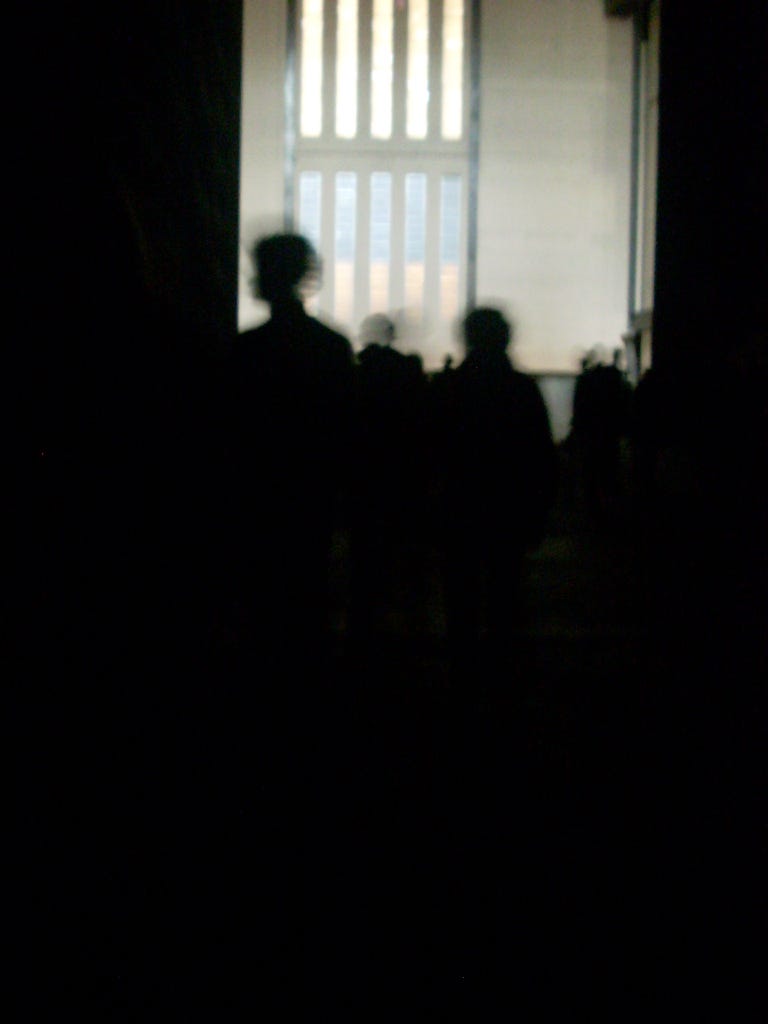
I swivel toward the entrance whence Elspeth and I came, and what was darkness is now only grey shadow, a slew of silhouettes, people from all walks of life experiencing the void as one. No faces, we’ve joined the shadow, as what once was pitch black feels grey, a comforting shade, the result of the sun-visor I had cupped over my eyes.
Light, not so heavy, figures graze one another’s shoulders — ghosts finding their way to the next destination. Our cloud rests in the confines of this cavern; like water particles, we huddle. The cavern opens, and we wander, losing the sense of self while gaining a sense of unity. Just a sense, for the metal frame holds us in what feels like a ship sailing a modest sea.
When I reach the start-finish line, I peer into the space that was once a void. The cloud lifts. Now I can see people’s faces clear as day.
A little girl skips, donning a dress patterned with red tulips, characteristic of this spring day; she releases a few “la la la’s” in a tune I assume is familiar to her.
“Yo,” two American guys point straight ahead. I make out one saying to the other, “What’s that color?”
Next a turquoise headscarf comes into view, a mother with her arms wrapped around four children. “Ni … ye … ya …” they chant. Why?
For us all, what was once tunnel vision becomes a panorama. At the end of the ramp, my eyes adjust to the label I had overlooked — Miroslaw Balka’s How It Is.
Mr. Balka, the artist who has amplified the earth’s shadow.
Elspeth paces past me, doe-eyed, awakened. I catch her hand, we lock pinkies, while I linger on the brink of the dark box and she pivots toward the well-lit museum beyond. For the first time today, I smile, a real smile, part my teeth and breathe in the air of hundreds of people flocking from the box. My chest tightens, then relaxes with each inhale, each exhale. Amazing how the body plays tricks, holding onto a darkness that grows to shadow lined with light.
Like a child on the playground, I say to my companion, “Let’s go in again!”
She laughs at me and shrugs.
This time, Elspeth and I fumble through the dark together. An abyss above ground, the box becomes, for me, both a submarine and an aircraft.
My heart jumps to the top of the throat and beats an ever-increasing pulse. “Fffff,” I allow an air hole between my teeth.
“Why are you scared this time?” she asks.
I enter the darkness again. It’s not that I’m scared; my heart beats quickly because I trust there is more to come. Our walk in the dark is not over.
Clink. My nail hits the end of the void for the second time.
When we turn around, the shadowy figures are no longer. What was once shadow is now a beacon of light.
Lost souls — girls clinging to mama, and I to Elspeth— are polished to the point of pain and strength that allows us all to join the collective.
My friend releases my hand. A gasp of wind at our backs, we’re nudged onward, then faster and faster still, I imagine the vessel welcomes the crashing waves ashore to propel it forward. These sensations have no source; it stands to reason that this could all be a dream. Connected neither to sky nor ground, I imagine musical notes flying off the page, completely improvised, one by one.
Nothing but light, even the top of our steel box has opened to the heavens. I trust that we are all aware of each other’s presence, bidding goodbye to the stumbles of yesterday and carrying the torch of tomorrow. Tears nipped by the sun rain down my cheeks and drizzle between my smile. A mist fills our vessel, nebulous; as daybreak flashes before our eyes and illuminates this corner of London.
***
“How It Is” by Miroslaw Balka was showcased at the Tate Modern in 2009 and 2010. This cavernous, industrial space proved more beautiful than any “wonder of the world” on my itinerary. In it, I got to join the collective shadow and walk back to the beginning with hope of seeing the world through a new lens.
As you discovered too, when we ventured inside again, and it all made sense. I peered into the space, which was once a void, and saw people’s faces, not their shadows. There was light, in fact perspective, within the chamber’s confines. When we looked back for the second time, I could see why I went there in the first place. My eyes adjusted.
I learned a valuable lesson that day. Part of the human experience is hovering on the brink. We encounter fresh experiences, which can unnerve or inspire us. Undiscovered territory makes life interesting. Living in the grey through artistic expression is a gift — all of it, the yearning, the homesickness, the shadow work, the warm glow that follows. While reaching for a familiar friend or at the very least a stable surface in the steel structure at the Tate Modern, I realized that sometimes we must make peace with the unknown.