
[Technology] How IoT (Internet of Things) can link the world?
The secret behind device communications.
Can you imagine how many devices (smartphones, tablets, computers…) are available nowadays? What if I tell you that all those devices can communicate with each other? Yes, this is possible and we call those devices the Internet of Things.
Sending letters is a way of communication for human beings. For the communication to be done we need a sender, a receiver, and a letter written in a specific language. The same concept applies to machine-to-machine communication. The communication between machines can be wired (Ethernet, USB…) or wireless (Bluetooth, Wifi, GSM, RFID..). There is a protocol that governs how this communication should be done, the most common one is TCP/IP (Transmission Control Protocol/Internet Protocol). It is a set of rules and methods that allow different devices to communicate over the internet. It is divided into four different layers.
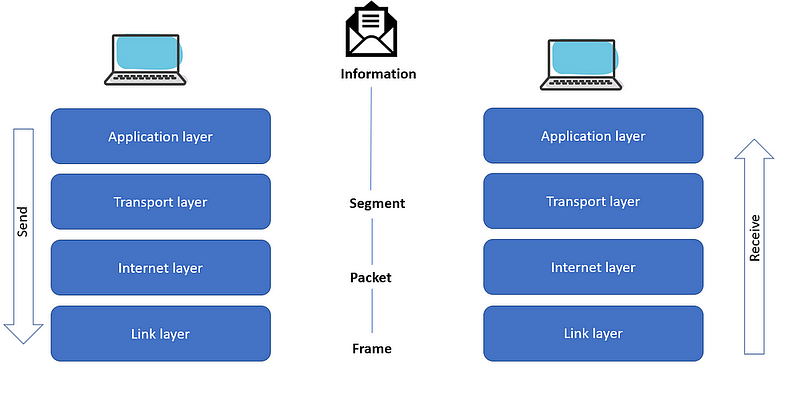
Don’t be afraid, those layers only define how information should be packetized, addressed, transmitted, routed, and received.
The lowest layer, as it is named, links the device to the network where data will be transmitted. The link can be wired using cables or wireless using repeaters or other technologies. At this level, the data is called frame.
The data we want to send is now available on the network. It should be delivered. The primary role of the internet layer is to take this data (Frame) and make it smaller and easier to transport. The data is now called Packet. It also creates an address where this data should be delivered. The address is called IP address.
The transport layer makes sure that those data (Packet) are delivered properly.
The application layer is responsible for presenting the data to the user. Thus it should be understood by a human being. Applications such as Web browsers are used for this purpose. The order of those layers depends on whether you send or receive the information.
To finish with an easy note, imagine you’re sending a letter to your friend. You take a paper and pen and start writing your words. This is the application layer. You go to your nearby post office, and you lend the paper to the postal worker. He folded it, put it into the envelope, and made it easy to deliver. This is the Transport layer. Then he wrote on it the address of your friend. This is the internet layer. In the end, there will be someone giving this letter to your friend. This is the link layer.