
How Investors Can Take Advantage of Actual IPO Prices Without Being Super Wealthy
But is it worth the risk?

Are retail investors finally on equal footing with institutional investors?
Or, at least, closer to it?
Historically, initial public offerings (IPOs) have been reserved for institutional investors (i.e. investment firms) and affluent individuals. That’s changed over the last few months. Budding fintech companies — SoFi and Robinhood — are giving average, everyday investors early access to offering prices.
But why does early access to an IPO matter? How can you take advantage of it? What’re the risks of investing in an IPO?
Let’s explore.
Why is early access to an IPO significant?
Traditionally, when a company goes public, it announces an IPO. The company would then work with an underwriter (e.g. Goldman Sachs) to value the company and determine how much equity to offer and at what price. For example, let’s assume ABC inc. wants to offer 30% of its common stock at $15 per share.
Typically, that price point is reserved for institutional investors and ultra-high-net-worth clients. They get to pay $15 per share, meanwhile, ABC’s stock could open on the public market at $30 per share — so retail investors pay twice as much as the company was initially valued.
By offering early access to the initial offering price of stocks, SoFi and Robinhood are leveling the playing field for retail investors.
However, it’s important to be aware of your requirements as an IPO investor to avoid penalties, which we’ll cover below.
Why would brokerages offer IPO access to retail investors?
While it would be nice to assume companies do this out of the goodness of their hearts, that would be naive.
The conspicuous advantage for Sofi and Robinhood is that this new platform feature (which only members can access) should drive even more people to download their apps and join their platforms. You have to give them credit, it’s a brilliant marketing tactic.
How to purchase stocks at IPO prices on SoFi
In March, SoFi announced that its members could access IPOs before they opened on the market. So long as a SoFi member has at least $3,000 in their investment account, they’re eligible for IPO purchases.
After signing up for SoFi and downloading the app, you can navigate through the “Invest” tab to “IPO investing.” Once there, you’ll answer preliminary questions and indicate your interest in available IPOs — your answers aren’t binding and you aren’t locked into any purchases. On the other side, your order also isn’t guaranteed to be filled since shares are limited.
SoFi is a little ambiguous about how it chooses to allocate shares, indicating two factors (out of an unquantified total) are (1) the size of your order request and (2) the total account value across SoFi investment accounts.
You can review SoFi’s complete instructions for IPO early access here, including the process’s timeline.
How SoFi discourages “flipping”
Part of the reason that IPOs are volatile is that early, early investors (like company executives and stakeholders) use the event to cash out some of their equity — for them, this is a liquidation event and a major financial milestone. Typically, insiders are restricted from selling their shares until a certain amount of time has elapsed, such as 90 days (this is known as a lock-up period).
Otherwise, the stock price could drastically fall in a short period of time. For example, if the CEO sells 10% of all available shares, that would put enormous downward pressure on the company’s share price.
Now that SoFi and Robinhood are opening the doors for retail investors, they’re discouraging them from selling too soon — a process known as “flipping” — and amplifying initial volatility.
According to its instructions, SoFi doesn’t restrict members from selling shares after the IPO officially hits the public market. However, you could incur a $50 fee if you sell before the 120th day of trading, which is roughly six months. On top of that, if the IPO is a SPAC and you sell within the first 30 days, you’ll be temporarily banned from IPOs for 180 days. That penalty increases to one year on the second occurrence and a permanent ban if you do it a third time.
How to purchase stocks at IPO prices on Robinhood
In May, Robinhood started rolling out IPO Access — its feature for enabling its customers to access IPOs at offering prices.
In fact, Robinhood is taking this approach for its own IPO, which debuts on July 29. Sign up for the Due Diligence newsletter to receive a thorough review of Robinhood once it publishes tomorrow morning.
Once you download the app and fund an account, you can search “IPO Access” to locate available IPOs. Here’s an arbitrary example of Riskified, including its estimated offering price range.
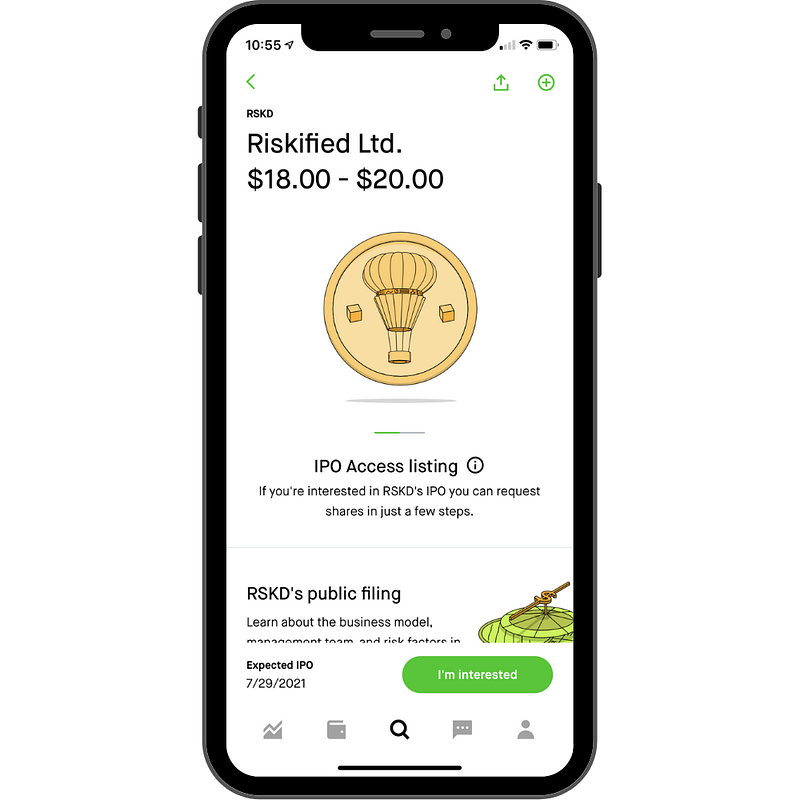
Once you select a company, you must confirm your eligibility — you can’t be an insider or have familial access to an insider and you have to acknowledge the risks and flipping policy.
Next, you can request a specific number of shares at the default share price range or a custom price. You’ll then receive an estimated cost. Similar to SoFi’s process, you aren’t locked into a purchase, but you also aren’t guaranteed to receive shares.
Unlike SoFi, Robinhood promotes that its share allocation process is completely random.
How Robinhood discourages “flipping”
If you use Robinhood’s IPO Access feature to buy an initial offering, you aren’t prohibited from selling your shares. However, if you sell within 30 days of the IPO, you may be temporarily banned for 60 days. Robinhood doesn’t share details about additional transgressions.
Beware: IPOs are risky
IPOs are inherently risky. The primary risks are:
- Lack of information
- Lack of consensus valuation
- Increased volatility
Lack of information
For starters, private companies aren’t required to share financial information. Once they apply to become public companies, they’re required to compile a prospectus, which is a lengthy and meticulous account of the company’s operations, risks, management, financials, etc. These documents are often hundreds of pages long.
Even though it’s thorough, it still doesn’t shed a ton of light on the company’s history beyond a couple of years. Plus, there isn’t much guidance on the company’s future. So, when the company’s stock becomes available to the public, the public doesn’t have a ton of information to base their decision on.
Lack of consensus valuation
When a company goes public, it doesn’t have a history of prices, earnings, or valuations — beyond what’s in its prospectus and what the underwriter estimated to be the appropriate value. Demand for a stock at a particular price isn’t guaranteed. By the close of the IPO day, the stock could be below the initial offering price.
Increased volatility
When stocks join the public markets for the first time, their prices tend to violently fluctuate. Why? A combination of the factors we’ve mentioned. For instance, once a lock-up period ends, investors can cash out and capture their profits — which drives share price down.
Let’s walk through two visual examples. Roblox (RBLX) went public in March via a direct listing (so there wasn’t an underwriter or offering price). Here’s how shares of Roblox (RBLX) have fared since they went public.
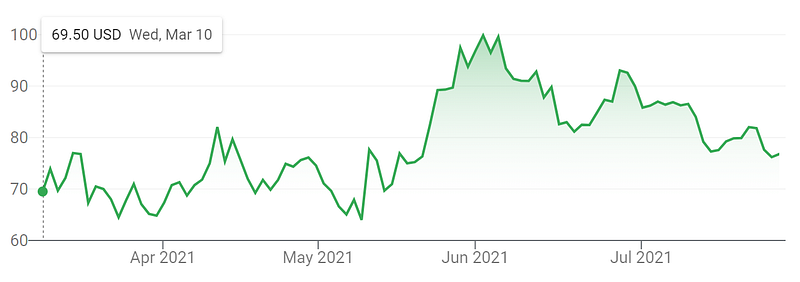
Since it went public, RBLX has peaked at $103.87 and has valleyed at $60.50.
What about a company that did have an offering price? Let’s look at Airbnb, which went public in December 2020 at an offering price of $68.
Shares of ABNB opened at $146. Whoever purchased the initial offering was immediately up 114%.
Since its IPO, ABNB has risen as high as $219.94 and dropped as far as $121.50.
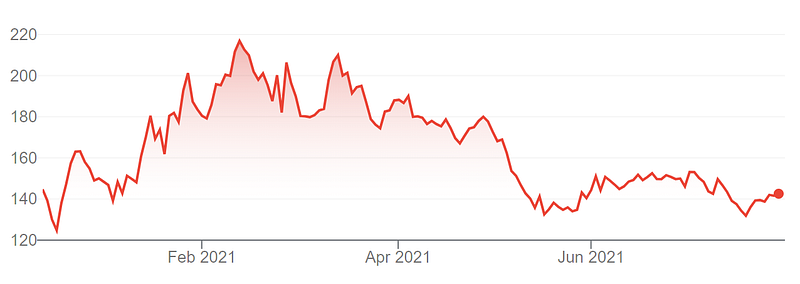
So, before you jump into an IPO, beware of the risks. While these are only two examples, there are plenty of companies like them — and ones that even dropped below their offering price.
If you want to understand what makes a “good” investment, sign up for the Due Diligence newsletter. We provide free reports so that you can make logical and informed decisions instead of speculative risks.