How Interbreeding Turned The Spanish Royals Mad
Eccentricity and insanity bedeviled Habsburgs and Bourbons alike
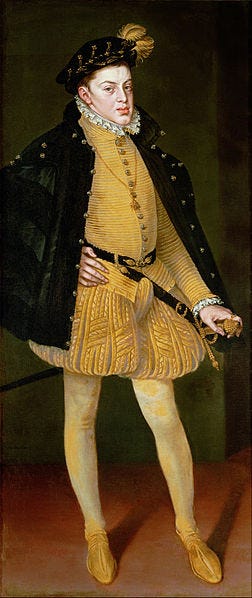
The history of the Spanish royal family between 1547 and 1759 was one of almost constant misfortune, due to the physical and mental infirmities of many of its members. There were intervals during which sanity was resumed, but these did not last.
There was one single root cause, namely the royal custom of marrying within the family so that unfortunate genetic conditions became inherited by later generations.
Don Carlos
Born in 1547, his parents were the future King Philip II and Princess Maria Manuela, who were first cousins twice over. Two of his great-grandmothers were sisters.
Don Carlos was physically malformed and mentally retarded, but he was also Philip’s sole heir, which became particularly important after Philip became king in 1556.
Candidates in Philip’s search for a bride for Don Carlos included an aunt and a cousin, but fortunately, neither of these matches came to fruition.
Don Carlos remained unmarried, but his behavior became bizarre in the extreme, including acts of pure sadism. His condition only worsened after an accidental fall leading to a serious head injury which he only just survived.
In 1567, Don Carlos said that he wanted to kill his father, which was of course treasonous. A death sentence was pronounced on him and, although Philip had no wish to have him executed, he may well have given instructions that nothing should be done should he have another life-threatening incident, which is indeed what happened in July 1568, when Don Carlos died aged 23.
Carlos II
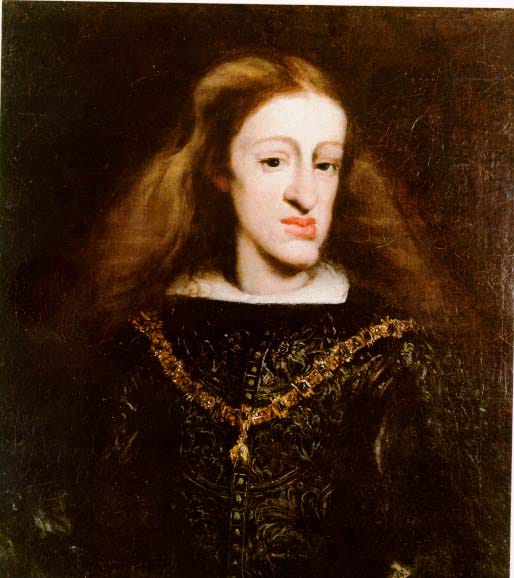
The next two reigns after Philip II were trouble-free, although there was no let-up with the interbreeding. Philip II’s son, who became King Philip III, was the son of Philip II’s second wife, this being Anne of Austria, who was also his niece.
Philip III’s successor, King Philip IV, also married a niece. Their son, Carlos, became King Carlos II in 1665 at the age of four.
It was back to square one as far as royal infirmities were concerned. Carlos was physically deformed, having the “Habsburg jaw” to such an extent that he was unable to chew, and his tongue was so large that he constantly drooled and his speech was very difficult to understand.
He was also mentally impaired, but not so badly that he was unable to understand his condition. He believed that he had been bewitched and underwent exorcisms in an attempt to free himself of his devils.
Philip V
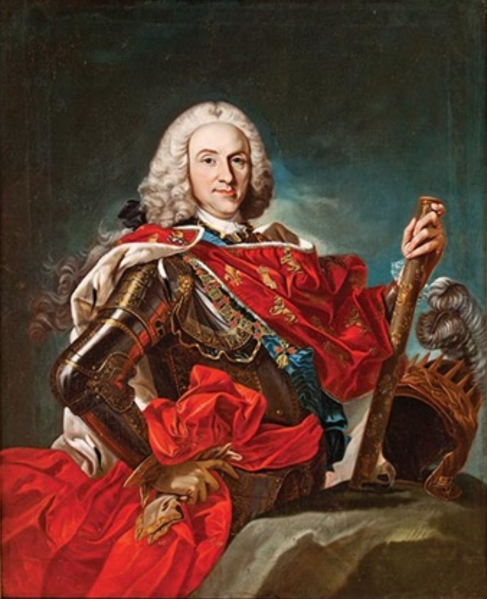
Carlos II was impotent and therefore died (in 1700) without an heir. This led to the War of the Spanish Succession (1701–13), during which the great powers of Europe fought for the right to appoint the next Spanish king.
The winner was France, so the Bourbons took over from the Habsburgs, with King Philip V being the new monarch.
However, interbreeding had also been rife among the Bourbons, with Philip’s grandparents being double first cousins. Philip’s mother was Maria Anna of Bavaria, a member of the Wittelsbach family who had also suffered from mental instability from time to time.
Philip V was King of Spain for 46 years, despite trying to abdicate at one point but being forced to continue after his son Luis died after seven months on the throne.
Philip suffered from intense melancholia and a conviction that he was utterly unsuitable as a king, which had to be true. He shut himself away and refused to talk to anyone apart from the priest who acted as his confessor.
His symptoms would these days have been diagnosed as manic depression.
In 1732 he retired to his bed and refused to move or speak to anyone apart from his wife and his son Ferdinand. He stayed there for seven months, while the government of Spain virtually ground to a halt.
In 1739 his condition worsened and he was given to emitting loud howlings that reverberated throughout the palace, making it very difficult for his courtiers to conceal the fact that the king had gone mad.
Another strange aspect of his condition was a manic appetite for sex, but his refusal to take a mistress meant that his wife had to cater to his needs whenever he wanted, which was frequent. After bearing him four children, Marie Louise died at the age of 26, and his second wife, Elizabeth of Parma, bore him another seven.
Philip died in July 1746 at the age of 63.
Ferdinand VI
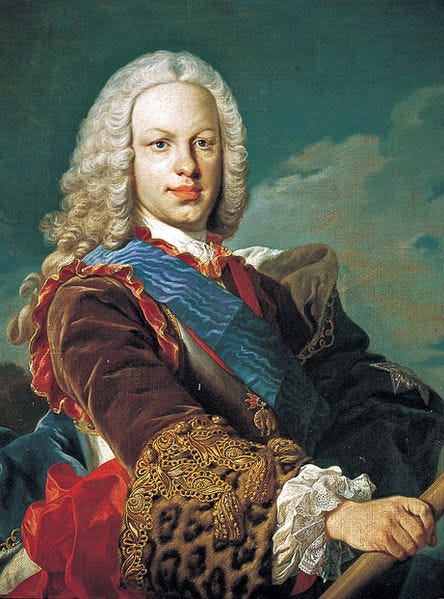
Philip V was succeeded by his third son as King Ferdinand VI, who carried on the unfortunate line of unstable Spanish monarchs.
Ferdinand was 33 when he came to the throne, and all seemed well at first. He was a keen patron of the arts and sciences and built three royal observatories. He also loved to wallow in luxury and delighted in making public appearances with a great deal of pomp and ceremony.
However, there was a much darker side to Ferdinand that gradually emerged as he got older. He was neurotic and suspicious by nature and subject to violent rages.
He longed for solitude and retreated to a monastery where nobody could reach him. He behaved at times similarly to his father, in that he would speak to no one and sign no documents.
When his beloved wife Barbara died in 1758 he lapsed into insanity, refusing to wash or dress, and throwing his excrement at members of his entourage. He became suicidal, but eventually died from a fit in August 1759 at the age of 46.
The End of the Madness
Fortunately for Spain, Ferdinand was the last of Spain’s mad monarchs. He was succeeded by his half-brother who ruled as King Carlos III, an enlightened despot, for the next 29 years.
Things could have gone wrong when Carlos died in 1788, because his elder son, Don Felipe, showed all the signs of the family ailment. Fortunately, a decision was made to pass him over in favour of his younger, much more stable, brother, who took over the throne as King Carlos VI.
The long Spanish nightmare was therefore at an end.
Did you like this? Maybe not! Either way, your comment will be very welcome!
For other similar pieces, see my List:


