
How Inflation Eats You Inside.
Make no mistake about it
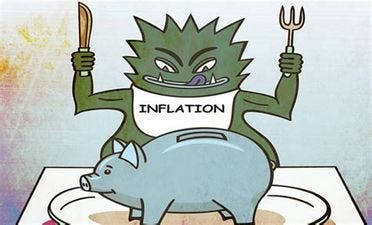
Imagine you walked into your local bank in the 1920s and hand the teller a $100 note to deposit in your saving account. That $100 note would be worth less than $10 today. I know you might be wondering why that? I deposited $100! What is going on? Well technically speaking, nothing has changed in terms of numbers however, what does change is the purchasing power of your $100. Thanks to inflation.
I am not in any shape form a financial adviser and none of this is financial advice. Always do your own research!
Background
Inflation is a term that we all hear a lot in the mainstream media but few really understand what causes it and barely questioned why our monetary system is so inflationary in the first place? To deeply understand this, we should travel back a few decades in the past and see how money use to work.
We all know that precise metals such as gold and silver served the role of money for decades and were widely accepted around the world because of their scarcity and utility. The supply of gold is limited plus it has different use cases such as ornament so it has an intrinsic value. Years passed by and we realise that carrying gold bars and coins is not safe so we shifted to paper notes which represent the gold that is been deposited in a vault somewhere safe. So the piece of paper is as valuable as gold because it can be redeemed at any time with gold. Just say the paper money used to be backed by real gold.
Since there are only two ways to get gold 1) to mine them which requires intense labour or 2) to trade them with goods and services which also require labour, making them valuable in the eyes of everyone. However, there is a trade-off in using gold as currencies. During wars, governments need money to finance them and since that gold is not something they can just print, they are left with two options 1 to raise taxes or 2 to borrow from banks and others countries. If taxes are too high, people would simply refuse to pay them and borrowing money to finance wars is not a good idea either because it has to be paid with interest down the line. Therefore, governments are left with no choice but to exclude gold from the equation. That means shifting the gears to a pure fiat monetary system that has no limited supply and can easily be created to finance wars and government spending without raising taxes or increasing production.
The consequences of this fiat approach are countless. Inflation is just one of them. Now let’s move our focus to inflation.
What is inflation?
“Inflation is the term we use to describe the increase in prices over time. How quickly those prices go up is called the rate of inflation.” Definitions from the BoE
“Inflation is the rate at which the value of a currency is falling and, consequently, the general level of prices for goods and services is rising.” Definition from Investopedia
According to these two definitions, Inflation can be seen in two different ways. 1) The increase in prices of goods and services. 2) the losing power of a currency. Both definitions are correct it is just the way they look at it. The rate of inflation is measured by using the Consumer Price Index(CPI) which is a basket of goods and services purchased by households to measure the increase or decrease of prices at a certain period. It is then given in terms of percentages. So if we say the inflation rate this year is “7%”, what we mean is that the cost of goods and services in the CPI has increased by 7%. Or the value of the currency is falling by 7%.
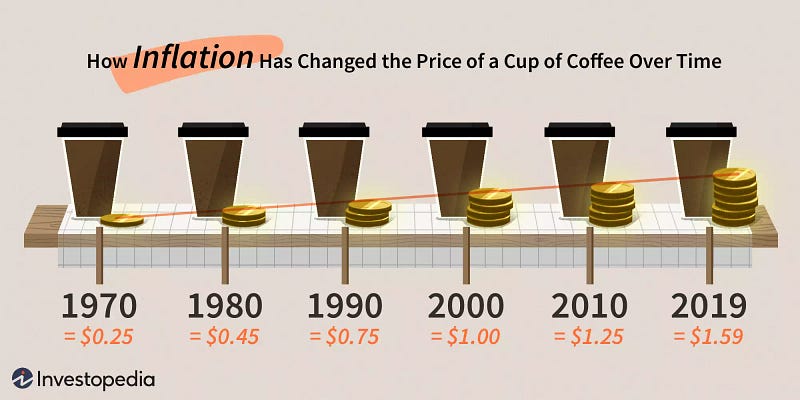
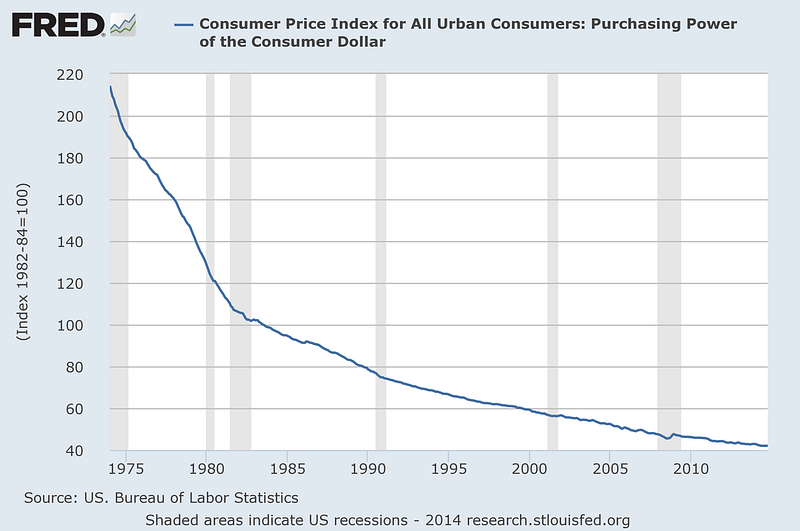
o, While the former is much more obvious, the latter provides a better view to think of inflation. Once you can see the loss of the value of a currency is the result of the price increase, it will change everything you think of inflation.
What Causes Inflation?
In the economy, various factors can drive prices and inflation such as production costs, high demands, supply chain issues, fiscal policies and finally monetary policy.
Production costs and high-demand I do not want to go deep into the economics but it suffices to say that prices tend to go higher if demand exceeds supply. Let’s take gas as an example, the demand for gas in Europe is too high and at the same time, Russia is cutting the supply. So it is natural to see the price of energy skyrocket. Since demand/wants are unlimited, a slight shortage in supply/resources can cause prices to go to the roof. Also since most businesses rely heavily on energy to produce goods and services, the increase in their production costs/energy will be passed to customers which will result in higher prices.
Supply-chain issues
A supply chain is a network between a company and its suppliers to produce and distribute a specific product to the final buyer. Definition from Investopedia
Broadly speaking, the supply-chain factor tends to cause major inflation in one sector during economic uncertainties and since one sector’s product is another’s supply, increases the issue further. Covid-19 is a good example. when most countries went on lockdown, most businesses felt the shortage of supply and transportation and the result is an increase in the prices of final goods.
Fiscal policy
A fiscal policy is simply a government’s taxes and spending policies. Governments can loosen the fiscal policy by cutting taxes and spending more on the economy. However, doing so will theoretically increase demand as people will have more money than otherwise would have gone to the taxman plus the government spending. This two combined will cause prices to go up. To slow it down, they just do the opposite, raising taxes and spending less.
Monetary policy
However, the biggest factor that causes inflation is the monetary policy. Monetary policy is the power given to a central bank to manipulate the money supply and interest rates/the cost of borrowing money. The technicality of this process is beyond the scope of this article but know that central banks can create money out of nothing and inject it into the economy through the process of “buying” government bonds and Quantitative Easing (QE). All this newly created money will somehow end up increasing the demand for goods and services. Remember that the money supply/demand is unlimited while the goods and services they can buy are limited.
The hidden truth about inflation
Recall that earlier we said the primary reason for this monetary system is to allow governments to finance their operations and spend more without raising taxes. But wait! Where does all that money come from? We know that governments are not rich entities that sit in a pile of cash. So the money has to come from somewhere right. Most of us still believe that the taxes they pay to the government is what finance the government’s spending and if taxes raised are not enough, the difference will be borrowed from either in our savings or from another entity. However, taxes are not here to finance any operation at all. but that’s a topic for another day.
To understand this better, think of your own financial situation. What would you do if you want to spend money on a brand new car? You have three options.1) Purchase it with your income/salary. 2) Sell your assets/valuable stuff to buy it. and 3) Borrow money to buy it. Now take a look at governments and ask yourself this; How do governments pay their expenses? Options are: 1) From taxes/income. 2) Sell assets and 3) borrowed money. We all know that governments( US, UK, EU) spend more than what they raised in taxes and almost none of them have any assets to sell. This left us with the third option borrowing money/debt. But how can a government i.e. U.S borrows its own currency the U.S Dollar? Doesn’t make sense at all. The truth is that the government just creates the money it spends not of course by turning on the printing press, that would be too obvious to see but by pretending to borrow them from its central bank/the Fed. Since the federal reserve has the ability to create money out of thin air, the government can pretend to “borrow” money from the Fed but in reality, what happens is the government lets the central bank do the job/printing on their behave.
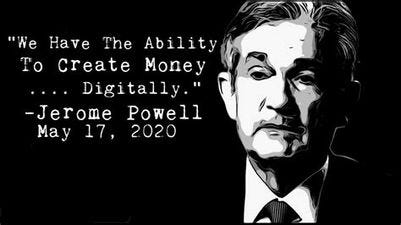
The catch is the government doesn’t have to pay the so-called “loan” at all. The end result/goal is the same. Increase spending without “raising taxes” but this still doesn’t answer where the money REALLY comes from? In his book The Creature from Jekyll Island, G. Edward Griffin puts it this way;
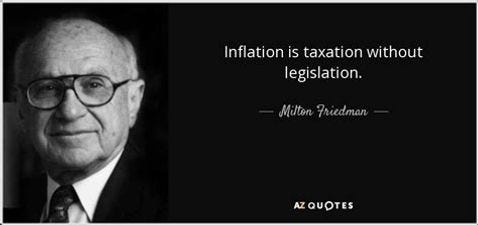
“Fiat money is the means by which governments obtain instant purchasing power without taxation. But where does that purchasing power come from? Since fiat money has nothing of tangible value to offset it, government’s fiat purchasing power can be obtained only by subtracting it from somewhere else. It is, in fact, “collected” from us all through a decline in our purchasing power. It is, therefore, exactly the same as a tax, but one that is hidden from view, silent in operation, and little understood by the taxpayer.”
So rather than raising taxes to collect more money from us which can arouse resentment and political disadvantages, it is been done in such an absurdity and unnoticeable way that provides governments access to unlimited cash from the central bank at cost of our purchasing power, booms and busts and big wealth gaps.
How to hedge yourself against inflation
Although inflation causes much more harm than good, there are ways to benefit from it or protect your capital against it. The way one can achieve this is by holding valuable assets that appreciate as more money gets pumped into the economy. These assets can be stocks, real estate, gold and the best of all bitcoin. As the money supply increases so do asset prices. So while cash holders see their purchasing power decrease over time, asset holders enjoy the price appreciation of their holdings. This of course comes with its downsides during market busts that tend to happen the central bank messes with the monetary policy. That is why diversification should be considered when holding assets.
Closing thoughts
We are unfortunately living in an inflationary system that one cannot help but wonder how this is possible. Inflation can be caused by various factors as listed above but at its core, it is primarily a product of fiat money. Paper money and cheque books are decreed as legal tender and not backed by gold and silver or anything valuable but government debt and the so-called “monetary scientists” who pretend to understand some hidden economic forces that are beyond the reach of the average person. They are legally given the ability to play with the monetary supply which is a recipe for disaster. Their actions not only resulted in the loss of our purchasing power over time but it is also the cause of boom and busts, depressions and reforms that plagues our system.


