
How India should deal with Foreign Interference in its Internal Affairs
#opinion
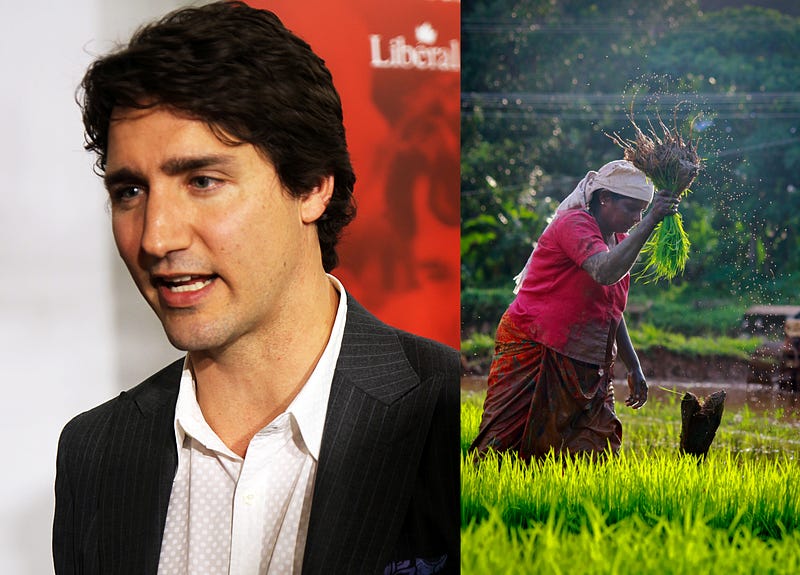
In the past few weeks, India has witnessed protests in the states of Haryana and Punjab by farmers over the passing of the new agricultural reforms. The protests have not only attracted national and state political parties, which is expected when such issues arise, but also those from outside the nation as well, such as the President of Canada, Justin Trudeau, who berated the country for using water cannons and tear gas on protesters. Ironically, Canada itself used similar means to suppress protests by certain indigenous tribes because of a pipeline. Trudeau may be merely attempting to pander to his Sikh voter base in Canada or boost his ‘secular’ image. To make matters worse, Khalistan sympathizers have attempted to use these protests to fuel their separatist agenda.
This isn’t the first time a foreign entity has poked its nose in India’s internal matters, and unfortunately, won’t be the last. So how should an emerging superpower like India expand its international influence while simultaneously reduce the internationalization of its domestic affairs?
The Holier-Than-Thou Sentiment in the West
The West has always seen itself as the pioneer and guardian of liberty, equality, and other secular values. While this is mostly for the right reasons, some states and/or members have occasionally used this as an excuse to meddle in the domestic affairs of other nations. Recently, the European Union (EU) Parliament even considered a resolution against the Citizenship Amendment Act (CAA) bill passed this year in India for apparently being ‘discriminatory’ towards Muslims. These sentiments were channeled by others as well such as the Labour Party in the UK. They were clearly overstepping their jurisdiction by interfering in the bills and laws passed by another nation.
However, these machinations that sought to undermine a nation’s sovereignty in the name of secularism backfired, and quite ironically, France, one of the EU’s own member states, is now trying to regulate Islam to fight religious extremism! While countries such as Turkey and Malaysia rebuked France for these actions, India wholeheartedly extended its support to the nation. Now, the EU has acknowledged it needs India’s support to fight global terror, and thus, set aside past issues.
.jpg)
These incidents show that ultimately most sensible nations would not undermine India’s sovereignty as long as it has something to offer them. Diplomacy is based on the concept of ‘give and take’, and propaganda usually fails to give.
The International Media and the Power of Narrative
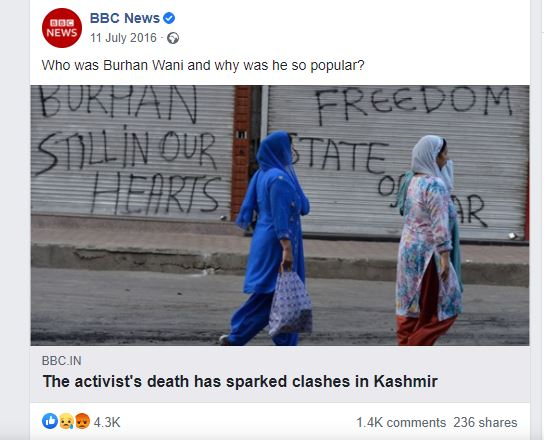
In principle, the media should be the 4th pillar of Democracy, but that hasn’t always been the case in practice. Several leading news outlets have provided a venue for Anti-Indian articles in the past. An article in the BBC, which was posted on Facebook too, called the slain Kashmiri terrorist Burhan Wani an activist! What is more appalling is that nowhere in the article is it mentioned that he was the commander of the Hizbul Mujahideen, an EU and now, a US-designated terrorist organization.
This is quite tragic, as the whole world needs to be united when dealing with issues like terrorism.
In 2015, the Indian Government banned Al Jazeera because it displayed a distorted map of India that did not include portions of Jammu and Kashmir, as well as the Lakshadweep and the Andaman and Nicobar islands. The New York Times was accused of mocking India’s Mars Mission in one of its cartoons. In what was seen as derogatory and elitist, a barefooted, turban clad, and dhoti wearing man with a buffalo next to him is shown knocking on the doors of an ‘Elite Space Club’. Sadly, such articles increase public support for Anti-India lobbies across the world.
Although it may not be possible to fully control the foreign media’s narrative, the Indian media can expand its reach in the world and counter it. The extent to which the media can bolster international relations is difficult to ascertain, but it definitely can improve the public perception of India.
Currently, World Is One News (WION) is India’s only international news network, but Republic TV is expected to launch its international wing within the next two years. Hence, by reducing the public support for these lobbies through counter-narratives, lawmakers would be less inclined to bring resolutions against India.
Disclaimer: We are a platform that allows all views to be represented without bias or discrimination. This piece is not to be judged upon as the final stance of MUNner’s daily or MEC MUN Society.
Read more
We are now on LinkedIn! Do follow us there!
Follow us on Medium for more for International events, news, MUN tips and tricks, and detailed analysis. Get in touch with us on Social media to stay in the loop -
Facebook| Instagram|Telegram Channel |YouTube|Twitter|LinkedIn.
We also invite guest writers to publish their material via this blog!