avatarFabian Bock

Free AI web copilot to create summaries, insights and extended knowledge, download it at here

5715

Abstract

441g CO₂ per kWh, France 59g CO₂ per kWh, and Poland 773g CO₂ per kWh (<a href="https://www.eea.europa.eu/data-and-maps/daviz/co2-emission-intensity-5#tab-googlechartid_chart_11_filters=%7B%22rowFilters%22%3A%7B%7D%3B%22columnFilters%22%3A%7B%22pre_config_ugeo%22%3A%5B%22European%20Union%20(current%20composition)%22%3B%22France%22%3B%22Germany%22%3B%22Poland%22%5D%7D%7D">European Environment Agency</a>).</li><li>There are doubts that having a green energy plan has a significant impact on your personal value for CO₂ per kWh. First, green power certificates can be bought easily without the increased production of green power. Second, voluntary contributions are comparably small and have only a small impact(<a href="https://www.verbraucherzentrale.de/wissen/energie/preise-tarife-anbieterwechsel/ist-ein-tarif-mit-oekostrom-und-oekogas-ueberhaupt-sinnvoll-8207">Verbraucherzentrale</a>).</li><li>Several of the assumptions are based on my personal consumption and the devices used in my household. Other consumptions or devices may vary significantly.</li><li>When I refer to CO₂, I actually mean CO₂ equivalents. For easier reading, I used the less precise but simpler term CO₂.</li></ul><h1 id="5648">Explanations & references:</h1><p id="98e0">[1] 1kg of butter causes CO₂ emissions of 20–25 kg according to most sources I found (e.g. <a href="https://literatur.thuenen.de/digbib_extern/bitv/dn046465.pdf">Thuenen-Institut</a>, <a href="https://www.oeko.de/oekodoc/328/2007-011-de.pdf">Öko-Institut</a>). However, some also mention 15kg (<a href="https://www.wwf.de/fileadmin/user_upload/Klimawandel_auf_dem_Teller.pdf">WWF</a>) or just 9kg (<a href="https://www.klimatarier.com/de/CO2_Rechner">Klimatarier/IFEU Institut</a>). The CO₂ emission estimations for 1kg margarine range between 0.7kg (<a href="https://literatur.thuenen.de/digbib_extern/bitv/dn046465.pdf">Thuenen-Institut</a>) and 2kg (<a href="https://www.klimatarier.com/de/CO2_Rechner">Klimatarier/IFEU Institut</a>). Note: When buying margarine, you might want to look for a product not having palm oil in the ingredients. <b>For this calculation, I used: 21 CO₂/kg for butter and 1kg CO2e/kg for margarine</b></p><p id="5c05">[2] 1kg of beef leads to emissions between 11 kg CO₂ (lower bound of <a href="https://www.oeko.de/oekodoc/328/2007-011-de.pdf">Öko-Institut</a>) and 21 kg CO₂ (upper bound of <a href="https://www.wwf.de/fileadmin/user_upload/Klimawandel_auf_dem_Teller.pdf">WWF</a>). 1kg of chicken or pork leads to between 3 kg CO₂ (lower bound of <a href="https://www.oeko.de/oekodoc/328/2007-011-de.pdf">Öko-Institut</a>) and 8 kg CO₂ (upper bound of <a href="https://www.wwf.de/fileadmin/user_upload/Klimawandel_auf_dem_Teller.pdf">WWF</a>). <b>For this calculation, I used: 12 kg CO₂/kg of beef and 4kg CO2e/kg of chicken/pork.</b></p><p id="796a">[3] A survey of multiple studies (<a href="https://www.researchgate.net/publication/315685068_Product_Carbon_Footprint_for_drinking_water_supply_through_a_Grohe_Blue_faucet_system_compared_to_mineral_water">Schröder et al.</a>) reports that many estimates are in a range between 100g and 500g CO₂ per liter of bottled water. The emissions for tap water are neglectable (<a href="https://nachhaltig-sein.info/lebensweise/leitungswasser-mineralwasser-vergleich-nachhaltigkeit-gesundheit#:~:text=Besonders%20importiertes%20Flaschenwasser%20verursacht%20bis%20zu%201000%20Mal%20mehr%20Umweltbelastungen%20als%20Leitungswasser.&amp;text=Kurz%3A%20F%C3%BCr%20einen%20Berliner%20Mineralwassertrinker,F%C3%BCr%20Leitungswasser%20entstehen%200%2C35g.">nachhaltig-sein.info</a>). <b>For this calculation, I used: 200g CO₂ per liter of bottled water and 0g CO₂ per liter of tap water.</b></p><p id="23b9">[4] 1 liter of cow milk leads to emissions between 1 kg CO₂ and 3 kg CO₂ (<a href="https://www.researchgate.net/publication/325532198_Reducing_food%27s_environmental_impacts_through_producers_and_consumers">Poore&Nemecek</a>), also strongly depending on the continent you are living in. 1 liter of soy milk leads to around 1kg CO₂ (<a href="https://www.klimatarier.com/de/CO2_Rechner">Klimatarier/IFEU Institut</a>). <b>For this calculation, I used: 2kg CO₂/liter of cow milk and 1kg CO2e/liter of soy milk.</b></p><p id="8931">[5] 1kg of rice leads to emissions between 3kg CO₂ (<a href="https://www.klimatarier.com/de/CO2_Rechner">Klimatarier/IFEU Institut</a>) and 6kg CO₂ (<a href="https://www.wwf.de/fileadmin/user_upload/Klimawandel_auf_dem_Teller.pdf">WWF</a>). 1kg of pasta leads to 0.5kg CO₂ (<a href="https://www.klimatarier.com/de/CO2_Rechner">Klimatarier/IFEU Institut</a>). <b>For this calculation, I used: 4.5kg CO₂/kg of rice and 0.5kg CO2e/kg of pasta.</b></p><p id="e90d">[6] Calculated on <a href="https://www.atmosfair.de/en/offset/flight/">atmosfair.de</a> (round-trips): Cologne (GER) - Rostock(GER): 311kg CO₂; Cologne(GER)-Hurghada (Egypt): 1,803 kg CO₂</p><p id="967c">[7] In 2018, licensed cars in Germany needed 7.8 liters of gasoline or 7 liters of diesel per 100km on average (<a href="https://de.statista.com/statistik/daten/studie/484054/umfrage/durchschnittsverbrauch-pkw-in-privaten-haushalten-in-deutschland/#:~:text=Der%20durchschnittliche%20Kraftstoffverbrauch%20von%20Personenkraftwagen,Kraftstoff%20f%C3%BCr%20die%20gleiche%20Strecke">de.statista.com</a>). Burning gasoline leads to 2.37 kg CO2 per liter, diesel to 2,65 kg CO₂ per liter (<a href="https://www.helmholtz.de/erde_und_umwelt/wie-viel-co2-steckt-in-einem-liter-benzin/">helmholtz.de</a>). Thus, there is an average emission of 185g CO₂ per km on both gasoline or diesel. <a href="https://www.umweltbundesamt.de/themen/verkehr-laerm/emissionsdaten#verkehrsmittelvergleich_per

Options

sonenverkehr">umweltbundesamt.de</a> reports even 220g CO₂ per km (considering their average number of passengers). Cars in the UK have between 173 and 180g CO₂ per km (<a href="https://www.bbc.com/future/article/20200317-climate-change-cut-carbon-emissions-from-your-commute">bbc.com</a>), cars in the US even 250 g CO₂ per km (<a href="https://www.epa.gov/greenvehicles/greenhouse-gas-emissions-typical-passenger-vehicle">epa.gov</a>). Local public transport in Germany causes 57g CO₂ per km and per passenger (<a href="https://www.umweltbundesamt.de/themen/verkehr-laerm/emissionsdaten#verkehrsmittelvergleich_personenverkehr">umweltbundesamt.de</a>). <b>For my calculation, I used a difference of 120 g CO₂ per km between both modes of transportation, assuming only one passenger in the car.</b></p><p id="1428">[8] Gas consumption increases by 50% when driving 160kph instead of 120kph, mainly due to aerodynamic drag (<a href="https://www.researchgate.net/publication/275341584_Ploetz_C_Reuscher_G_Zweck_A_Mehr_Wissen_-_weniger_Ressourcen_VDI_Technologiezentrum_Hrsg_Schriftenreihe_Zukunftige_Technologien_Consulting_Nr_83_Dusseldorf_2009/figures?lo=1">Ploetz et al.</a>). According to <a href="https://www.theguardian.com/money/2011/mar/12/cut-your-speed-cut-your-petrol-bill">theguardian.com</a>, cruising at 70mph (113kph) instead of 80mph (129kph) leads to a fuel reduction of 10%.<b> For my calculation, I assumed 180g CO₂ per km (see [7]). Also, I assumed a decreased consumption of 10% when going 10kph slower.</b> (Of course, this is a strong simplification neglecting the driving speed).</p><p id="6384">[9] see [7]</p><p id="86c1">[10] No transmission losses are considered. I assumed 400g CO₂ per kWh.</p><p id="5b16">[11] 14 m³ of gas per year and m² of the apartment (<a href="https://www.energiesparen-im-haushalt.de/energie/bauen-und-modernisieren/modernisierung-haus/heizung-modernisieren/heizungsanlage-erneuern/gasheizung-erneuern/durchschnittlicher-gasverbrauch.html">energiesparen-im-haushalt.de/</a>) and 2kg CO₂ per m³ of gas (<a href="https://www.klimaneutral-handeln.de/">klimaneutral-handeln.de</a>) lead to 28kg CO₂ per m² and year or 2.3kg CO₂ per m² and month. Of course, these values strongly depend on the condition of your apartment and the type of your heater.</p><p id="4331">[12] Based on [11], the emissions for a 90m² flat are 207 kg CO₂ per month. A reduction of the temperature in your flat by one degree Celsius leads to savings of about 6% (<a href="https://www.test.de/Klimaschutz-CO2-sparen-ein-Selbstversuch-5482892-0/">test.de</a>).</p><p id="ed91">[13] A 3-minute hot shower with a regular showerhead leads to 2.9 kg CO₂ according to <a href="https://www.sueddeutsche.de/wissen/die-persoenliche-co2-bilanz-den-ganzen-tag-kohlendioxid-1.831549">sueddeutsche.de</a>. However, <a href="https://www.dw.com/en/a-day-in-co2e-emissions/a-18892482">dw.com</a> reports that 12 minutes of showering lead to 1kg CO₂. <b>For computing the monthly impact, I used 0.7 kg CO₂ per minute showering.</b></p><p id="cefe">[14] 3.1 million tons of CO₂ per year in Germany (<a href="https://kommunalwirtschaft.eu/tagesanzeiger/detail/i40341/c000?view=presse_detail&amp;tmpl=component&amp;print=1">kommunalwirtschaft.eu</a>) ( →48kg CO₂ per person and year, if 80% of inhabitants contribute), 500.000 tons of CO₂ per year in Austria (<a href="https://www.ara.at/kreislauf-wirtschaft/umweltauswirkungen">ara.at</a>) ( →71kg CO₂ per person and year, if 80% of inhabitants contribute). <b>For computing the monthly impact, I used 60kg CO₂ per person per year.</b></p><p id="e5f1">[15] A run of a modern dishwasher causes less than 1 kWh and thus 400g CO₂ (<a href="https://www.umweltbundesamt.de/umwelttipps-fuer-den-alltag/elektrogeraete/geschirrspueler-spuelmaschine#unsere-tipps">umweltbundesamt.de</a>).</p><p id="5bad">[16] Estimations range between 1g (<a href="https://www.zdf.de/nachrichten/heute/klickscham-wie-viel-co2-e-mails-und-streaming-verusachen-100.html">zdf.de</a>) and 10g (<a href="https://www.oekotest.de/freizeit-technik/Eine-E-Mail-ist-genauso-klimaschaedlich-wie-eine-Plastiktuete-_600843_1.html">oekotest.de</a>) per email. <b>I assumed 4g per email</b> → 30 days * 5 emails / day * 4 g = 0.6kg CO₂</p><p id="090d">[17] 30kg CO₂ per year according to <a href="https://www.geo.de/natur/nachhaltigkeit/17010-rtkl-co2-bilanz-verbessern-nachhaltig-leben-ein-tipp-fuer-jeden-raum-im">geo.de</a></p><p id="eff0">[18] Efficient heat pump dryers need less than 2kWh per run (e.g. <a href="https://media3.bosch-home.com/Documents/eudatasheet/de-DE/WTW854E2.pdf">bosch-home.com</a>). I assumed 1kg CO₂ per run being pessimistic about these manufacturer numbers. Traditional dryers cause around 3kg CO₂ per run (<a href="https://www.test.de/Klimaschutz-So-sparen-Sie-Geld-und-CO2-1511629-1511844/">test.de</a>) The construction of a dryer has estimated emissions of 209 kg CO₂ (<a href="https://www.ecotopten.de/sites/default/files/ecotopten_kriterien_waeschetrockner.pdf">ecotopten.de</a>). With an estimated lifetime of 12 years, the monthly CO₂ impact is around 1.5 kg CO₂. I neglected this additional impact as this would imply the general decision of buying a dryer or not.</p><p id="9f14">[19] 20W 2h/day 30days400g/kWh = 0.48 kg CO₂</p><p id="72b5">[20] 500 sheets of paper lead to 2.2–2.6kg CO₂ according to <a href="https://www.papiernetz.de/informationen/nachhaltigkeitsrechner/">papiernetz.de</a> <b>For this calculation, I used: 2.5kg CO₂ per 500 sheets</b></p><p id="385b">[21] Modern TVs need around 1 Watt in standby mode (<a href="https://www.test.de/Fernseher-im-Test-1629201-5335754/">test.de</a>) 1W24h30days400g/kWh=0.288kg CO2</p></article></body>

How Impactful are My Actions to Reduce My Carbon Footprint?

Photo by Joshua Earle on Unsplash (adapted)

Have you ever wanted to compare the impact of your measures, reducing your carbon footprint? What saves more CO₂: using public transportation instead of your car or eating margarine instead of butter?

A good way to analyze the impact of your different CO₂ actions is to unify. That means you compute your CO₂ savings per month to make them comparable.

In this article, I provide you a detailed collection of measures to reduce your carbon footprint and their impact in terms of CO₂ equivalents per month and person. I would be glad to extend this list with your suggestions on further CO₂ reduction actions. Please let me know in the comments.

If you are interested in how to make the most out of the following collection, have a look at my article:

Food & Drinks
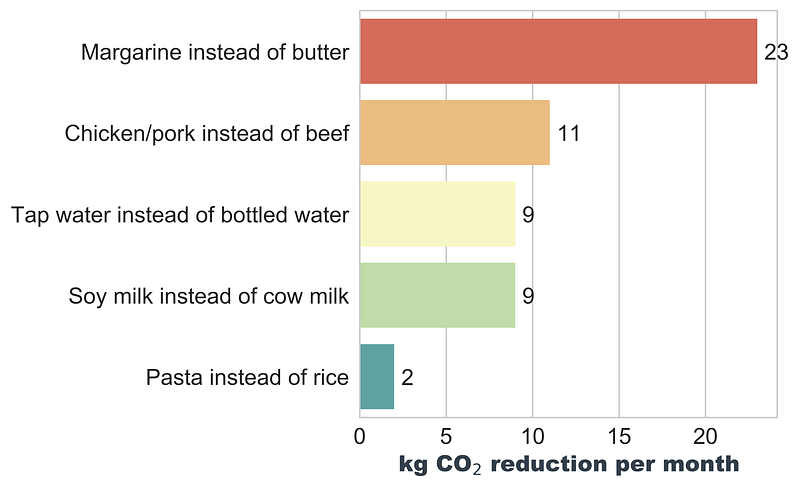
Impact of CO2 saving actions in nutrition. Source: Generated by myself based on the number discussed here.
  • Margarine instead of butter: 23kg CO₂ (assuming one packet (250g) per week) [1]
  • Chicken/pork instead of beef: 11kg CO₂ (150g per meal, twice per week) [2]
  • Tap water instead of bottled water: 9kg CO₂ (assuming 1.5l daily) [3]
  • Soy milk instead of cow milk: 9kg CO₂ (assuming 2l weekly) [4]
  • Pasta instead of rice: 2kg CO₂ (100g per meal, twice per week) [5]

Mobility
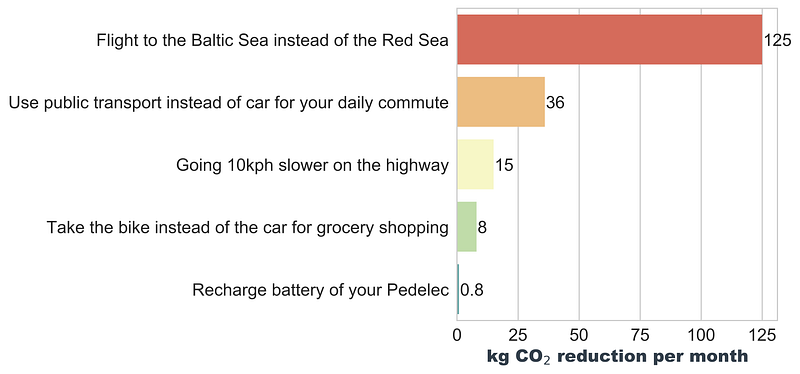
Impact of CO2 saving actions in mobility. Source: Generated by myself based on the number discussed here.
  • Fly to the Baltic Sea instead of the Red Sea as your summer vacation destination: 125 kg CO₂ (1,500kg CO₂ divided by 12) [6]
  • Use public transport instead of a car for your daily commute: 36kg CO₂ (15 days a month, distance 10 kilometers one way) [7]
  • Going 10kph slower on the highway: 15kg CO₂ (assuming 10,000km/year on the highway) [8]
  • Take the bike instead of the car for grocery shopping: 8kg CO₂ (assuming 5km distance one way, once per week) [9]
  • Recharge battery of your Pedelec: 0.8kg CO₂ (assuming once a week, 500Wh capacity) [10]

Living
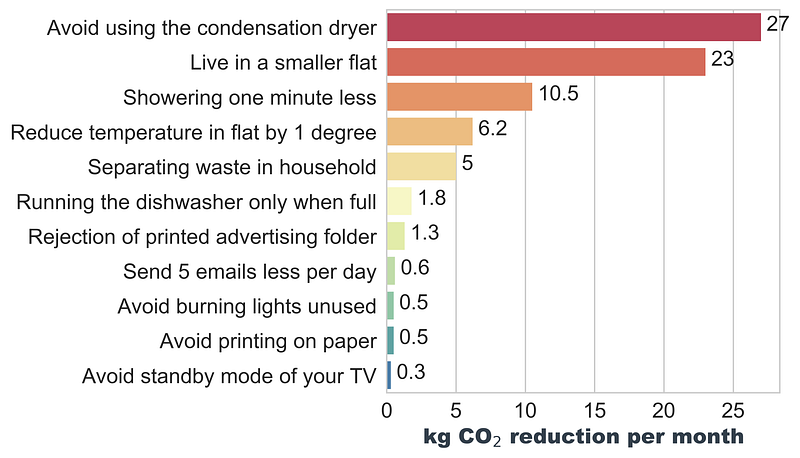
Impact of CO2 saving actions in living. Source: Generated by myself based on the number discussed here.
  • Drying clothes outside instead of using the dryer instead: 9kg -27kg CO₂ (heat pump dryer vs. condensation dryer; running twice per week) [18]
  • Live in a smaller flat: 23kg CO₂ (80 sqm instead of 100sqm, per person for a 2-person household) [11]
  • Showering one minute less: 10.5kg CO₂ (assuming 15 times per month) [12]
  • Reduce the temperature in the flat during the heating period by 1 degree: 6.2kg CO₂ (assuming 90sqm flat, per person for a 2-person household) [13]
  • Separating waste in household: 5kg CO₂ [14]
  • Running the dishwasher full once instead of half-full twice: 1.8kg CO₂ (if once per week) [15]
  • Rejection of printed advertising folder: 1.3 kg CO₂ (per person for a 2-person household) [17]
  • Send 5 emails less per day: 0.6kg CO₂ (without attachment) [16]
  • Avoid burning lights unused: 0.5kg CO₂ (assuming 4x 5 Watt LEDs unnecessarily burning 2 hours per day) [19]
  • Avoid printing on paper: 0.5kg CO₂ (for 100 sheets) [20]
  • Avoid standby mode of your TV: 0.3 kg CO₂ [21]

General notes:

  • All CO₂ equivalents are computed as monthly emissions of one person. For simplicity, I used 4.5 weeks per month instead of the yearly average of 4.345.
  • If you have better references or deviating information, please let me know, and we can discuss adding them. As this is not a scientific article, I often did not spend the effort to search for the primary source.
  • I am sorry that many of my references are written in German. Please let me know if you have English references for the same category.
  • For any consumption of electric energy, I assume 400g CO₂ per kWh. This value is strongly dependent on the country you are living in. As an example, for 2016, the European Union had an average of 296g CO₂/kWh, Germany 441g CO₂ per kWh, France 59g CO₂ per kWh, and Poland 773g CO₂ per kWh (European Environment Agency).
  • There are doubts that having a green energy plan has a significant impact on your personal value for CO₂ per kWh. First, green power certificates can be bought easily without the increased production of green power. Second, voluntary contributions are comparably small and have only a small impact(Verbraucherzentrale).
  • Several of the assumptions are based on my personal consumption and the devices used in my household. Other consumptions or devices may vary significantly.
  • When I refer to CO₂, I actually mean CO₂ equivalents. For easier reading, I used the less precise but simpler term CO₂.

Explanations & references:

[1] 1kg of butter causes CO₂ emissions of 20–25 kg according to most sources I found (e.g. Thuenen-Institut, Öko-Institut). However, some also mention 15kg (WWF) or just 9kg (Klimatarier/IFEU Institut). The CO₂ emission estimations for 1kg margarine range between 0.7kg (Thuenen-Institut) and 2kg (Klimatarier/IFEU Institut). Note: When buying margarine, you might want to look for a product not having palm oil in the ingredients. For this calculation, I used: 21 CO₂/kg for butter and 1kg CO2e/kg for margarine

[2] 1kg of beef leads to emissions between 11 kg CO₂ (lower bound of Öko-Institut) and 21 kg CO₂ (upper bound of WWF). 1kg of chicken or pork leads to between 3 kg CO₂ (lower bound of Öko-Institut) and 8 kg CO₂ (upper bound of WWF). For this calculation, I used: 12 kg CO₂/kg of beef and 4kg CO2e/kg of chicken/pork.

[3] A survey of multiple studies (Schröder et al.) reports that many estimates are in a range between 100g and 500g CO₂ per liter of bottled water. The emissions for tap water are neglectable (nachhaltig-sein.info). For this calculation, I used: 200g CO₂ per liter of bottled water and 0g CO₂ per liter of tap water.

[4] 1 liter of cow milk leads to emissions between 1 kg CO₂ and 3 kg CO₂ (Poore&Nemecek), also strongly depending on the continent you are living in. 1 liter of soy milk leads to around 1kg CO₂ (Klimatarier/IFEU Institut). For this calculation, I used: 2kg CO₂/liter of cow milk and 1kg CO2e/liter of soy milk.

[5] 1kg of rice leads to emissions between 3kg CO₂ (Klimatarier/IFEU Institut) and 6kg CO₂ (WWF). 1kg of pasta leads to 0.5kg CO₂ (Klimatarier/IFEU Institut). For this calculation, I used: 4.5kg CO₂/kg of rice and 0.5kg CO2e/kg of pasta.

[6] Calculated on atmosfair.de (round-trips): Cologne (GER) - Rostock(GER): 311kg CO₂; Cologne(GER)-Hurghada (Egypt): 1,803 kg CO₂

[7] In 2018, licensed cars in Germany needed 7.8 liters of gasoline or 7 liters of diesel per 100km on average (de.statista.com). Burning gasoline leads to 2.37 kg CO2 per liter, diesel to 2,65 kg CO₂ per liter (helmholtz.de). Thus, there is an average emission of 185g CO₂ per km on both gasoline or diesel. umweltbundesamt.de reports even 220g CO₂ per km (considering their average number of passengers). Cars in the UK have between 173 and 180g CO₂ per km (bbc.com), cars in the US even 250 g CO₂ per km (epa.gov). Local public transport in Germany causes 57g CO₂ per km and per passenger (umweltbundesamt.de). For my calculation, I used a difference of 120 g CO₂ per km between both modes of transportation, assuming only one passenger in the car.

[8] Gas consumption increases by 50% when driving 160kph instead of 120kph, mainly due to aerodynamic drag (Ploetz et al.). According to theguardian.com, cruising at 70mph (113kph) instead of 80mph (129kph) leads to a fuel reduction of 10%. For my calculation, I assumed 180g CO₂ per km (see [7]). Also, I assumed a decreased consumption of 10% when going 10kph slower. (Of course, this is a strong simplification neglecting the driving speed).

[9] see [7]

[10] No transmission losses are considered. I assumed 400g CO₂ per kWh.

[11] 14 m³ of gas per year and m² of the apartment (energiesparen-im-haushalt.de/) and 2kg CO₂ per m³ of gas (klimaneutral-handeln.de) lead to 28kg CO₂ per m² and year or 2.3kg CO₂ per m² and month. Of course, these values strongly depend on the condition of your apartment and the type of your heater.

[12] Based on [11], the emissions for a 90m² flat are 207 kg CO₂ per month. A reduction of the temperature in your flat by one degree Celsius leads to savings of about 6% (test.de).

[13] A 3-minute hot shower with a regular showerhead leads to 2.9 kg CO₂ according to sueddeutsche.de. However, dw.com reports that 12 minutes of showering lead to 1kg CO₂. For computing the monthly impact, I used 0.7 kg CO₂ per minute showering.

[14] 3.1 million tons of CO₂ per year in Germany (kommunalwirtschaft.eu) ( →48kg CO₂ per person and year, if 80% of inhabitants contribute), 500.000 tons of CO₂ per year in Austria (ara.at) ( →71kg CO₂ per person and year, if 80% of inhabitants contribute). For computing the monthly impact, I used 60kg CO₂ per person per year.

[15] A run of a modern dishwasher causes less than 1 kWh and thus 400g CO₂ (umweltbundesamt.de).

[16] Estimations range between 1g (zdf.de) and 10g (oekotest.de) per email. I assumed 4g per email → 30 days * 5 emails / day * 4 g = 0.6kg CO₂

[17] 30kg CO₂ per year according to geo.de

[18] Efficient heat pump dryers need less than 2kWh per run (e.g. bosch-home.com). I assumed 1kg CO₂ per run being pessimistic about these manufacturer numbers. Traditional dryers cause around 3kg CO₂ per run (test.de) The construction of a dryer has estimated emissions of 209 kg CO₂ (ecotopten.de). With an estimated lifetime of 12 years, the monthly CO₂ impact is around 1.5 kg CO₂. I neglected this additional impact as this would imply the general decision of buying a dryer or not.

[19] 20W *2h/day *30days*400g/kWh = 0.48 kg CO₂

[20] 500 sheets of paper lead to 2.2–2.6kg CO₂ according to papiernetz.de For this calculation, I used: 2.5kg CO₂ per 500 sheets

[21] Modern TVs need around 1 Watt in standby mode (test.de) 1W*24h*30days*400g/kWh=0.288kg CO2

Sustainability
Awareness
Future
Numbers
Climate Change
Recommended from ReadMedium