
How I Wrote a Sherlock Holmes Pastiche in High School
Why does the Great Detective created by Sir Arthur Conan Doyle continue to fascinate us? Why do people still write Sherlock Holmes stories?
How I Met Sherlock Holmes
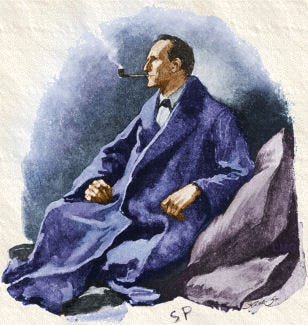
When I was in junior high school, my father let me borrow his two-volume copy of the acclaimed The Annotated Sherlock Holmes, with notes by Holmes scholar William S. Baring-Gould. I got to read all the Holmes stories I wanted without waiting for the Scholastic Books shipment. I saw the Sidney Paget illustrations. I also got to read detailed notes about each tale. (You can listen to a podcast about this scholar and his very special book at I Hear of Sherlock Everywhere.)
Dad and I also watched Sherlock Holmes movies together whenever we could, good and bad. You could catch the Basil Rathbone Sherlock Holmes movies on local TV stations back then.
Enter the Sherlock Holmes Pastiche
Quickly, I learned about something called the Sherlock Holmes pastiche. These are new Sherlock Holmes stories by people other than Conan Doyle. There is a long line of Sherlock Holmes pastiches.
The first pastiche I came across was The Seven-Per-Cent Solution by Nicholas Meyer (who also went on to work on Star Trek movies). I saw the adaptation in the theater and adored the book the movie was based on.
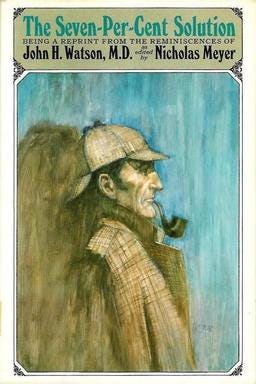
Many Holmes fans loved the story. Others felt betrayed. The revelation about Professor Moriarty angered some.
Not me! I sought out more pastiches. All types. From Sherlock Holmes vs. Dracula, by Loren D. Estleman, to Exit Sherlock Holmes, by Robert Lee Hall, which had time travel and cloning. (I’m not making this up!)
But the biggest controversy involved Jack the Ripper…
The Most Controversial Sherlock Holmes Pastiche Ever?
If you dare, read The Last Sherlock Holmes Story by Michael Dibdin. Like many, you might loathe it.
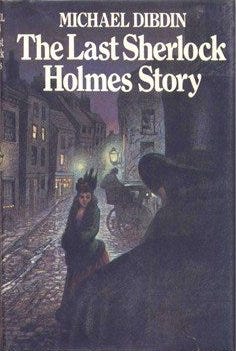
I went into it not knowing what to expect. Just that it had something to do with Sherlock Holmes and Jack the Ripper.
The twist! The solution! Holy shit!
I loved it. But I deduced that I was in the minority.
Fans felt betrayed by that plot. Horrified that the Conan Doyle estate had allowed this one through.
I understood their feelings. But I still loved the heck out of the book. Decades later, I reread it and loved it, but this time, I discovered another layer. It … was … more … ambiguous … than … I … remembered.
The movie Murder by Decree also mixed Sherlock Holmes and Jack the Ripper, but in a much different way. (It was directed by Bob Clark, who directed everything from slasher films to Porky’s to A Christmas Story.)
As if Jack the Ripper wasn’t enough, Sherlock Holmes encountered another terrifying subject. Modern times!
Sherlock Holmes Meets … Us!
One day, I stumbled upon the movie They Might Be Giants. A story that dropped Sherlock Holmes into the modern world.
To me, They Might Be Giants is not just the name of a band. It’s also a charming and magical movie. George C. Scott plays a modern-day judge who starts thinking he’s Sherlock Holmes. Joanne Woodward stars as a psychiatrist named… Dr. Watson! She’s hired to try to get him institutionalized but ends up pulled into his adventures.
Another influence is a TV pilot called The Return of the World’s Greatest Detective. If you think of Larry Hagman as J. R. Ewing on Dallas, you’re in for a surprise when you see him in this movie. Here, he’s a bumbling motorcycle cop. His motorcycle falls on him while he’s reading a Sherlock Holmes story. After the resulting head injury, he wakes up thinking he’s Sherlock Holmes. Goofy but fun.
So it was natural that I wanted to write a story where Sherlock Holmes ended up in the modern world.
Putting Pen to Paper
I didn’t need a motorcycle landing on my head to spur me on. One day, I simply decided to write my own Sherlock Holmes in modern times story. I grabbed a spiral-bound notebook and started scribbling away. My tale was about a modern-day judge named Victor. Shortly after the story starts, he learns that he has lost his wife. (Hmm, where did I get that idea from?) He responds dramatically, and then melodramatically. Of course, when he wakes up, he states that he is Sherlock Holmes. (Ditto!)
My story would be different than those other Sherlock Holmes stories set in modern times. You see, everyone thought Victor was crazy when he decided he was Sherlock Holmes. But it would turn out that he really was Sherlock Holmes. Holmes was immortal! Literally! (Unfortunately, so was Moriarty.) For years, Victor had amnesia and thought he was a judge (who looked suspiciously like George C. Scott in my mind). But he was really Sherlock Holmes. He lost his memory in … uhm, err, a skiing accident.
Hey, it sounded like a great idea at the time. And at least it was different?
One of the defining moments of my writing life came when I took my notebook to a Girl Scout meeting. Because of the bad weather, most members didn’t show up that day. Just the leader and her daughters and their friend. And me. While we waited for my father to come back and pick me up, my Girl Scout leader patiently looked over the story. She deciphered my handwriting and gave me great feedback on the budding story. I still have those marked-up pages.
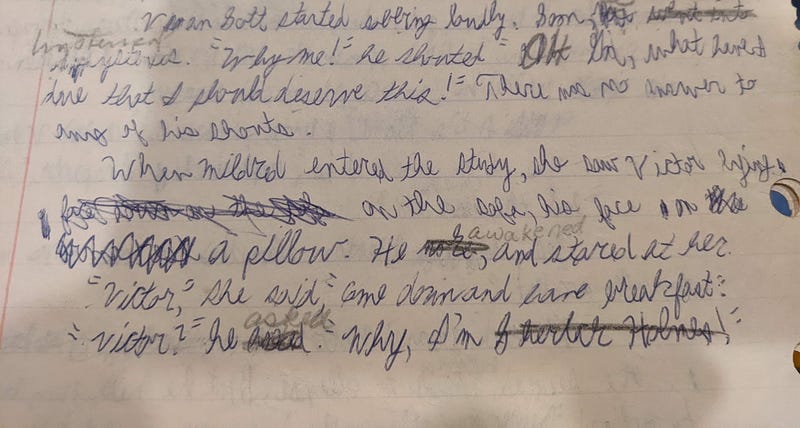
Most importantly, she pointed out a character couldn’t just say he was Sherlock Holmes out of the blue. If my main character suddenly said he was Sherlock Holmes, there had to be a reason. It couldn’t come out of thin air. That was why the characters in They Might Be Giants and The Return of the World’s Greatest Detective were Sherlock Holmes fans before they woke up and claimed to be Sherlock Holmes.
Some little brain cell inside me whispered, “So that’s why writers do that…”
My leader later apologized for marking my text up. But I didn’t mind. It was a revelation.
Based on her suggestions, I adjusted the beginning. OK, I added notes and scribbled over a few things on the draft. I wasn’t about to rewrite the entire first few pages when I could just use what I had and scribble in a few notes.
From there, I went to town. I wrote my story. I added a woman named Dr. Watson, who was hired by a scheming brother to prove Victor was insane. (Hmm, that sounds familiar, too…) I added eccentric characters. And a villain. I even drew a map or two.
Sure, the plot later turned out to be an incohesive mess. Because I didn’t know how to plot yet, and I didn’t know where the story was going. Finally, I gave up and threw in an impending attack at a nuclear power plant for Victor to prevent.
Who cares? I had fun.
Someday, maybe I will think of the perfect plot for poor Victor and the lovely Dr. Watson. And I will bring back the immortal (literally!) Sherlock Holmes.
Why? Because it’s fun.
Postscript
Since then, we have seen all sorts of Holmes pastiches and adaptations. The Return of Sherlock Holmes, a 1987 TV movie where Holmes is revived from suspended animation. (Damn it, why didn’t I think of that?!) Fan favorite Jeremy Brett as Sherlock Holmes. The Robert Downey, Jr. Sherlock Holmes movie. And of course, the series Sherlock and Elementary.
Last week, I dipped my toe back into Sherlock Holmes. And I bought a copy of The Big Book of Sherlock Holmes, a giant tome of pastiches edited by the renowned Otto Penzler.
But poor Victor will always have a place in my heart.
Additional Resources
The Baker Street Irregulars website
Olivia Rutigliano for Crime Reads, The 100 Best, Worst, and Strangest Sherlock Holmes Portrayals of All-Time, Ranked.
Tim Major for Crime Reads, The Joys and Difficulties of Writing a Faithful Sherlock Holmes Novel
If you like my stories, or if you want to read more stories by authors like me, please click here to upgrade to full membership. This is an affiliate link, meaning I receive a financial incentive for new referrals.