
How I Write With My Whole Body
A prose poem in response to the question: “How do you write so much?”
“Language is like a road, it cannot be perceived all at once because it unfolds in time, whether heard or read. This narrative or temporal element has made writing and walking resemble each other.”
― Rebecca Solnit, Wanderlust: A History of Walking
They ask:
How do you write so much?
I write while I walk. The words pound through as soles hit pavement. Sometimes the words sing, and often they flutter. Sometimes I have to stop to catch them.
I have to.
I sit on the curb, sometimes. I stop mid-sidewalk.
I feel my blood / my lungs / this air / this heart — my relationship to this persisting pain / these powerful pleasures / these pasts / this pliable present.
I am the mad woman, like my Θεία Ευαγγελία in Greece, who wrote. Obsessively, she wrote poetry. Obsessively, she wrote songs. Obsessively, she sang.
“You know she is crazy, Κατερίνα?” they said to me.
My Θεία Ευαγγελία cried for her lost husband, for the children she never had, and then she lifted us to dance and then poured out the sludge of my coffee and read my futures.
She insisted that I hope. So, I hope, like her. I write and I hope.
My voice to text; my thumbs to words; sound; error. Autocorrect offers no rational comfort. Sometimes it chooses the words, writes the poem for me.
It tries.
Forward movement / torrential capture. I trip over cracked driveways, hurt my back. Is it worth it?
Is it a problem because it’s a problem or because we say it’s a problem?
“The modern writer (scriptor) is born simultaneously with his text; he is in no way supplied with a being which precedes or transcends his writing, he is in no way the subject of which his book is the predicate; there is no other time than that of the utterance, and every text is eternally written here and now.”
― Roland Barthes, “The Death of the Author”
And why does there have to be an author? Barthes proclaimed it as though he was the one, as though he was the first, though I don’t blame him for that. He knew he wasn’t.
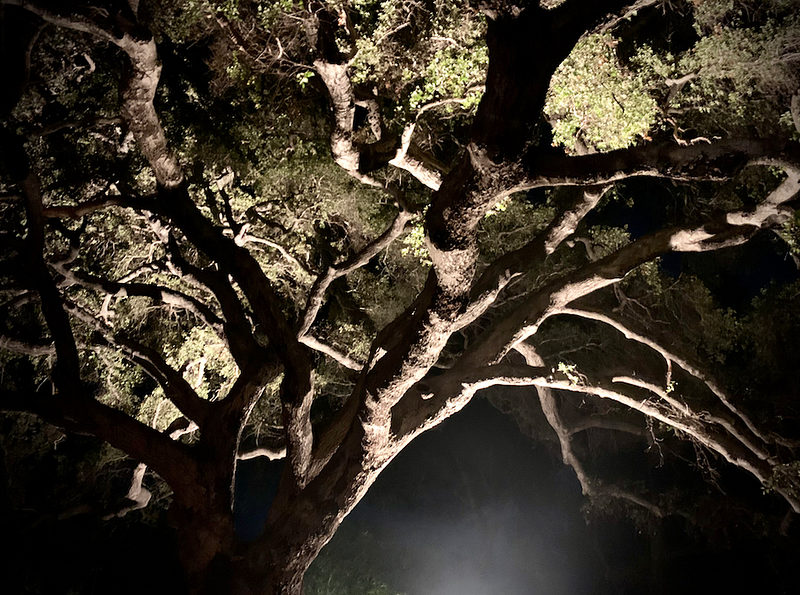
I only believe in what I see: Cornflowers, live oaks, camellias, crawling ivy and dappled ferns. Caretakers, yes.
No original author here.
Replication, rejuvenation, processes of life.
No origins here. Only the dying journey which is in liminal space with the compost.
Even the concrete cracks.
I looked tired in the morning selfie of us/ your first day of school, your return after eighteen months gone. I looked tired because I am but that is no problem — it’s a temporary state of being/ even the cracks in my face are liminal. I’m waiting for your text / I am trying trying to care-take this day.
Tomorrow has not happened yet.
Here: a violin inside my earbuds; here: two fathers with two babies. Here: warming air; here: humidity and light and shade.
This is the day we’ve been waiting for.
And during all that waiting — Did we sleep through the days that mattered?
The word is a journey, an arrival, a place, a destination. Where to?
Whole inside my self, whole inside the world. But also I was there last time, with you. It feels presumptuous and hopeful and terrifying.
You may never know.
I write with my whole body.
I walk down the street, towards you.
Translations:
Θεία Ευαγγελία: Aunt Evangelia
Κατερίνα: my name in Greek, Katerina
E. Katherine Kottaras holds an M.A. in English and an M.S. in Kinesiology with a focus on Integrative Wellness, and she is a contemplative writer and holistic teacher, having worked at the middle, high school, and community college levels for over two decades. She is a registered yoga teacher, personal trainer, and health coach while also living with invisible illnesses and neurodivergence, and as such, she is passionate about mindfulness, bodily self-determination, and health equity. As the queer daughter of an immigrant, Katherine believes that holistic and inclusive approaches to expression, healing, and growth should be accessible to all.
Connect with Katherine on all the social medias: IG, YouTube, FB, LinkedIn, Twitter, or at katherinekottaras.com


